A controversial poker hand at The Lodge Card Club in Texas has triggered a heated discussion across the poker community after a player known as Justin appeared to reverse a verbal call during a high-stakes river confrontation. The incident, captured during a Poker at The Lodge livestream, involved nearly $29,000 in the pot and raised questions about poker etiquette, angle shooting, and the importance of enforcing betting rules.
The dispute unfolded between Justin and fellow player San Kim during a no-limit Texas Hold’em cash game in early November 2026. What initially looked like a routine decision facing a large river bet quickly became a confrontation requiring intervention from the tournament floor staff.
Justin appeared to announce a call and move his chips forward before pulling them back as Kim began revealing his hand. The disagreement that followed centered on whether Justin had already committed to calling an $8,700 wager.
The floor ultimately ruled that the call was binding, forcing the hand to showdown. In an unexpected twist, neither player won the entire pot. Instead, both held the same five-card hand, resulting in a split pot.
Although the financial outcome was relatively uneventful, the sequence of events generated considerable criticism, with viewers questioning whether Justin had deliberately attempted to gain information about his opponent's cards without committing his chips.
A $28,000 Poker Hand Turns Into an Unexpected Controversy
The incident occurred during a mid-stakes cash game at The Lodge Card Club in Round Rock, Texas, a popular destination for live poker players and home to the widely followed Poker at The Lodge livestream.
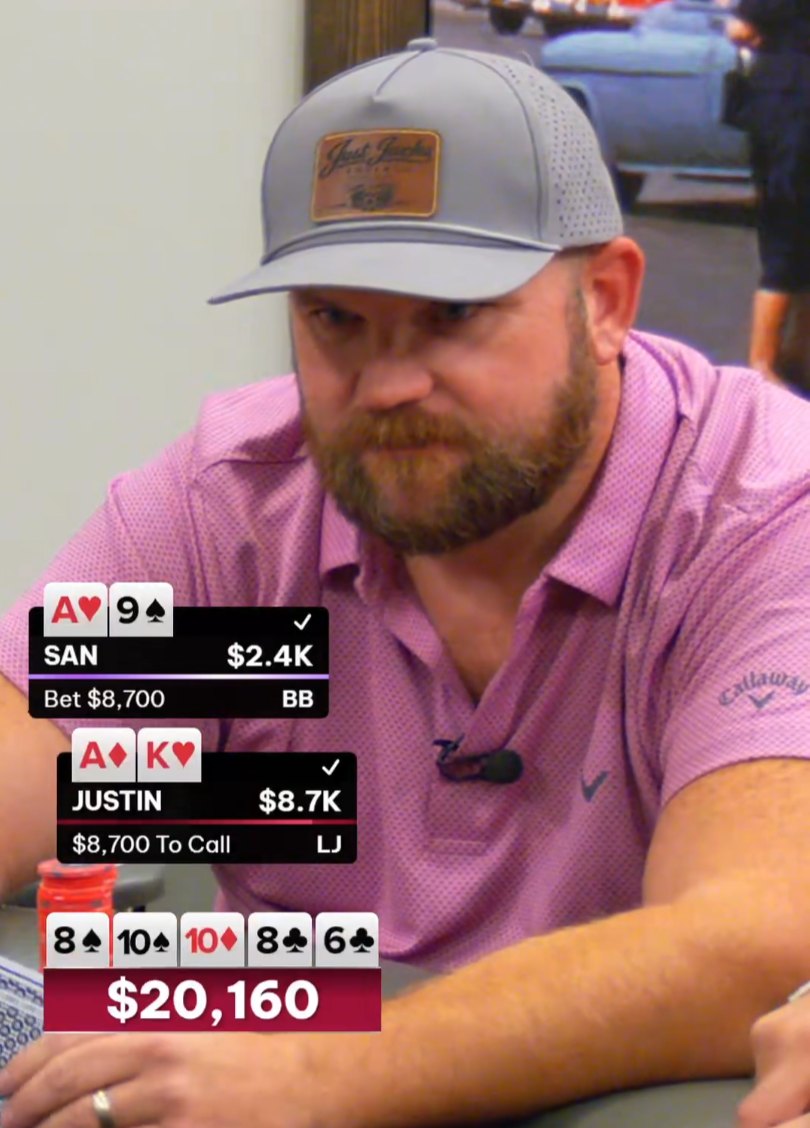
The hand involved San Kim, holding A♥9♠, and Justin, who had been dealt A♦K♥. Both players reached the turn on a board displaying 8♠10♠10♦8♣, leaving two pairs on the community cards.
At that point, the pot contained approximately $6,460. Kim elected to bet $2,500, putting additional pressure on Justin despite holding only ace-high beyond the paired board.
Justin made the call with his ace-king, keeping both players in contention as the dealer prepared to reveal the final community card.
The river brought the 6♣, a seemingly insignificant card that failed to improve either player's hand. With the board now reading 8♠10♠10♦8♣6♣, both players held tens and eights with an ace kicker.
However, neither player could see the other's hole cards during the live hand.
Kim seized the opportunity to apply maximum pressure, firing an $8,700 river bet that effectively put Justin's remaining stack at risk.
Facing a significant decision, Justin spent time considering his options. Calling incorrectly could cost him thousands of dollars, while folding would surrender a substantial pot without discovering whether Kim had been bluffing.
The situation appeared straightforward from a strategic perspective: Justin needed to decide whether his ace-high kicker was strong enough to justify calling the river bet.
Instead, the hand took an entirely different direction.
After deliberating, Justin appeared to verbally declare a call and began moving his chips toward the center of the table.
Kim responded by preparing to reveal his cards, apparently believing that the betting action had concluded.
At that moment, Justin brought his chips back toward his stack, creating confusion over whether the call had actually been completed.
The resulting disagreement transformed an otherwise ordinary cash-game showdown into one of the week's most discussed poker controversies.
Justin’s Disputed River Call Raises Angle-Shooting Questions
The most controversial part of the hand was not Justin's decision to call the river bet. It was what happened immediately afterward.
During the livestream, Justin could be heard apparently saying, "I got to go anyway. I call," while pushing chips forward.
Under standard live poker procedures, a clear verbal declaration of "call" generally commits a player to matching the outstanding wager, regardless of whether the chips have been physically released.
Kim's response suggested that he understood Justin's action as a completed call. He began turning over his cards in preparation for the showdown.
However, Justin then appeared to withdraw his chips and disputed having made a binding verbal commitment.
This sequence prompted the accusations of angle shooting.
In poker, an angle shoot generally involves exploiting ambiguous behavior, misleading actions, or procedural technicalities to gain an advantage over another player.
Unlike a conventional bluff, which is an accepted and essential part of poker strategy, angle shooting typically relies on manipulating an opponent's understanding of the rules or the current state of play.
In this case, the suspected advantage would have come from persuading Kim that his river bet had been called, encouraging him to expose his cards, and then attempting to retain the option of folding.
If such a sequence succeeded, the player facing the bet could potentially learn whether the opponent held a winning hand without accepting the financial consequences of a call.
That possibility explains why the incident attracted criticism.
However, there is an important distinction between behavior that resembles an angle shoot and a proven deliberate attempt to deceive an opponent.
The available footage shows a disputed betting action and subsequent disagreement, but Justin's precise intentions cannot be established from the video alone.
He disputed making the verbal call, while the recorded sequence was treated by the floor as sufficient to establish that a call had occurred.
Regardless of whether the incident resulted from confusion, a change of mind, or an intentional attempt to obtain information, it presented a practical problem for the dealer and floor staff.
The decision was no longer simply about who held the best poker hand. It was about whether a player could withdraw an action after an opponent had reasonably understood it to be final.
The Lodge Floor Enforces the Call as Poker Rules Take Center Stage
With the players unable to agree on what had happened, a floor manager was called to the table to determine whether Justin was required to match Kim's $8,700 river bet.
The ruling ultimately went against Justin.
The floor determined that the call was binding, meaning Justin had to commit the required chips and proceed to showdown.
The decision reflected a fundamental principle of live poker: clear verbal betting declarations are generally enforceable.
According to the Poker Tournament Directors Association's official rules, a player's verbal declaration of an action such as calling or raising normally creates a binding commitment when made in turn.
Although these tournament rules do not automatically govern every cash game, the underlying principle is widely recognized across live poker environments. Individual rooms retain authority over their own house rules and floor decisions.
The distinction matters because betting actions cannot depend entirely on whether a player later decides that the outcome looks favorable.
If players were routinely allowed to announce calls and then withdraw them after observing an opponent's response, significant opportunities for manipulation would emerge.
An opponent might expose a hand, release cards toward the muck, or otherwise provide information based on the reasonable assumption that betting had ended.
For that reason, live poker rules place considerable importance on establishing precisely when an action becomes final.
A spoken declaration can be more decisive than the physical movement of chips.
In Justin's case, the dispute involved both elements. There was an apparent verbal call, accompanied by forward movement of chips, followed by an attempt to bring those chips back.
The floor's intervention resolved the immediate question without requiring a definitive judgment about Justin's motivation.
It established that the money had to go into the pot.
Importantly, enforcing a call is not the same as formally finding a player guilty of deliberate cheating. The ruling addressed the betting action itself, and the public footage does not establish that Justin received a separate disciplinary penalty.
The outcome also provided an example of why poker rooms need clear procedures for resolving disputed actions, particularly during livestreamed cash games where financial stakes and audience scrutiny can be substantial.
An Unlikely Split Pot Adds Another Twist to the Poker Hand
After the floor enforced Justin's call, both players revealed their cards and the hand reached its conclusion.
The result was considerably less dramatic than the preceding argument.
Kim showed A♥9♠, while Justin turned over A♦K♥.
Despite Justin holding the stronger unpaired starting hand, his king did not give him an advantage at showdown.
The community cards already contained two pairs, tens and eights, meaning each player used an ace as the fifth card to complete the best possible five-card combination available from their respective hands.
Both players therefore held exactly the same hand: two pairs, tens and eights, with an ace kicker.
The pot, which had grown to approximately $28,860 after the river bet and call, was divided between them.
Neither player gained a meaningful financial advantage from the controversial final action.
This was particularly notable because the dispute had centered on an $8,700 decision that appeared capable of producing a substantial swing in one player's fortunes.
Had Justin folded to Kim's river bet, Kim would have collected the pot without needing to reveal his cards.
Had the call been accepted immediately without argument, the hand would have ended in a straightforward chop.
Instead, the confrontation introduced a dispute over betting conduct into a hand where both players ultimately possessed identical showdown value.
The outcome also demonstrates an important aspect of poker strategy that is sometimes overlooked.
Players do not make decisions with access to the hole-card information available to livestream viewers.
Although an audience watching with card graphics can immediately recognize when two opponents share the same effective hand, the participants must evaluate their decisions using incomplete information.
Justin's river decision was therefore genuine from a strategic standpoint. He could not know that Kim also held an ace, nor could Kim know that Justin's ace-king would produce an identical five-card combination.
Nevertheless, the fact that the hand ended in a split pot did little to diminish the criticism surrounding the disputed call.
For many viewers, the defining issue was not the distribution of the money but the apparent attempt to reverse an action after an opponent had begun preparing for showdown.
Poker Community Reacts as Angle Shooting Returns to the Spotlight
Footage of the incident circulated on social media after Poker at The Lodge commentator Skull Mike shared the controversial sequence on November 10, 2026.
His social media post featuring the hand drew attention to Justin's actions and encouraged viewers to examine the moment when the chips moved forward and then back.
The reaction illustrated how strongly poker players feel about conduct that potentially crosses the boundary between legitimate psychological strategy and procedural manipulation.
Bluffing, deception, and pressure are fundamental elements of poker. Players routinely represent stronger hands than they actually hold, attempt to provoke calls, and use betting patterns to influence their opponents.
Angle shooting occupies a different category.
Rather than deceiving someone about hand strength through legal betting decisions, an angle shoot may involve misleading an opponent about the mechanics of the game itself.
That distinction helps explain why controversial betting gestures often provoke intense reactions even when the monetary consequences are limited.
For experienced players, the concern extends beyond a single disputed pot.
Poker depends on a shared understanding of when betting begins, when actions become binding, and when cards can safely be revealed.
If those expectations become unreliable, players may feel compelled to scrutinize every gesture and statement rather than concentrate on the strategic decisions that make the game competitive.
Livestreamed poker adds another dimension to such incidents.
A questionable action at an ordinary cash-game table may be witnessed by only a handful of people. At a televised or streamed table, the same incident can be replayed, examined, and debated by a much larger audience.
Camera coverage and recorded audio can help clarify what occurred, but they also expose players to public criticism that may continue long after the hand has ended.
For Justin, the episode has created unwanted attention around his conduct at The Lodge.
However, criticism on social media should not be confused with an official disciplinary finding. Determining deliberate intent would require evidence beyond the mere existence of a disputed call and a subsequent disagreement.
The broader conversation nevertheless demonstrates that poker audiences increasingly expect participants in public cash games to maintain clear and consistent standards of behavior.
Even when no player suffers a direct financial loss, questionable conduct can become a significant talking point because of its implications for fairness and trust.
What Justin’s Angle-Shooting Controversy Means for Live Poker
The incident at The Lodge provides a reminder that seemingly minor procedural disputes can become major controversies when substantial amounts of money are involved.
At the center of the disagreement was a simple but essential question: when a player says "call," can that player subsequently change their mind?
In most conventional live poker settings, the answer is no when the declaration is clear and made during the player's turn.
That principle protects both participants in a hand.
The player making the declaration knows what action is being committed, while the opponent can proceed without fearing that the decision will be reversed after new information becomes available.
The Lodge controversy illustrates why that protection is necessary.
Kim's reaction was consistent with believing the hand had reached showdown. Justin's subsequent withdrawal of chips created uncertainty about an action that should ordinarily have been resolved.
By enforcing the call, the floor restored a clear procedural outcome and allowed the hand to conclude according to the established betting sequence.
The case also highlights the responsibility of players to avoid ambiguous actions when facing substantial bets.
A player considering a difficult river decision can ask for a count, take additional time to think, or clearly announce a fold or call.
What creates problems is a sequence of statements and gestures that reasonably suggests one action before the player attempts to take another.
For poker rooms, consistent enforcement is equally important.
A rule that is applied differently depending on a player's reputation, experience, or the amount of money involved can undermine confidence in the game.
The increasing popularity of livestreamed cash games makes these questions especially relevant.
Broadcast poker combines serious financial competition with an entertainment format that encourages personality, conversation, and dramatic moments.
Yet the presence of cameras does not change the fundamental obligation to follow betting procedures.
Players may enjoy entertaining the audience, but their actions still affect the financial interests of everyone sharing the table.
Whether Justin's disputed call was a deliberate angle shoot or a poorly handled moment of confusion remains an unresolved question of intent.
What is clear is that the floor treated the verbal commitment as binding, the hand proceeded to showdown, and the two players divided a pot worth nearly $29,000.
The unusual combination of a disputed call, a floor ruling, and an eventual chop has made the hand particularly memorable.
More importantly, it has reopened a broader discussion about where poker's psychological battles should end and its rules must take priority.
For Justin, the controversy may ultimately prove more consequential to his reputation than to his bankroll. The ruling prevented the disputed action from changing the distribution of the pot, but it could not prevent the footage from attracting scrutiny.
As the poker community continues to debate the episode, the incident serves as a clear example of why verbal commitments matter in live poker.
A player can bluff with almost any two cards, apply pressure with a weak hand, and attempt to outthink an opponent throughout a session.
But once a binding call has been made, the decision is no longer part of the psychological contest.
It is an obligation that the rules are designed to enforce.
Remember Landon Tice, the poker prodigy who lost HU battle vs Perkings and disappeared? Read about what he is doing now by clicking here.