Few individuals in the history of professional poker have left behind a legacy as extraordinary as that of Stu Ungar. Widely regarded as one of the best poker players ever, Ungar possessed a rare combination of mathematical intelligence, exceptional memory, competitive instincts and an almost unparalleled ability to read his opponents.
During a career spanning approximately two decades, the American poker legend won three World Series of Poker (WSOP) Main Event titles, earned millions of dollars in tournament prize money and established himself as one of the most naturally gifted card players in history.
However, behind the championships and remarkable achievements was a man whose personal struggles frequently overshadowed his professional success. Despite earning substantial amounts of money throughout his career, Ungar repeatedly found himself in financial difficulty as addiction and destructive gambling habits took their toll.
His journey from a young card-playing prodigy in New York to a three-time world poker champion remains one of the most compelling stories in the history of professional gambling.
Decades after his death, Stu Ungar continues to occupy a prominent position in discussions about the greatest poker player of all time. His achievements are particularly remarkable considering that he competed during an era without sophisticated poker software, online training platforms or the extensive strategic resources available to modern professionals.
Stu Ungar's Early Life and Extraordinary Talent for Card Games
Stuart Errol Ungar was born on September 8, 1953, in Manhattan, New York. Unlike many professional poker players who discover the game later in life, Ungar was introduced to the gambling environment during his childhood.
His father was involved in bookmaking and operated a bar, exposing the young Ungar to an environment where gambling was a regular part of everyday life.
From an early age, Ungar demonstrated an exceptional aptitude for numbers, probabilities and competitive card games. His ability to remember previously played cards and recognize patterns distinguished him from other players, including individuals with considerably more experience.
However, poker was not the game that initially established his reputation.
Ungar first made a name for himself through gin rummy, a card game that requires strategic thinking, memory and an understanding of probability. He reportedly won his first gin rummy tournament at the age of ten, providing an early indication of the talent that would eventually define his professional career.
Following the death of his father, Ungar became increasingly involved in New York's gambling scene. His exceptional ability attracted the attention of experienced gamblers, and he began competing for significant amounts of money while still relatively young.
As his reputation grew, finding opponents willing to challenge him became increasingly difficult. Experienced gin rummy players understood that competing against Ungar represented a considerable financial risk.
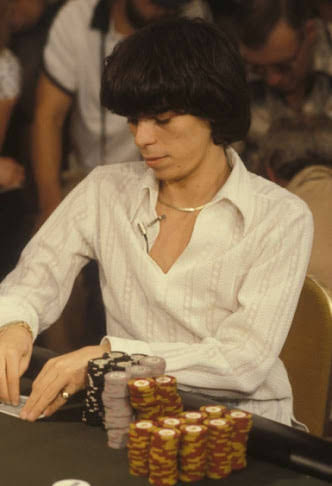
His dominance was based on more than an ability to memorize cards. Ungar could process information rapidly, anticipate potential outcomes and identify opportunities that other players frequently overlooked.
These characteristics would later become essential components of his poker strategy.
By the late 1970s, Ungar had relocated to Las Vegas, the center of American professional gambling. Although gin rummy remained his strongest game, the growing popularity of poker presented him with an opportunity to compete against new opponents.
The transition would ultimately change both his life and the history of tournament poker.
While established professionals had spent years developing their understanding of no-limit Texas Hold'em, Ungar entered the competitive poker scene with comparatively limited experience in that particular format.
Nevertheless, his natural intelligence and extensive background in competitive card games allowed him to adapt remarkably quickly.
How Stu Ungar Became a Two-Time World Poker Champion
In 1980, Stu Ungar entered the $10,000 World Series of Poker Main Event at Binion's Horseshoe in downtown Las Vegas. At the time, the tournament was considerably smaller than it is today, but its participants included some of the most experienced and respected gamblers in the United States.
Among them was Doyle Brunson, an established poker champion who had already won consecutive WSOP Main Event titles in 1976 and 1977.
Despite his relative inexperience in tournament poker, Ungar navigated a field of 73 players before eventually facing Brunson in the heads-up stage of the competition.
Ungar secured the championship, collecting $365,000 in prize money and immediately establishing himself as a major figure in professional poker.
At just 26 years old, he became the youngest WSOP Main Event champion at the time. His youthful appearance earned him the nickname “The Kid,” which remained associated with him throughout his career.
Although winning a single poker tournament can involve a considerable degree of favorable variance, Ungar's subsequent performances demonstrated that his first championship was no coincidence.
He returned to the World Series of Poker in 1981 and successfully defended his Main Event title. This time, he defeated Perry Green heads-up, overcoming a field of 75 players and collecting another $375,000.
Winning consecutive world championships placed Ungar among a select group of players who had managed to accomplish one of tournament poker's most difficult achievements.
His success was not limited to Texas Hold'em. During the 1981 WSOP, Ungar also won the $10,000 Deuce-to-Seven Draw event, adding another $95,000 to his tournament earnings.
Two years later, he secured his fourth WSOP bracelet by winning a $5,000 Seven Card Stud tournament for $110,000.
The ability to achieve success across multiple poker variants demonstrated the depth of Ungar's understanding of card games. Rather than relying on a strategy designed exclusively for Texas Hold'em, he could adapt his decision-making to different formats and competitive environments.
By the age of 29, Ungar had already accumulated four WSOP bracelets, including two world championships.
His rapid rise established him as one of the most recognizable figures in Las Vegas poker and an opponent that even experienced professionals had difficulty competing against.
What Made Stu Ungar the Best Poker Player of His Generation?
One of the most fascinating aspects of Stu Ungar's poker career was the manner in which he approached the game.
During the early years of professional tournament poker, players relied heavily on experience, observation and intuition. Modern concepts such as game theory optimal strategy, advanced range analysis and computer-generated simulations were not widely accessible.
Ungar nevertheless demonstrated an understanding of several strategic principles that would later become fundamental elements of competitive poker.
His playing style was characterized by aggression, adaptability and an exceptional willingness to challenge opponents regardless of the strength of his own cards.
Rather than waiting exclusively for premium starting hands, Ungar recognized opportunities to win pots by exploiting weaknesses in his opponents' decision-making.
He understood that poker was not simply a competition between different combinations of cards. It was also a psychological contest in which betting patterns, perceived strength and uncertainty could influence the outcome of individual hands.
His background in gin rummy provided him with an additional advantage. Years of competitive play had developed his ability to retain information, recognize patterns and calculate probabilities under pressure.
These skills were particularly valuable in tournament situations where players were required to make complicated decisions with incomplete information.
Ungar could adjust his approach depending on the circumstances of a hand, the tendencies of an opponent and the potential consequences of applying additional pressure.
His willingness to make unconventional decisions also made him difficult to predict. Opponents could not necessarily rely on established assumptions about how an experienced poker player should behave in a particular situation.
However, Ungar's aggression should not be confused with indiscriminate risk-taking at the poker table. His greatest performances demonstrated an ability to identify circumstances in which calculated aggression could create a meaningful strategic advantage.
Modern professional poker players spend considerable time studying these concepts through specialized software and reviewing extensive databases of previously played hands.
Ungar developed much of his understanding through practical experience and natural aptitude.
This distinction remains an important part of the argument that Stu Ungar was the best poker player ever. His ability to reach an elite competitive level without access to modern educational resources continues to set his achievements apart.
Addiction and Financial Problems Threatened Ungar's Poker Career
Despite establishing himself as one of the most successful poker players of his generation, Ungar experienced considerable difficulties away from the poker table.
His tournament earnings provided him with access to substantial amounts of money, but financial stability remained an increasingly difficult objective.
Ungar frequently participated in other forms of gambling, including sports betting and horse racing. Unlike poker, where his understanding of the game provided him with a competitive advantage, these activities repeatedly contributed to significant financial losses.
His increasingly serious cocaine addiction created additional problems, affecting his physical health, personal relationships and ability to compete consistently.

Throughout the 1980s, Ungar continued participating in high-stakes poker games and major tournaments. However, maintaining the level of success that had characterized the beginning of his career became increasingly challenging.
One of the most dramatic examples of his deteriorating condition occurred during the 1990 World Series of Poker Main Event.
Despite his personal difficulties, Ungar had once again demonstrated his exceptional tournament poker abilities by accumulating a substantial chip stack. However, a medical emergency prevented him from returning to the tournament.
His chip stack was gradually reduced as mandatory bets were collected in his absence. Remarkably, he had accumulated enough chips to finish in ninth place without returning to play.
The incident represented a defining moment in Ungar's career. Although he remained capable of competing against some of the world's strongest poker players, his personal circumstances were increasingly preventing him from capitalizing on his abilities.
As the 1990s progressed, professional poker continued to develop. Tournament participation increased, prize pools expanded and the game attracted a new generation of competitors.
Ungar, meanwhile, struggled to maintain the financial resources necessary to participate in major tournaments.
For a player who had previously earned hundreds of thousands of dollars through individual tournament victories, the contrast was substantial.
By the middle of the decade, there were legitimate questions about whether the former world champion would ever return to the highest level of competitive poker.
His situation also highlighted an important distinction between being an exceptional poker player and successfully managing a professional gambling career.
While technical ability can provide a competitive advantage, financial discipline, emotional stability and responsible bankroll management are equally important components of long-term sustainability.
Ungar's career demonstrated how even extraordinary talent could be undermined when these elements were absent.
Nevertheless, one final opportunity would allow him to produce arguably the greatest performance of his career.
The 1997 WSOP Main Event: One of Poker's Greatest Comebacks
Seventeen years after winning his first world championship, Stu Ungar returned to the World Series of Poker in 1997.
At the age of 43, the former champion was experiencing serious financial difficulties and required assistance to cover the tournament's $10,000 entry fee.
Fellow professional gambler Billy Baxter ultimately provided the necessary financial backing, giving Ungar an opportunity to compete for his third world championship.
The 1997 WSOP Main Event attracted 312 participants, more than four times the number of players who had entered the tournament when Ungar first won the championship in 1980.
The competitive environment had changed significantly since his initial victories. Poker was attracting greater public attention, tournament fields were expanding and the Main Event offered a first-place prize of $1 million.
Despite his deteriorating physical condition and inconsistent appearances on the professional poker circuit, Ungar quickly demonstrated that his understanding of the game remained intact.
His aggressive approach allowed him to accumulate chips and establish control over numerous situations throughout the tournament.
As the field became smaller, the possibility of a historic third championship began to emerge.
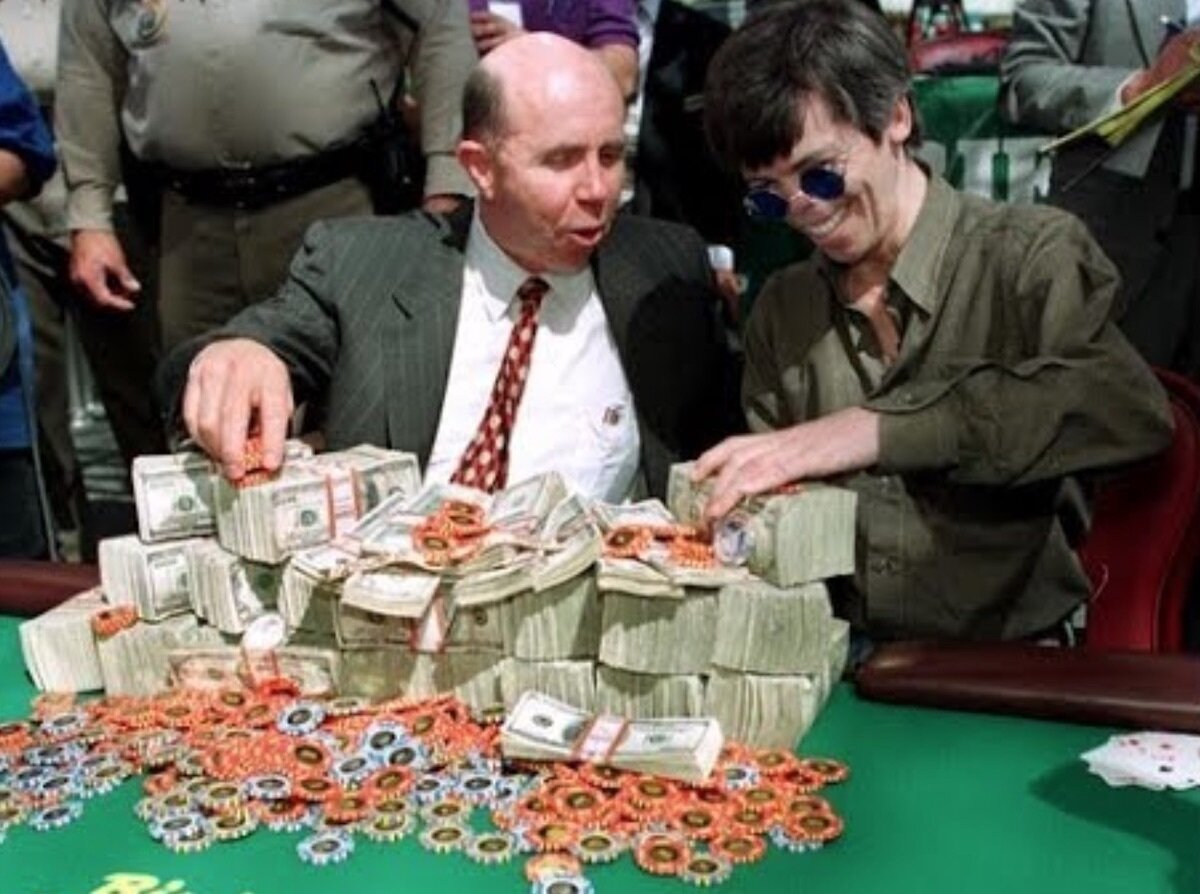
The final stage of the competition took place outdoors on Fremont Street in downtown Las Vegas, providing an unusual setting for one of the most significant moments in World Series of Poker history.
Wearing his distinctive round, blue-tinted sunglasses, Ungar eventually faced John Strzemp in the heads-up stage of the tournament.
The championship was decided when Ungar's ace-four improved to a straight on the river against Strzemp's ace-eight.
With that victory, Ungar secured his third WSOP Main Event title and the largest tournament prize of his career.
The achievement placed him alongside Johnny Moss as a three-time Main Event champion, although Ungar remains distinguished by winning all three of his championships through conventional tournament competition. Moss's first title, awarded in 1970, was determined by a vote among participating players.
For Ungar, the 1997 victory represented a remarkable return to the highest level of professional poker after years of personal and financial difficulties.
The performance earned him the nickname “The Comeback Kid” and remains one of the most celebrated individual achievements in World Series of Poker history.
However, the championship did not bring lasting stability to his personal life.
Ungar continued struggling with addiction and financial problems following his million-dollar victory. Although he was expected to defend his title at the 1998 WSOP, he ultimately did not participate in the Main Event.
On November 22, 1998, just 18 months after winning his third world championship, Ungar was found dead in a Las Vegas motel room.
He was 45 years old.
His death brought an abrupt end to a career that had produced some of the most extraordinary performances in competitive card games.
Stu Ungar's Legacy: Was He Really the Greatest Poker Player of All Time?
In 2001, Stu Ungar was posthumously inducted into the Poker Hall of Fame, formally recognizing his contribution to professional poker and his exceptional competitive achievements.
His career record includes five WSOP bracelets, three Main Event championships and more than $3 million in recorded live tournament earnings.
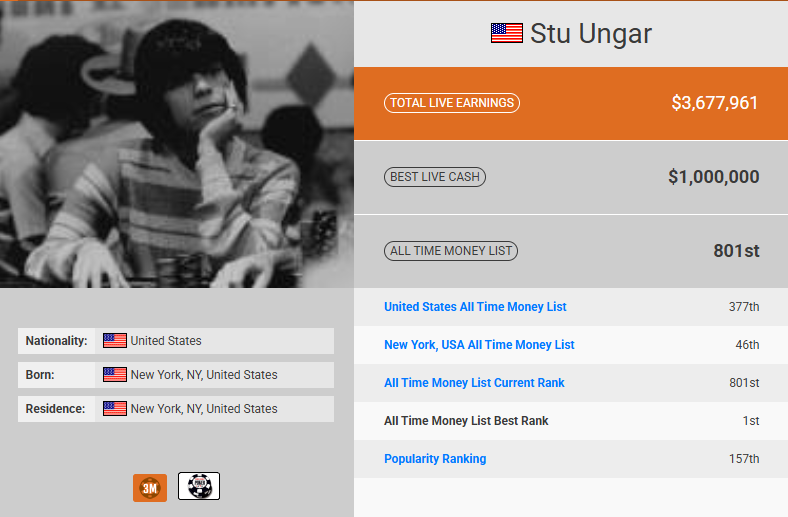
However, evaluating Ungar's legacy exclusively through tournament statistics provides an incomplete picture of his abilities.
Modern poker professionals compete in significantly larger tournament fields, participate in more events annually and have access to prize pools that were unimaginable during Ungar's career.
Consequently, comparing players from different generations based solely on their accumulated earnings can produce misleading conclusions.
Ungar's reputation instead rests largely on the exceptional level of natural ability he demonstrated across different card games and competitive formats.
His transition from gin rummy to professional poker remains particularly impressive. Few players have established such a dominant reputation in one card game before achieving world championship status in another.
His three WSOP Main Event victories also demonstrated his ability to succeed during different periods of professional poker history.
Winning consecutive championships in 1980 and 1981 established his initial dominance, while his 1997 victory demonstrated that his competitive instincts remained effective against a substantially larger tournament field.
Whether Stu Ungar was the best poker player ever ultimately depends on the criteria used to define greatness.
Longevity, consistency, adaptability, tournament results and technical understanding are all important considerations. Ungar's relatively short career and inconsistent participation make direct comparisons with modern professionals particularly difficult.
Nevertheless, when the discussion focuses specifically on natural talent, few players have a stronger claim.
His ability to process information, recognize weaknesses and adapt to unfamiliar competitive situations distinguished him throughout his career.
At the same time, his personal struggles remain an inseparable part of his story. His extraordinary achievements did not protect him from the consequences of addiction, nor did his tournament victories guarantee financial security.
Decades after his final championship, Stu Ungar remains one of the most recognizable figures in poker history.
His story continues to attract interest not only because of the titles he won, but also because of the unanswered questions surrounding what he might have achieved under different circumstances.
Professional poker has evolved considerably since his death. Tournament fields have expanded, strategies have become more sophisticated and technological developments have transformed how players approach the game.
Yet the reputation of Stu Ungar has endured.
For many poker enthusiasts, three world championships only begin to explain why “The Kid” deserves consideration as the greatest poker player of all time.
If you want to know more about how GTA 6 could impact online poker, you can read more about it here.