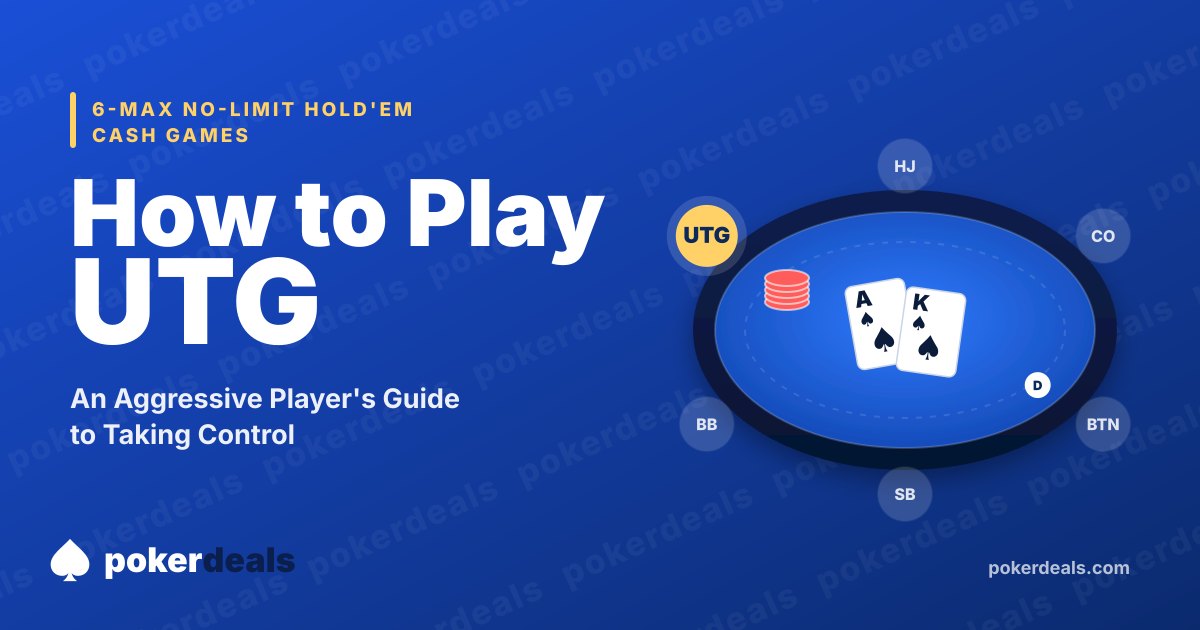
In modern 6-max No-Limit Hold'em cash games, aggression has become one of the defining characteristics of successful poker strategy. Players are constantly searching for opportunities to apply pressure, steal pots, and force opponents into uncomfortable decisions. However, one position continues to demand a particularly careful approach: Under the Gun, commonly known as UTG.
For aggressive poker players, UTG presents an interesting challenge. It is the first position to act before the flop, leaving five opponents with the opportunity to call, raise, or attack an opening range. Unlike playing from the cutoff or button, where aggression can be supported by positional advantages, playing UTG requires a stronger starting-hand selection and a more calculated approach to building pots.
Yet being first to act does not mean surrendering control. An aggressive UTG strategy can generate consistent pressure when it combines disciplined preflop decisions, intelligent postflop betting, and an understanding of how opponents respond to early-position raises.
The key is learning when aggression creates a genuine advantage and when it simply exposes a player to unnecessary risk. For those looking to improve their 6-max cash game performance, understanding this distinction can transform UTG from an uncomfortable position into a profitable part of their overall strategy.
Why UTG Is More Challenging for Aggressive Players in 6-Max Cash Games
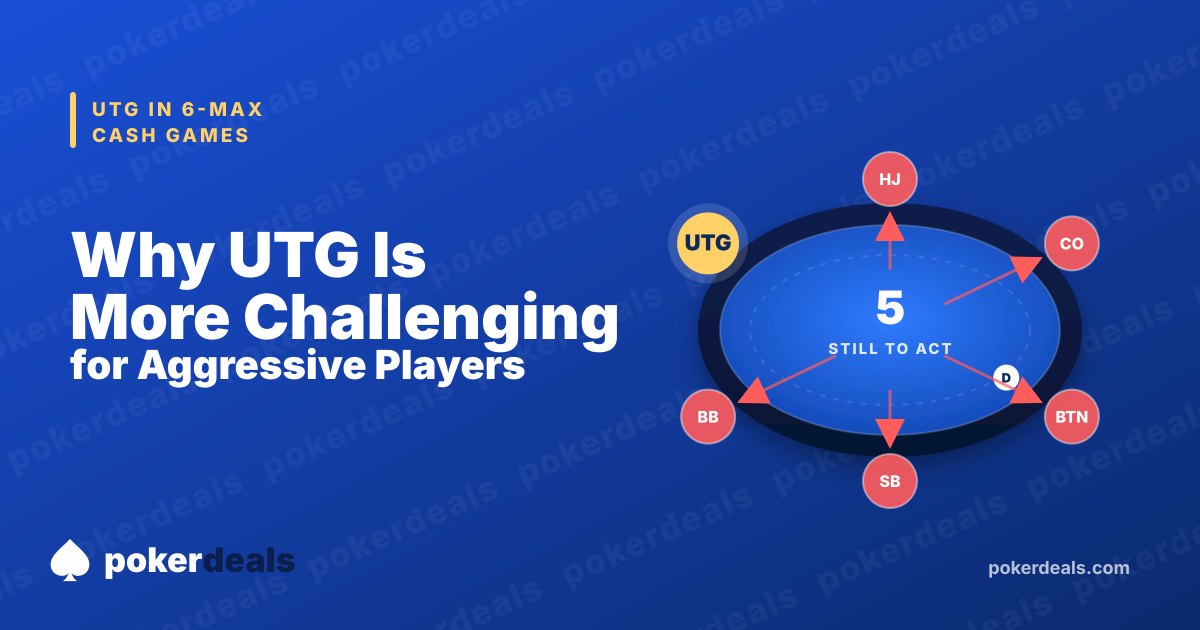
The biggest difficulty with playing UTG in 6-max No-Limit Hold'em is the number of players still waiting to act. Although six-handed tables feature fewer opponents than traditional nine-handed games, the first player entering the pot must still consider five possible responses.
This creates an immediate disadvantage for players who prefer opening a wide range of hands. An aggressive player might comfortably raise suited connectors, weaker aces, and marginal broadway combinations from the button, but attempting the same approach from UTG can quickly become expensive.
The problem is not simply the possibility of facing a premium hand. UTG raises also attract calls and three-bets from opponents who may have positional advantages throughout the hand.
When the hijack, cutoff, or button calls an UTG raise, the original raiser generally has to play out of position after the flop. This makes extracting value more difficult and allows opponents to control the pot more effectively.
However, UTG also carries an important strategic advantage: a naturally strong perceived range.
An early-position raise typically represents stronger hands than a late-position opening. Opponents understand that UTG players have fewer opportunities to enter pots profitably with marginal holdings, making their raises more credible.
Aggressive players can use this perception to their advantage. When the board favors the UTG raiser's expected holdings, continuation bets can place significant pressure on weaker parts of an opponent's range.
For example, an aggressive UTG player who raises before the flop and sees an ace-high board may represent numerous strong combinations, including pocket aces, ace-king, and ace-queen.
This does not guarantee that opponents will fold, but it creates opportunities to bet with a clear strategic purpose.
The central lesson is that aggressive UTG poker should not be confused with constantly entering pots. The objective is to establish a strong range before the flop and then use that range to create profitable betting opportunities.
Building an Aggressive UTG Opening Range Without Becoming Too Loose
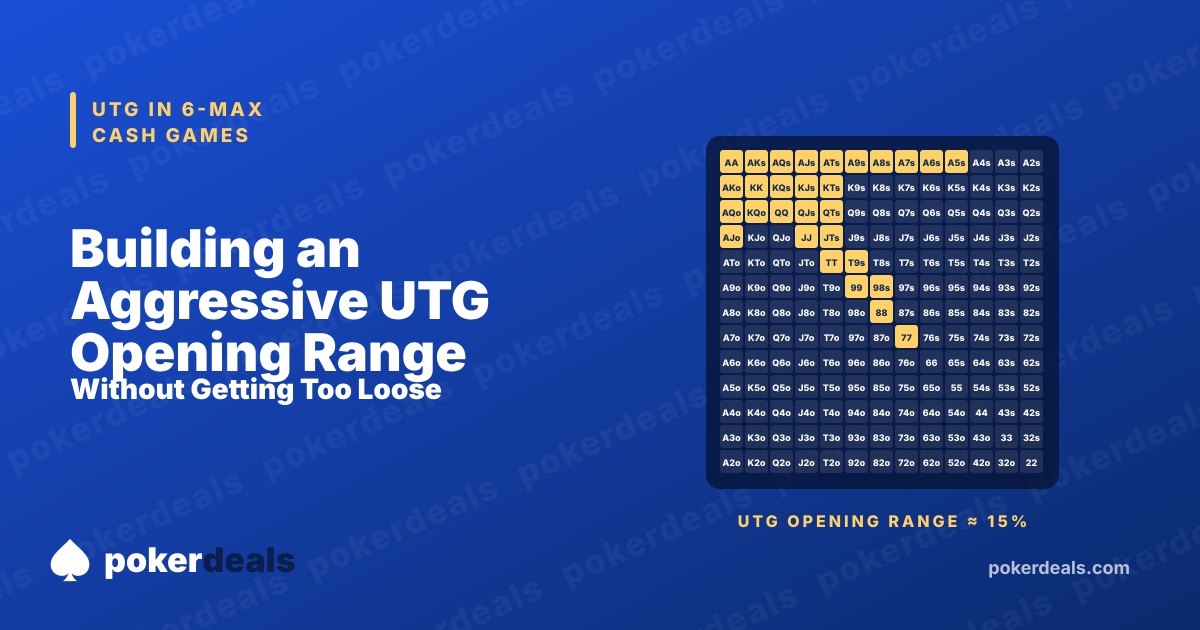
Every successful aggressive UTG strategy begins with preflop hand selection.
In 6-max No-Limit Hold'em cash games, a reasonable UTG opening range at approximately 100 big blinds might include somewhere around 17% to 20% of starting hands, depending on rake, table composition, opening size, and the tendencies of opponents.
This is not a universal rule. Some games reward a tighter approach, while others allow stronger players to expand their opening ranges against passive opposition.
For most aggressive players, the foundation should consist of strong pocket pairs, suited aces, high-card combinations, and selected suited connectors.
Premium hands such as pocket aces, kings, queens, and ace-king are automatic raises under normal circumstances. Stronger broadway hands, including ace-queen, ace-jack, and king-queen, also form an important part of the opening structure, although some offsuit combinations become more sensitive to table conditions.
Medium pocket pairs offer additional value because they can win without improving on favorable boards while retaining the potential to make powerful sets.
Suited hands introduce a different dimension to the strategy.
Hands such as ace-five suited, king-jack suited, queen-jack suited, and jack-ten suited can create strong draws, provide useful blockers, and occasionally make disguised holdings that win substantial pots.
However, their profitability depends heavily on how often opponents three-bet, how frequently pots become multiway, and how much rake is taken.
For an aggressive player, the temptation is often to add every suited connector or weak suited ace to the UTG opening range. That approach can create serious problems.
Opening hands such as seven-six suited or weak offsuit broadways without considering the table environment may produce difficult postflop situations against stronger ranges.
A better approach involves treating marginal hands as adjustable components rather than permanent additions.
At a passive table where opponents rarely three-bet and make significant postflop mistakes, an aggressive player may widen the UTG opening range selectively.
Against competent opponents who attack early-position raises and apply pressure after the flop, tightening the weakest combinations becomes essential.
Most importantly, aggression should appear through the frequency and quality of raises rather than through loose preflop calling or limping.
An aggressive UTG player generally wants to enter the pot with a raise, establishing initiative and giving themselves opportunities to win either immediately or on later streets.
Preflop Aggression: Raising, Facing 3-Bets, and Fighting Back From UTG
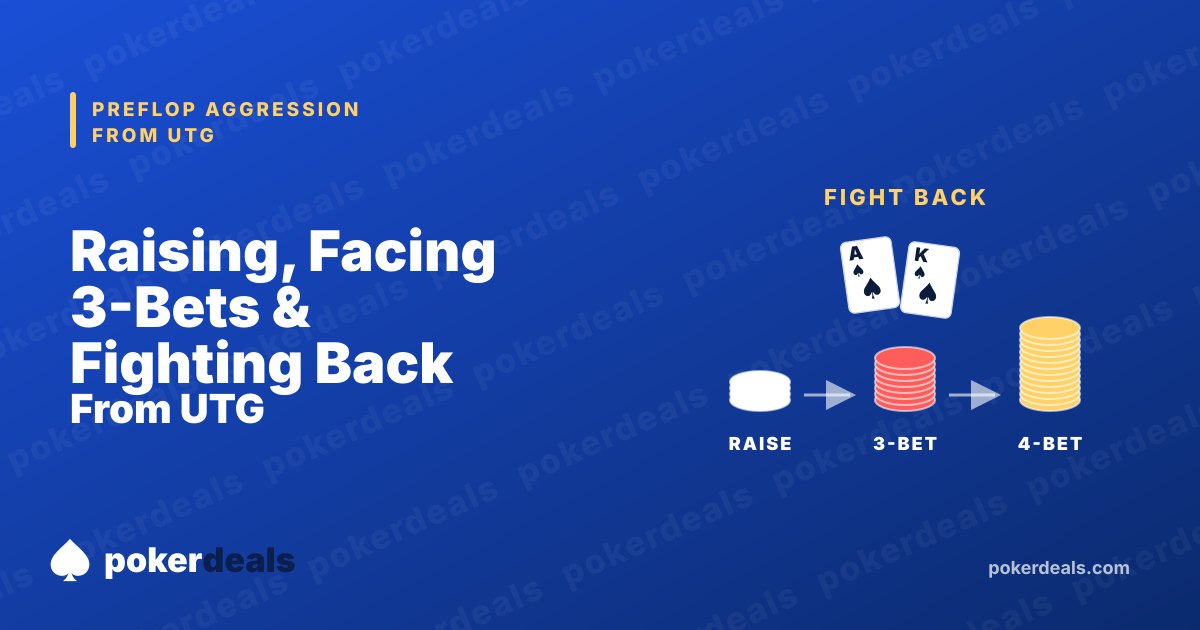
Once an appropriate opening range has been established, the next challenge involves deciding how to respond when opponents fight back.
In many online 6-max cash games, UTG opens around 2.2 to 2.5 big blinds are common strategic choices. These sizes allow a player to build pots with strong holdings without investing unnecessarily large amounts with every opening hand.
The precise sizing should reflect the game's structure and the opponents involved.
A smaller opening size risks less against three-bets and can support a strategically balanced range. Larger raises may become attractive against recreational opponents who call too frequently and fail to adjust to the increased price.
However, the most important preflop decision frequently occurs after an opponent three-bets.
Consider an aggressive player opening ace-queen suited from UTG and facing a three-bet from the button.
The immediate instinct might be to respond with another raise, especially for someone who prefers controlling the action. Yet automatically four-betting every strong-looking hand can create an unnecessarily vulnerable strategy.
Instead, the decision should depend on the opponent's three-betting frequency, effective stack depth, sizing, and likely continuing range.
Against a player who three-bets tightly, calling with suitable hands or folding weaker combinations may be preferable to escalating the pot.
Against opponents who attack UTG openings excessively, a more aggressive four-betting strategy can become profitable.
Premium combinations such as pocket aces and kings form the foundation of a four-betting value range. Certain suited ace combinations, particularly those containing an ace blocker, can sometimes serve as four-bet bluffs against opponents capable of folding enough of their three-betting range.
Ace-five suited is one example because it blocks some premium ace combinations while retaining reasonable playability when called.
However, that does not mean ace-five suited should automatically become a four-bet in every situation.
The goal is to punish opponents who three-bet too aggressively without creating a predictable pattern that can be exploited.
Position also matters.
When UTG faces a three-bet from the button, the original raiser must typically play the remainder of the hand out of position. Against a three-bet from the big blind, UTG retains the positional advantage after the flop.
That distinction can materially change which hands are suitable for calling.
For aggressive players, one of the most valuable skills is recognizing that folding to a three-bet is not a sign of weakness.
Sometimes the strongest way to protect an aggressive overall strategy is to refuse to continue with hands that have insufficient equity or poor realization against an opponent's range.
Playing the Flop Aggressively After Raising From UTG
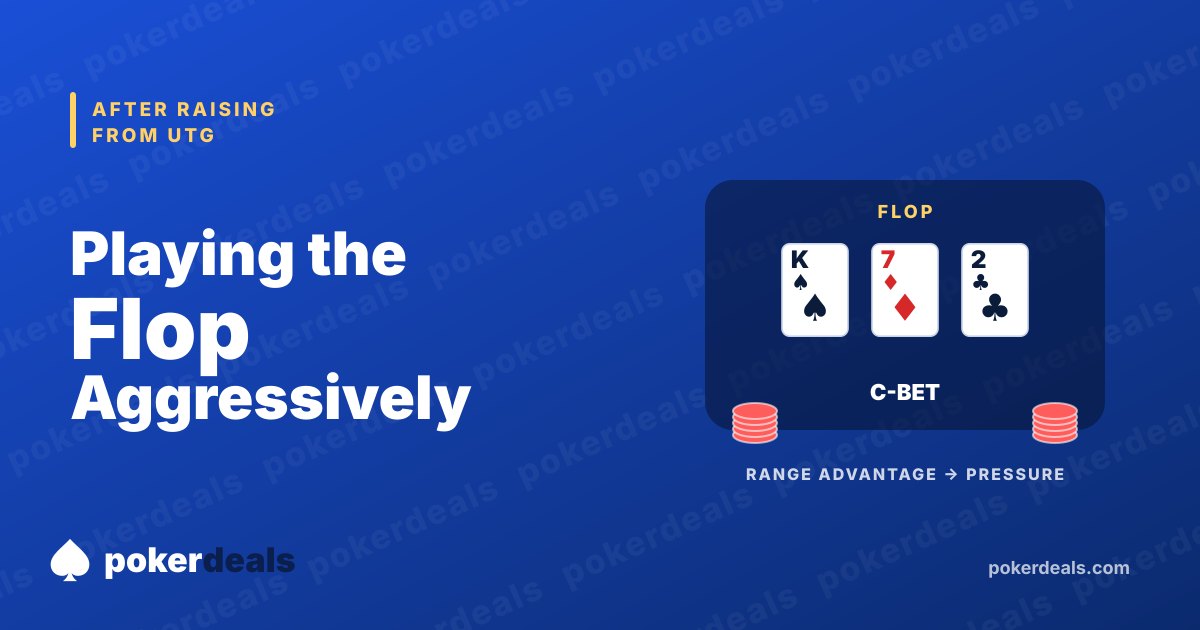
Preflop aggression creates initiative, but the flop is where many UTG players either capitalize on their range advantage or begin making expensive mistakes.
A common misconception is that the preflop raiser must continuation bet almost every board to maintain an aggressive image.
In reality, successful aggressive poker depends on understanding which boards favor the raiser and which boards interact more strongly with the caller's range.
Consider an UTG raise called by the big blind, followed by a flop of ace-seven-two rainbow.
This board often provides the UTG raiser with a meaningful range advantage because the opening range contains numerous strong aces and premium pocket pairs.
A relatively small continuation bet, perhaps around 25% to 33% of the pot, can be effective with a range of value hands and selected bluffs.
The smaller sizing can pressure the big blind's weak holdings without requiring the raiser to risk a large portion of the pot.
However, the situation changes dramatically on a flop such as ten-nine-eight with two cards of the same suit.
The big blind may have numerous two-pair combinations, straights, pair-and-draw holdings, and other connected hands that interact strongly with this texture.
An aggressive UTG player who automatically continuation bets every missed overcard combination on such boards can become vulnerable to calls and check-raises.
Checking becomes an important strategic weapon in these circumstances.
A check does not necessarily indicate weakness. It may protect the checking range, control the size of the pot, or create opportunities to bluff-catch against opponents who bet excessively.
Aggressive players should also differentiate between boards that support frequent small bets and those that justify larger, more polarized sizing.
On certain textures, a large continuation bet may be appropriate with strong value hands and carefully selected bluffs, particularly when the opponent's range contains enough hands that struggle to continue.
On other boards, smaller bets offer a more efficient way to extract value from weaker holdings while maintaining pressure.
Multiway pots require even greater discipline.
When two opponents call an UTG opening raise, the combined likelihood that someone has connected with the board increases. Bluffing frequencies should generally decrease, and the threshold for value betting becomes stronger.
The most effective aggressive players are not necessarily those who continuation bet most frequently. They are the ones who understand how board texture, range advantage, and opponent tendencies determine whether betting achieves anything useful.
Turn and River Strategy: Turning UTG Aggression Into Real Pressure
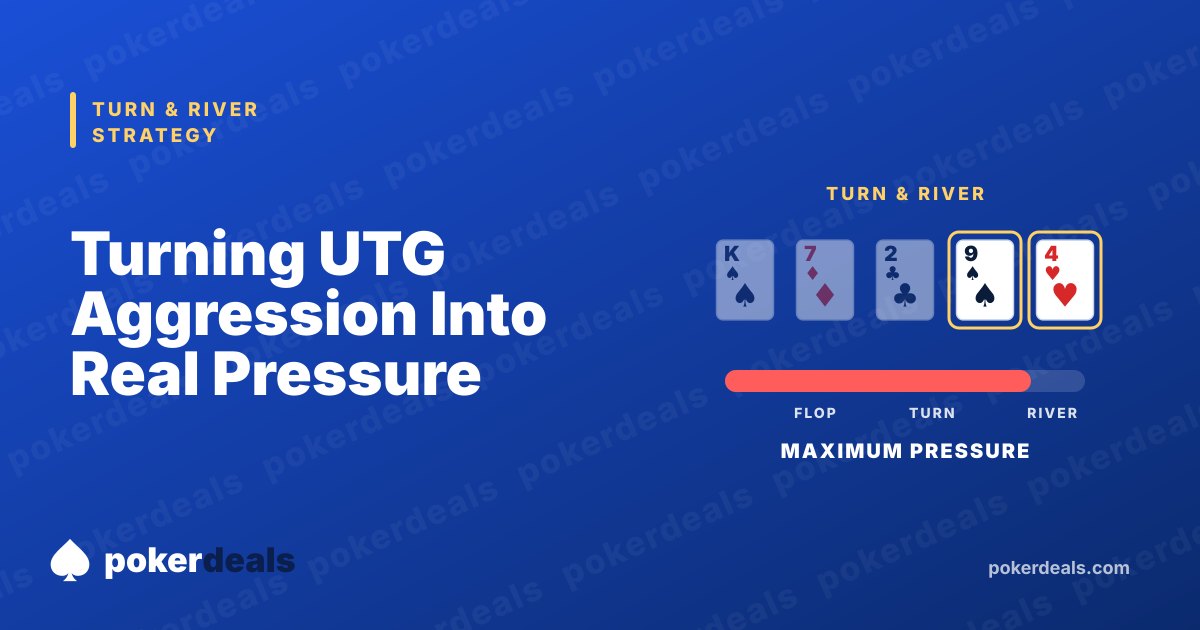
The turn and river are where aggressive UTG poker becomes especially demanding.
By the time a hand reaches the later streets, ranges have narrowed, pots are larger, and the consequences of unnecessary aggression can be substantial.
A player who has opened from UTG and continuation bet the flop must carefully consider whether the turn card improves their range, strengthens the opponent's likely holdings, or changes the credibility of further bets.
For example, imagine an UTG raiser holding king-queen suited on a jack-seven-two rainbow flop.
After continuation betting and receiving a call, an ace on the turn may provide an opportunity to continue bluffing against certain opponents.
The ace is a card that can improve the UTG raiser's perceived range, which includes numerous strong ace combinations.
However, the decision should not be based on the card's appearance alone.
An opponent who calls the flop with ace-high may now have improved to top pair, while another opponent may be unwilling to fold even a weaker pair.
This illustrates why aggressive turn betting must consider both the overall range interaction and the specific hands an opponent is likely to continue holding.
River decisions demand even greater accuracy.
When an aggressive UTG player reaches the river with a strong hand, extracting maximum value becomes a priority. Against opponents who call too often, betting larger with strong made hands can be more profitable than attempting elaborate bluffs.
Against disciplined opponents who fold excessively, carefully selected river bluffs can generate additional value.
Blockers become particularly important.
A hand that blocks an opponent's strongest potential holdings while leaving numerous missed draws in their range may be a better bluff candidate than a hand selected simply because it has no showdown value.
Conversely, bluffing with cards that block the opponent's likely folding hands can reduce the effectiveness of the bet.
Aggressive players should also resist the temptation to fire three barrels merely because they began the hand aggressively.
A successful triple-barrel bluff requires a credible value range, favorable opponent tendencies, and sufficient fold equity.
When these elements are missing, checking or surrendering can preserve more money than forcing another large bet into an opponent who is unlikely to fold.
The objective is not to win every contested pot. It is to ensure that aggressive actions consistently target situations where opponents are likely to make costly mistakes.
Exploiting Opponents and Making Aggressive UTG Poker Profitable Long Term
Even the strongest theoretical UTG strategy needs adjustments when applied to real 6-max cash games.
An aggressive player who treats every table identically will miss opportunities against weaker opponents while potentially losing unnecessary money against more sophisticated competition.
Table composition is one of the first factors worth examining.
When the players in the cutoff and button frequently three-bet, opening marginal hands from UTG becomes less attractive.
When the same players are passive and regularly surrender pots after the flop, an aggressive player may find more opportunities to widen their opening range and apply controlled pressure.
The blinds also influence UTG profitability.
Tight blinds who defend too infrequently create opportunities to win more pots before the flop. Loose blinds who defend excessively but play poorly after the flop may allow the UTG raiser to extract additional value from stronger hands.
Against calling stations, the emphasis should shift toward value betting rather than repeated bluffing.
Against players who fold too frequently, well-constructed bluffing lines become more attractive.
Effective stack size provides another important consideration.
At approximately 100 big blinds, UTG players have room to maneuver across multiple streets, but large pots can still develop quickly after three-bets.
When stacks become shallower, the value of speculative hands generally decreases, and preflop decisions become more closely connected to commitment thresholds.
With deeper stacks, suited and connected hands can gain value because they have opportunities to make strong disguised holdings. However, deeper play also increases the cost of building oversized pots with relatively weak one-pair hands.
Rake must also be considered, particularly at lower-stakes online cash tables.
High rake can make marginal UTG opens and loose preflop calls less profitable. Hands that appear theoretically playable in a low-rake environment may become losing propositions when a significant portion of smaller pots is removed.
For aggressive players, this reinforces the importance of selecting profitable situations rather than maximizing the number of hands played.
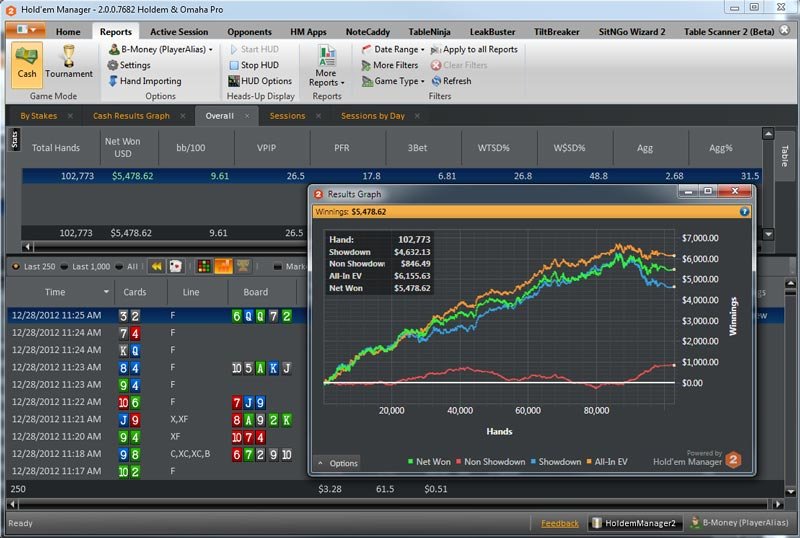
The most useful long-term adjustment comes from reviewing actual results.
Players can examine their UTG opening frequency, profitability when facing three-bets, continuation-bet performance, and outcomes in large pots played out of position.
However, individual session results should not be confused with reliable strategic evidence. A few successful bluffs do not establish that a particular line is profitable, just as losing several premium hands does not mean they were played incorrectly.
Meaningful analysis requires substantial samples and attention to the decisions behind the results.
Ultimately, the most dangerous aggressive UTG player is not the one who raises the widest range or makes the largest bets.
It is the player who understands when the strength of an early-position range creates genuine leverage and who adjusts quickly when opponents refuse to cooperate.
In 6-max No-Limit Hold'em cash games, UTG will always present structural challenges. The position demands discipline before the flop, careful range construction, and a willingness to play difficult postflop situations without the benefit of position.
But those limitations do not prevent aggressive players from building a strong strategy.
By opening selectively, responding intelligently to three-bets, recognizing favorable board textures, and choosing later-street bluffs with precision, players can maintain an attacking style without sacrificing fundamental profitability.
The defining principle is simple: profitable aggression from UTG is not about forcing action on every street. It is about creating pressure when the range, board, and opponent provide a legitimate reason to do so.
For players who master that distinction, the first seat to act can become far more than a position to survive. It can become a reliable starting point for controlling the action at a six-handed cash game table.
Read the article about Biggest Edges in Online Cash Game Poker in 2026