The Night the Table Taught Me More Than Any Solver
The first time I truly understood bumhunting in poker, it did not happen in a training video, a solver sim, or a hand history review. It happened at 2:13 in the morning, on a quiet Tuesday, when the online lobby looked half asleep and every table seemed to have the same familiar faces. Regulars sat with their usual stack sizes, their usual avatars, their usual waiting-list patience. They were not there to gamble. They were there to work.
I had spent the early part of that night doing what many serious players convince themselves is noble. I was battling. Six tables of tough 500NL, surrounded by aggressive regulars who three-bet too much, folded too little, and seemed to know exactly which river cards made my life miserable. I told myself it was good for my game. I told myself that if I could beat them, I could beat anyone. But after three hours, my graph looked like a ski slope, and the only thing I had improved was my ability to sigh quietly.
Then one table changed.
A new player sat down two seats to my right. Full stack. No HUD stats. No note. Within ten hands, he limped under the gun, called a squeeze out of position, donk-bet pot on a paired board, and showed down queen-seven suited for no pair. The entire table changed shape around him. The regulars stopped fighting each other. Nobody was eager to run a cold four-bet bluff anymore. Nobody was interested in proving dominance. Suddenly, every decision had a center of gravity, and that center was the weakest player at the table.
That is bumhunting in its simplest form. It is the practice of seeking out weak poker players, often recreational players, and choosing games where your expected value is significantly higher than it would be against a table full of competent regulars. The word itself has a harsh edge, and some players dislike it because it sounds predatory. But in practical poker terms, bumhunting is table selection. It is game selection. It is the decision to spend your limited poker hours in the most profitable games available instead of turning your session into an ego contest against other professionals.
The key difference between an average winning poker player and a highly profitable one is often not who understands more complex theory. It is who plays better games. A player may have a beautiful understanding of minimum defense frequency, blocker effects, polarized river ranges, and equilibrium bluff-catching, but if that player spends every session battling five other studied regulars, the edge becomes thin. Another player with slightly less technical skill but excellent game selection may earn far more money over the same sample.
This is why bumhunting matters. In modern poker, especially online poker, the skill gap between regulars has narrowed. Players study preflop charts, use solvers, review databases, and consume high-level content. Edges in regular-heavy games still exist, but they are smaller, more volatile, and more mentally expensive. Against recreational players, however, the old poker truths still breathe. People still call too wide, chase bad draws, overvalue top pair, under-bluff rivers, tilt after losing pots, and misunderstand stack depth. Bumhunting is the art of finding those situations consistently.
But doing it optimally is not as simple as waiting for a bad player and clicking buttons. True bumhunting requires discipline, patience, emotional control, and a realistic understanding of how winrate works. It means knowing when a table is worth playing, when a seat is valuable, when a game has dried up, and when your own ego is quietly costing you money.
How Bumhunting Actually Works in Real Poker Games
Imagine two poker tables running at the same stake. At the first table, every player is a solid regular. They defend blinds correctly, three-bet at reasonable frequencies, continuation bet with coherent ranges, and punish obvious leaks. You may still have an edge, but that edge is probably small. Maybe you are better than the pool. Maybe you exploit population tendencies well. Maybe your mental game is stronger. Even then, your winrate might be modest because everyone else is also trying to avoid big mistakes.
Now imagine the second table. Four players are competent, one is average, and one recreational player is playing 60% of hands, calling raises out of position, and stacking off too lightly. The entire game changes. Your expected value no longer comes only from marginal edges against regulars. It comes from a player making repeated, expensive mistakes. You are no longer trying to win tiny theoretical battles in every seat. You are positioning yourself to play as many pots as possible against the weakest player.
That is the core of optimal bumhunting: you are not hunting hands, you are hunting situations.
The first skill is identifying weak players quickly. Online, this can come from obvious signs. Limping too much is one of the clearest. Calling large raises with weak hands is another. Short-stacking randomly, buying in for strange amounts, open-minraising from odd positions, playing too many hands, and showing down dominated holdings are all useful signals. Live poker has different tells. Recreational players may talk about wanting action, complain about bad luck, drink heavily, misunderstand basic rules, or reveal through bet sizing that they are not thinking in ranges.
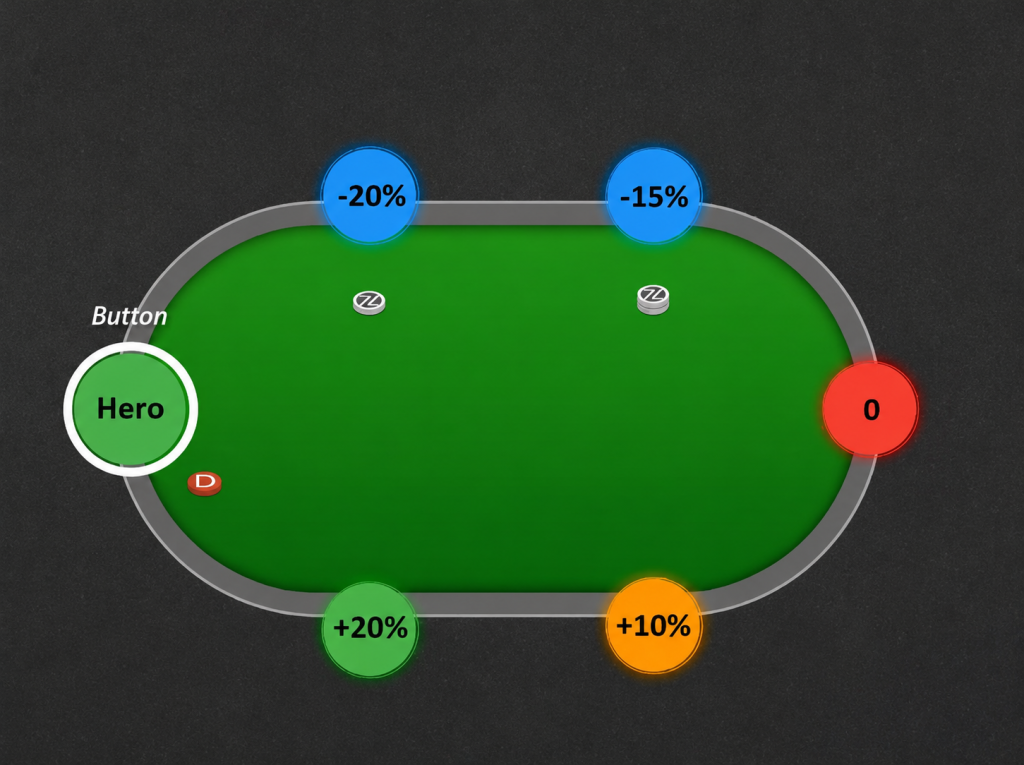
But good bumhunting goes beyond spotting the weakest player. Seat selection is just as important. The dream is to have position on the recreational player, preferably directly to their left. Poker is a positional game, and position becomes even more powerful when your opponent makes large strategic errors. When you act after the weaker player, you control pot size more effectively, isolate them more often, value bet thinner, and avoid difficult guessing games. A bad player on your direct left is still profitable, but a bad player on your direct right can be a gold mine.
Once seated, the objective is not to play wildly just because a weak player is present. That is one of the most common mistakes players make when bumhunting. They see a recreational player enter the game and suddenly expand every range beyond reason. They isolate too wide, bluff too much, and force action in spots where patience would be more profitable. Bumhunting is not permission to abandon strategy. It is permission to adjust strategy intelligently.
If you are looking for a site to play poker and want a good rakeback deal, you should check out Champion Poker, as it offers flat rakeback of up to 30%.
Against players who call too often, your value range becomes more important and your bluffs become less attractive. You can value bet hands that would be too thin against a regular. Top pair with a strong kicker, overpairs, two pair, and even second pair in certain lines can become meaningful value candidates. Against a sticky opponent, the money is made by betting strong hands relentlessly, not by trying to tell an elaborate story with ten-high.
Against players who fold too much, the adjustment is different. Some recreational players are not calling stations. They are scared money. They limp, call preflop, and then overfold whenever faced with pressure. Against them, small continuation bets, delayed bluffs, and river pressure can become extremely profitable. The point is not that weak players all play the same way. The point is that weak players tend to make large, repeated mistakes, and your job is to identify which mistake they are making.
The best bumhunters are patient observers. They watch showdowns carefully. They note bet sizes. They notice whether a player snap-calls draws, slowplays monsters, overbets with air, or checks back medium strength. They do not simply label someone a fish and start blasting. They build a profile. The more accurate the profile, the more profitable the hunt.
Table dynamics also matter. A weak player at a table does not guarantee a great game if every regular is fighting for the same target and you have a poor seat. If the recreational player is on your left and two aggressive professionals are isolating them before you get the chance, your edge may be much smaller than it appears. Conversely, a table with two slightly weak players and passive regulars may be better than a table with one huge spot and four elite grinders.
This is where many players underestimate the skill of bumhunting. It is not merely avoiding tough games. It is evaluating the expected value of the entire environment. Who has position? Who is deep stacked? Who is tilted? Who is likely to leave? Who is playing too many tables and missing exploitative opportunities? Who is emotionally attached to winning a pot from the recreational player? Every one of these factors affects your real winrate.
The Winrate Difference Between Bumhunting and Regular Play
The reason poker players bumhunt is simple: winrates can be dramatically higher. The exact difference depends on stake level, rake structure, player pool, format, stack depth, and your own skill set, but the general pattern is consistent. A tough regular-heavy game might offer a small winrate or even a break-even environment after rake. A soft game with one or two recreational players can multiply that edge several times over.
In online cash games, a solid winning regular in tough pools might achieve something like 1 to 4 big blinds per 100 hands over a meaningful sample. At higher stakes, even strong players may be thrilled with a small positive winrate because the games are so competitive. In softer lineups, especially when consistently playing with weak opponents and good position, that same player might generate 6 to 12 big blinds per 100 hands or more. In particularly soft games, short-term winrates can be much higher, though extreme numbers often shrink with sample size.
This is the central economic truth of bumhunting in poker: the weaker the opposition, the larger the edge, and the larger the edge, the more forgiving variance becomes.
Suppose you are playing 200NL. If you win at 2 big blinds per 100 hands in regular-heavy games, you are making $4 per 100 hands before considering rakeback or rewards. If careful bumhunting raises that to 8 big blinds per 100 hands, you are making $16 per 100 hands. That is not a small improvement. It is four times the winrate. Over 50,000 hands, the difference becomes massive. At 2 bb/100, your expectation is 1,000 big blinds. At 8 bb/100, your expectation is 4,000 big blinds. Same stake. Same cards. Same software. Different games.
Live poker makes the contrast even more obvious. A player who battles tough regulars in a serious 5/10 game may have a respectable but not spectacular hourly rate. Put that same player in a splashy weekend lineup with deep stacks, loose calls, and emotionally driven betting, and the hourly rate can change completely. Live winrates are usually measured in big blinds per hour rather than big blinds per 100 hands, but the principle remains the same. The game quality often matters more than small technical differences between good players.
However, it is important not to exaggerate bumhunting into a fantasy. You do not automatically become a crusher just because a weak player is present. Bad seats, poor emotional control, rake, shallow stacks, and over-adjustment can destroy the value of a good game. If you start calling too wide because you are desperate to win pots from the recreational player, you may become part of the reason the table is good. If you bluff a calling station repeatedly, you are not exploiting them. You are donating.
The optimal bumhunter thinks in expected value rather than entitlement. A weak player does not owe you their stack. Sometimes they will win. Sometimes they will cooler you. Sometimes they will sit for eight hands, double up through someone else, and leave. Sometimes the table will break before you get a meaningful spot. That is part of the game. Bumhunting increases your average edge; it does not remove variance.
A realistic way to think about the winrate difference is through tiers. Regular-heavy play may create a thin edge, perhaps 0 to 4 bb/100 depending on your ability and the toughness of the pool. Good table selection with occasional recreational players may push a strong player into the 4 to 8 bb/100 range. Dedicated bumhunting with strong seat selection, disciplined quitting, and excellent exploitative adjustments can sometimes produce 8 to 15 bb/100 in softer environments. Above that, samples often become fragile, game conditions highly specific, or stakes unusually soft.
The most important comparison is not the exact number. It is the ratio. Bumhunting can easily double, triple, or quadruple a player’s winrate compared to battling regulars in neutral or bad games. For professionals and serious grinders, that difference changes everything. It changes bankroll growth. It changes stress. It changes downswings. It changes how much volume is needed to reach the same financial goal.
But there is a trade-off. Bumhunting can reduce volume. You may spend more time waiting, scanning lobbies, changing tables, or quitting bad games. A player who insists on only perfect spots may play too few hands to fully monetize their edge. The goal is not to become so selective that you never play. The goal is to balance hourly expectation. Sometimes a slightly tougher game running immediately is better than waiting an hour for a dream table. Sometimes leaving a mediocre table is correct because better spots are available. Optimal bumhunting requires understanding that winrate and volume work together.
Playing the Predator Without Becoming Predictable
The best bumhunters do not look desperate. They do not instantly sit out when the recreational player leaves, at least not always. They do not berate weak players, mock bad calls, or educate the table after losing a pot. They understand that the ecosystem matters. Recreational players are not machines dispensing expected value. They are people playing poker for entertainment, competition, curiosity, or escape. If the game becomes hostile, slow, predatory, or joyless, they leave.
This is one of the quiet secrets of optimal bumhunting: making the game pleasant can be profitable. In live poker, friendly conversation, emotional control, and basic respect are part of your edge. Online, you may not have the same social tools, but you can still avoid tapping the glass. Do not criticize bad plays. Do not type sarcastic comments in chat. Do not complain when someone makes a terrible call and wins. That terrible call is why you are in the game.
Strategically, optimal bumhunting requires flexibility. When the weak player is deep, you should think carefully about implied odds and stack leverage. Hands that can make disguised nutted holdings may go up in value, especially in position. Small pairs, suited aces, and suited connectors can perform well when stacks are deep and the opponent is likely to overpay after making one pair or a worse draw. When stacks are shallow, high-card strength and direct value become more important. You do not need to get fancy when the effective stack is only forty big blinds and your opponent is willing to stack off with top pair no kicker.
Preflop, isolation is one of the key weapons. If a weak player limps, raising larger than usual can be correct, especially when they call too wide and the players behind are not aggressive enough to punish you. The goal is to play heads-up pots in position against the weaker player with an equity and skill advantage. But isolation should not become automatic. If aggressive regulars behind you are squeezing often, or if your hand performs poorly in bloated pots, forcing the issue can backfire.
Postflop, value betting is the engine. Many players underestimate how thinly they can value bet against weak opponents. A regular may correctly fold worse hands on the river, but a recreational player might call because they do not believe you, because they have a pair, because they missed a draw and are frustrated, or because folding feels boring. When opponents call too often, the correct response is not to bluff harder. It is to value bet wider and size up.

Sizing is a major part of bumhunting. Against inelastic calling ranges, larger bets print money. If a player will call $40 almost as often as $25 with a worse hand, betting $40 is superior. Against fit-or-fold players, smaller bets may accomplish the same fold equity at a better price. Against emotional players, overbets can induce stubborn calls or panicked folds depending on the profile. The optimal bumhunter is constantly asking one question: what mistake is this opponent most likely to make against this size?
Knowing when to leave is equally important. A game can go from excellent to mediocre in a single orbit. The recreational player busts. The deep stack leaves. A strong regular gets direct position on you. The table becomes short-handed with only tough players. Many poker players stay because they are stuck, because they want revenge, or because they feel embarrassed to quit. Professional table selection requires emotional detachment. If the game is no longer good, leaving is not cowardice. It is discipline.
There is also a deeper psychological challenge. Bumhunting can make players softer if they use it as an excuse to avoid study. If you only play weak opponents and never sharpen your fundamentals, you may struggle when games change or when you are forced into tougher lineups. The strongest approach is to combine bumhunting with serious technical development. Study theory so you have a strong baseline. Use bumhunting so your money is made in the best available conditions. Theory protects you when the game gets tough. Game selection maximizes your profit when the game is soft.
In the end, bumhunting in poker is not about fear. It is not about refusing competition. It is about understanding where profit comes from. Poker is not scored by style points. Nobody pays you extra for battling the toughest opponent in the room. The cashier does not ask whether your winrate came from balanced river ranges or from value betting a calling station for three streets. The only thing that matters is making good decisions, hand after hand, session after session.
That Tuesday night, after the weak player sat down, I stopped trying to win every pot. I stopped trying to prove I belonged. I watched. I waited. I isolated when the spot was right, folded when the regulars fought back, and value bet hands I might have checked against tougher opponents. The recreational player won some pots, lost more, laughed in chat, reloaded twice, and eventually disappeared into the lobby.
When he left, the table changed back. The regulars resumed their quiet war. The three-bets returned. The thin river check-raises reappeared. The easy money was gone.
I played one more orbit, looked at the lineup, and sat out.
That decision may have been the most profitable one I made all night.
If you wanted to know how to master only cash games, and climb from 2c to 2$ games, you can read more about it here..