Ask ten regulars what the best style is for online cash games and you will get a debate about red line versus blue line, GTO versus exploitative, aggression versus patience. The debate is framed wrong. Poker style is not a fixed identity you choose once. It is a contextual response to the conditions in front of you, and the best players switch between modes as those conditions change.
Think of a winning strategy as an adaptive decision system. It observes variables, estimates expected value and adjusts when the inputs shift. A strategy that crushes one player pool can lose in another even when the person running it is technically excellent.
Red line poker: winning without showdown
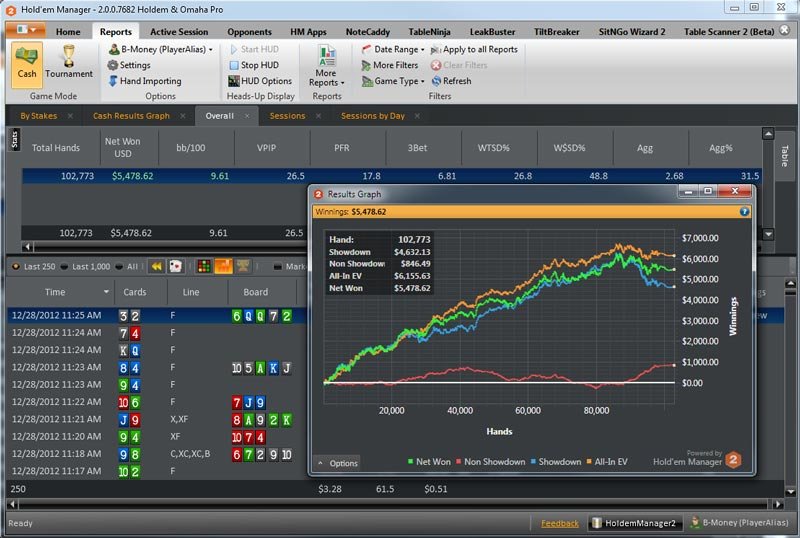
The red line on a tracking graph measures non-showdown winnings. Red line players make money by stealing blinds, continuation betting, check-raising, three-betting and forcing folds before the river. They lean on fold equity and range advantage rather than waiting for strong hands.
A rising red line is often treated as proof of good play. It is not. You can inflate non-showdown results by bluffing far too much, and the bill arrives later when opponents adjust. Graph lines are outputs of strategy, not goals. Strong red line results should emerge naturally from exploiting real weaknesses: opponents who fold too often, defend badly out of position or arrive at the river with capped ranges.
Blue line poker: getting paid at showdown
Blue line players win at showdown. They value bet relentlessly, bluff sparingly and let opponents make calling mistakes. It looks less sophisticated and, at many stakes, it is more profitable.
At the lower limits, most recreational players evaluate their own hand rather than your range. Against someone who will not fold second pair, an elaborate multi-street bluff is just burning money. Straightforward value poker beats it.
A strong blue line player can still be extremely aggressive. The aggression simply comes from value combinations rather than from bluffs. That is why the aggressive versus passive label is too crude to describe a real strategy.
The hybrid: let the opponent's error choose your style
For most serious players, the strongest long-term approach is a hybrid. The reason is simple: when an opponent deviates from equilibrium, the highest expected value response is usually to deviate in the opposite direction.
- Against opponents who fold too much, bluffs gain value and your red line rises.
- Against opponents who call too much, value bets gain value and your blue line rises.
The variable that decides your style in any hand is not your preference. It is the opponent's mistake. Being an aggressive player means nothing on its own. Being aggressive against the right person in the right spot is the entire game.
Adapting as you move up
Climbing stakes changes several things at once. Player pools get more technical, pre-flop ranges tighten, recreational density falls and the obvious exploits vanish.
Micro stakes reward blunt structural exploitation. Opponents limp too much, call with dominated hands, under-bluff, size their bets transparently and defend badly. Your optimal response can be wildly unbalanced, and your red line may look unimpressive because the money comes from value.
Mid stakes punish lazy exploitation. Regulars notice patterns and strike back. Your strategy needs a robust baseline, usually grounded in game theory, from which deviations are measured and justified.
Higher stakes require granular reads. Rather than tagging someone as "too aggressive", strong players identify exactly where the leak lives: single-raised versus three-bet pots, specific positions, specific streets. The stronger the competition, the more specific your profitable deviations need to be.
Data-driven decision making
Online poker generates behavioural data at a scale no live game can match. Hand histories, database analysis, population reports and solver outputs together show where expected value is actually won and lost.
The main benefit is correcting memory. You remember the big bluff and the sick call. You do not remember the four thousand routine decisions that matter more. The database does.
The main danger is overfitting. Filter a database down to a narrow situation and the sample becomes too small to trust. Strong analysis separates three sources of evidence and weights them accordingly: individual reads, population tendencies and theoretical baselines. That is evidence-weighted adaptation, and it is the modern version of "playing the player".
Build modes, not a style
The goal is not to become a red line player, a blue line player or a solver clone. It is to develop several strategic modes and know when each applies.
At lower stakes, run simple, high-confidence exploits and accept that your graph will not look glamorous. As competition improves, harden your baseline so it is difficult to exploit, and make your deviations selective and backed by evidence.
The best poker style for online cash games is hybrid, adaptive and increasingly data-driven, built on a sound theoretical foundation. Success does not come from how often you bluff, how often you value bet or how closely you track a solver. It comes from identifying which approach a situation calls for, quantifying the evidence for the adjustment, and changing by the right amount.
Poker is an optimisation problem under uncertainty. Treat your style as a decision model you update continuously, not an identity you defend.