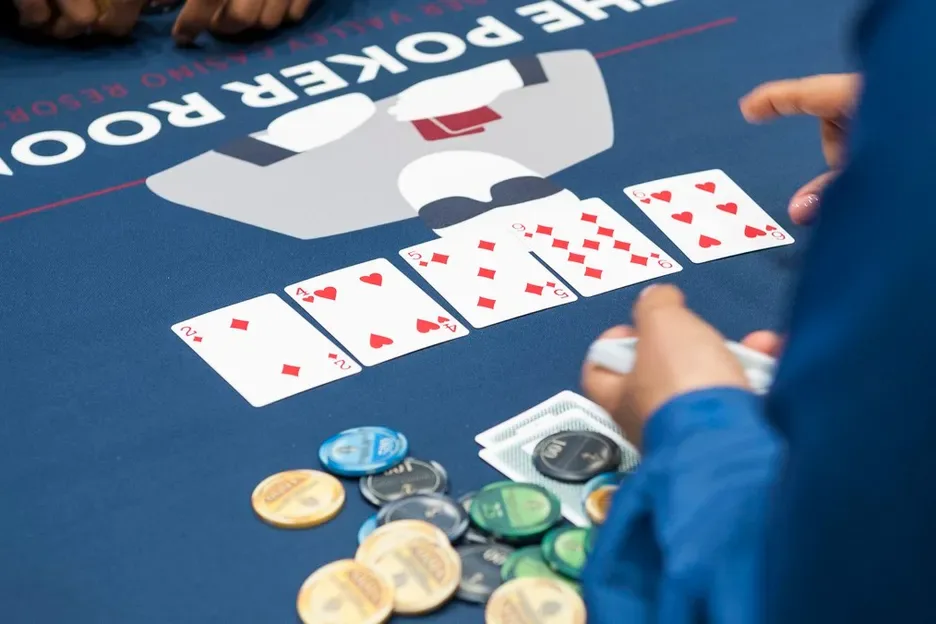
Multi-table tournament poker is often described as a game of incomplete information, probabilistic reasoning, and psychological adaptation. Yet at the final table of a major tournament, another strategic problem frequently appears that has little to do with whether a player should three-bet, defend the big blind, or continuation-bet a particular flop. The remaining players may be asked a deceptively simple question: do you want to make a deal?
Final table deal making, sometimes called chopping, introduces a second layer of game theory into tournament poker. Players are no longer evaluating only the expected value of individual hands. They are negotiating over the distribution of a prize pool while accounting for chip stacks, payout jumps, skill differences, variance, risk tolerance, and future tournament utility.
The decision is mathematically complex because tournament chips do not have a linear relationship with real money. Doubling a stack does not necessarily double its monetary value, while losing all chips reduces tournament value to zero. This nonlinearity is the foundation of the Independent Chip Model, commonly abbreviated as ICM, and it explains why rational final table deals frequently differ from simple chip-count calculations.
Understanding the art of deal making at MTT final tables therefore requires more than knowing how to calculate percentages. A strong negotiator must understand tournament equity, identify when variance is disproportionately expensive, recognize when a proposed deal ignores a meaningful skill advantage, and avoid allowing emotion to distort expected-value decisions.
In many situations, making a deal is the most rational decision available. In others, agreeing to one may quietly surrender a large portion of a player’s long-term edge.
The Mathematical Foundation of MTT Final Table Deals
The central mathematical problem at an MTT final table is that chips are valuable, but their monetary value changes depending on stack distribution and payout structure.
Consider a tournament with three players remaining. Suppose the payouts are $100,000 for first place, $60,000 for second, and $35,000 for third. One player owns 50% of the chips, while the other two players each hold 25%.
A purely proportional chip chop would assign 50% of the remaining prize money to the chip leader. However, tournament economics do not work this way. Even the shortest stack is guaranteed at least the third-place prize, and the chip leader cannot simply convert half the tournament chips into half of the entire remaining prize pool.
This is why ICM is commonly used during final table negotiations.
The Independent Chip Model estimates each player’s probability of finishing in every remaining position based on chip stacks. Those probabilities are then multiplied by the corresponding payouts to produce an approximate monetary value for each stack.

ICM is not a perfect model of poker. It assumes players have roughly equal skill and ignores factors such as position, blind structure, future strategic opportunities, and individual playing styles. Nevertheless, it provides a powerful baseline because it captures the nonlinear relationship between tournament chips and money.
In practical terms, an ICM deal attempts to answer a crucial question: if the tournament were played repeatedly from the current stack distribution under neutral assumptions, what would each stack be worth on average?
That theoretical value becomes the starting point for rational negotiation.
The important word is starting.
Professional-level deal making rarely ends with the raw ICM calculation because real final tables contain additional variables that the model cannot fully incorporate.
When Making a Final Table Deal Is Mathematically Rational
The strongest argument for making a deal is usually variance reduction.
Tournament poker contains enormous short-term variance. Even a highly skilled player may lose a critical all-in while holding 80% equity. At a final table, the financial consequences of those outcomes can be enormous because prize jumps may represent months or even years of normal poker income.
Imagine four players remain in a tournament and the payouts are $500,000, $320,000, $210,000, and $140,000. A player may have an expected tournament value of approximately $300,000 based on stack distribution. However, the actual result could still range from $140,000 to $500,000.
If an ICM-based deal guarantees that player close to $300,000 immediately, the deal dramatically reduces financial variance while sacrificing little theoretical value.
From the perspective of utility theory, this can be rational even if the player believes that continuing to play offers slightly higher raw expected value.
Money does not always have linear personal utility.
For a professional with a $5 million bankroll, the difference between securing $300,000 and gambling for an expected value of $310,000 may be relatively insignificant. For a recreational player with $40,000 in poker savings, the same decision may transform their financial situation.
This concept is sometimes dismissed as “playing scared,” but that interpretation misunderstands risk-adjusted decision making.
A decision can have positive mathematical expectation while still being inappropriate relative to bankroll, financial utility, and risk of ruin.
Deal making becomes particularly attractive when stacks are relatively shallow and the blinds are large. In such structures, the probability that tournament outcomes will be determined by unavoidable all-in confrontations increases substantially.
At 15 effective big blinds, even elite players have less room to express post-flop skill than they do at 60 or 80 big blinds. Much of the game becomes dominated by pre-flop ranges, reshoves, blind-versus-blind confrontations, and high-variance all-ins.
As effective stack depth declines, the economic value of reducing variance generally increases.
A deal can also make strong mathematical sense when several stacks are close together. If four players each hold approximately 25% of the chips, the tournament may have enormous future variance despite relatively small differences in present equity.
An ICM chop can efficiently convert uncertain future equity into guaranteed money.
Why Chip Leaders Should Be Careful About Agreeing Too Quickly
The largest stack at the table often has the most complicated deal decision.
A chip leader may look at a proposed ICM calculation and assume that accepting it is automatically correct. However, chip leadership can create strategic advantages that are not fully reflected in static models.
ICM pressure affects shorter stacks more severely than dominant stacks.
When a major payout jump is approaching, medium stacks frequently avoid marginal confrontations because busting before a shorter stack can be extremely expensive. A large stack can exploit this constraint by opening more hands, applying pressure, attacking capped ranges, and forcing opponents to defend under uncomfortable risk premiums.
This creates what could be described as an ICM pressure premium.
Suppose five players remain and the chip leader controls 40% of all chips. Two medium stacks each hold approximately 20%, while two short stacks have around 10%.
The medium stacks cannot behave as though the tournament were a cash game. If they lose a large pot to the chip leader while shorter stacks remain, their monetary equity may collapse.
The chip leader, by contrast, can often survive a confrontation and still remain in the tournament.
This asymmetry creates opportunities.
A sophisticated chip leader may therefore have future expected value greater than the raw ICM estimate, particularly if the remaining opponents are risk-averse or technically weak.
For this reason, large stacks should rarely accept the first deal proposal automatically.
The correct question is not simply, “Is this a fair ICM number?”
The more important question is, “Does this number compensate me for the strategic value of my stack?”
Some final table deals address this problem by using ICM as a baseline and then giving the chip leader an additional amount. Another common approach is to reserve a portion of the prize pool for the eventual winner.
For example, the players might distribute most of the remaining money according to ICM while leaving $50,000 or $100,000 on the table for first place.
This structure reduces financial variance without completely eliminating competitive incentives.
It also allows a skilled chip leader to retain some upside from future play.
Skill Edge: The Variable That ICM Cannot Properly Measure
One of the largest weaknesses of standard deal calculations is that they usually assume equal skill.
Real poker tables are rarely equal.
A world-class tournament professional playing against inexperienced recreational opponents may have considerably higher future expected value than an ICM calculator suggests. Conversely, a recreational player surrounded by elite professionals may rationally prefer a deal even if the offer is slightly below their theoretical ICM value.
The difficulty is quantifying skill edge accurately.
Poker players are notoriously vulnerable to overconfidence. Many players believe they are the strongest player at the table even when objective evidence suggests otherwise.
For this reason, subjective skill adjustments should be made conservatively.
A player should ask several specific questions.
How deep are the effective stacks? How large is the average stack relative to the blinds? How experienced are the opponents in short-handed tournament play? Are there clear strategic weaknesses that can actually be exploited? Does the player understand ICM better than the field? Is position favorable relative to the largest stacks?
These factors matter because skill edge requires structural opportunities to produce value.
If you are looking for a site to play poker and want a good rakeback deal, you should check out Champion Poker, as it offers flat rakeback of up to 30%.
A player may be dramatically better than the remaining field, but if everyone has eight big blinds, that skill advantage is restricted. Most decisions will involve relatively narrow pre-flop ranges and all-in outcomes.
At 50 big blinds, the same player may have substantially more opportunities to exploit bet sizing, range construction, post-flop mistakes, and psychological tendencies.
Therefore, the value of rejecting a deal because of skill edge tends to increase with stack depth.
The identity of the remaining opponents also matters.
If several players appear uncomfortable with major payout jumps, a strong professional may generate additional equity through controlled aggression. Players who visibly tighten because they are protecting a life-changing score can become highly exploitable.
However, there is an important distinction between possessing a genuine edge and simply preferring to gamble.
“I think I can win” is not an economic argument.
Every remaining player can win.
The relevant question is whether continuing the tournament produces enough additional expected value to justify accepting the variance that comes with it.
When You Should Avoid Making a Final Table Deal
There are several situations in which rejecting a deal can be strategically justified.
The clearest is when the proposed deal materially undervalues your tournament equity.
This can happen when players suggest an equal chop despite major stack differences. If one player holds 55% of the chips and three opponents divide the remaining 45%, splitting the remaining prize pool equally would usually transfer substantial value away from the chip leader.
Similarly, chip-count deals can sometimes undervalue short stacks because they fail to account for guaranteed minimum payouts and nonlinear chip utility.
Another reason to avoid a deal is a significant and exploitable skill advantage.
If stacks are deep, opponents are making obvious strategic errors, and the payout structure leaves substantial money available for first place, continuing may have significantly higher long-term value.
Players should also be cautious when an opponent attempts to create artificial urgency.
Statements such as “This offer is only available right now” or “Everyone else already agreed” are negotiation tactics, not mathematical evidence.
A final table deal should be evaluated independently of social pressure.
Poker tournaments can produce unusual emotional environments. Players may feel uncomfortable being the only person refusing a deal. Others may worry that rejecting an agreement will make the table hostile.

Those concerns should not override substantial financial equity.
Another warning sign is a deal structure that removes virtually all incentive to continue competing.
If every remaining dollar is distributed and the players continue only to determine the official finishing positions, strategic behavior can become distorted. Depending on tournament rules, some organizers require a meaningful amount to remain in play precisely for this reason.
Leaving money for the winner usually produces a healthier structure.
A player should also avoid making a deal simply because the monetary amounts feel large.
Absolute numbers can create cognitive distortion.
A $250,000 offer may appear enormous in isolation. However, if the player’s realistic tournament equity is $310,000, accepting the deal could represent a $60,000 surrender.
The correct comparison is not between the deal amount and zero.
It is between the deal amount and the player’s estimated future tournament value.
The Psychology and Negotiation Science of Final Table Chops
Final table deal making is not purely mathematical. It is also a negotiation problem involving incentives, information asymmetry, anchoring, and emotional pressure.
The first number proposed can influence the entire negotiation.
This psychological phenomenon, known as anchoring, is well documented in behavioral economics. Once a number enters a negotiation, subsequent discussion often revolves around adjustments to that number rather than an independent evaluation of value.
Poker players should therefore avoid reacting emotionally to an opening offer.
The correct process is to determine a reasonable valuation first and negotiate from that reference point.
Another important concept is reservation value.
Every player should have an approximate minimum deal amount they are willing to accept before negotiations begin. This figure might be based on ICM value, adjusted for perceived skill edge, stack position, bankroll considerations, and risk preference.
Without a reservation value, players can easily become influenced by table dynamics.
Information should also be revealed strategically.
Announcing that a particular payout would “change your life” may be emotionally honest, but it can weaken negotiating leverage. Other players may infer that you are highly motivated to secure a deal and therefore willing to accept less than your theoretical value.
Similarly, excessive enthusiasm for a chop may invite stronger opponents to demand concessions.
The most effective negotiating style is generally calm and numerical.
Players should understand their approximate ICM value, explain disagreements using objective logic, and remain willing to continue playing if the numbers are unfavorable.
The ability to walk away is central to negotiation power.
Interestingly, the player who needs a deal least may have the greatest leverage.
This is especially true for a dominant stack or experienced professional facing opponents who strongly prefer variance reduction.
However, aggressive negotiation has limits.
Attempting to extract every possible dollar can cause negotiations to collapse even when an agreement would benefit everyone. There is an opportunity cost to pushing too hard.
The optimal approach is not necessarily to maximize the immediate deal amount. It is to maximize overall expected utility.
Sometimes accepting a slightly imperfect but favorable agreement is better than risking the entire negotiation over a small concession.
A Rational Framework for Deciding Whether to Deal
The decision to chop an MTT final table should ultimately be treated as a portfolio decision under uncertainty.
A player’s tournament stack represents a volatile asset with an estimated expected monetary value. Continuing to play maintains exposure to the full distribution of possible outcomes. Making a deal converts much of that uncertain equity into guaranteed capital.
Neither choice is inherently more courageous or sophisticated.
The correct choice depends on price.
A useful conceptual equation is straightforward: compare the guaranteed value of the proposed deal with the estimated expected value of continuing.
That estimate should begin with ICM.
Next, adjust cautiously for factors that ICM does not capture: skill differences, effective stack depth, seating position, blind structure, opponent tendencies, and the strategic leverage associated with large stacks.
Then consider personal utility.

If the deal would materially improve bankroll stability or financial security, accepting slightly below theoretical expected value may be completely rational. Conversely, a well-bankrolled professional may require a premium before surrendering a substantial skill edge.
Finally, examine the amount left in play.
A strong compromise is often an ICM-based distribution with a meaningful percentage reserved for the winner. This approach reduces catastrophic financial variance while preserving strategic competition.
The most important principle is that final table deals should be evaluated as financial transactions, not emotional decisions.
The fact that a player has been competing for ten hours does not make a deal good. The size of the displayed first-place prize does not make a deal bad. The desire of the other players to chop does not determine your equity.
Only the relationship between the offered value and your realistic future expected value matters.
At the highest level of tournament poker, deal making is therefore an extension of the same reasoning that governs every other profitable decision in the game. Players estimate probabilities, assign values to uncertain outcomes, account for incomplete information, and choose the action with the strongest risk-adjusted expectation.
The cards may determine who wins the final hand, but understanding when to make a deal can determine who captures the most value from reaching the final table in the first place.
If you ever wondered what is the best way to make money in poker and if you had a dilemma about precision vs volume, you can read a more about it here.