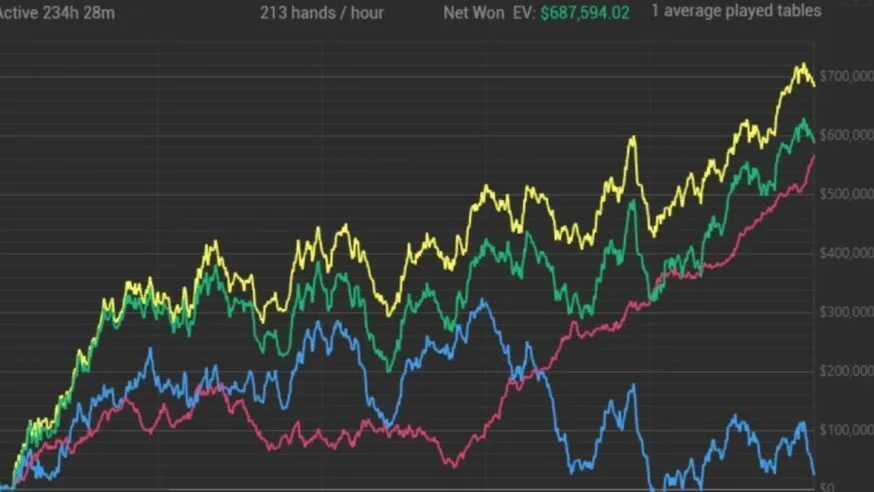
The question of what constitutes the best poker style for online cash games is often framed incorrectly. Players commonly ask whether they should become aggressive “red line” players, value-oriented “blue line” players, balanced GTO players, or highly exploitative players. In practice, however, poker style is not a fixed personality trait. It is better understood as a strategic response to the structure of the game, the tendencies of the player pool, rake, stack depth, position, and the amount of reliable information available.
From a scientific perspective, an online cash game strategy can be viewed as an adaptive decision system. The player observes variables, estimates the expected value of possible actions, and changes behavior when the environment changes. A style that generates excellent results in one pool can lose money in another even if the underlying player is technically competent.
This is particularly important when comparing red line poker and blue line poker. The red line on a poker graph represents winnings in pots that end without showdown, while the blue line represents winnings at showdown. Neither line independently measures the quality of a poker strategy. A player can have a strongly negative red line and still be a major winner, while another player can maintain an impressive red line yet lose money through excessive aggression, weak bluff selection, or poor showdown discipline.
The more useful question is therefore not whether red line or blue line poker is superior. It is how much aggression, showdown value, exploitation, and data-driven adjustment should be incorporated into your strategy at different stakes.
Red Line Poker: The Science of Winning Without Showdown
Red line poker refers to strategies that generate a substantial portion of profit through non-showdown pots. These winnings typically come from stealing blinds, continuation betting, check-raising, three-betting, squeezing, applying pressure on later streets, and forcing opponents to fold before reaching showdown.
Conceptually, red line poker is based on fold equity. Every aggressive poker action has two potential sources of expected value: the value generated when the opponent folds and the value generated when the hand continues. A successful bluff, semi-bluff, or aggressive thin-value bet combines these components in different proportions.
This makes red line poker especially attractive to technically sophisticated players. Instead of waiting for strong hands, the player attempts to extract value from range advantage, nut advantage, blockers, positional advantage, and opponent tendencies.
However, the red line is one of the most misunderstood metrics in online poker.
If you are looking for a site to play poker and want a good rakeback deal, you should check out Champion Poker, as it offers flat rakeback of up to 30%.
A rising red line does not automatically indicate strong play. Players can artificially improve their non-showdown results simply by bluffing more frequently, defending more aggressively, or refusing to give up pots. The problem is that additional aggression eventually reaches diminishing and then negative returns.
Suppose an opponent reaches the river with a range that is naturally strong and folds only 20% of the time. Increasing bluff frequency against that range may improve your red line in selected successful instances, but if the opponent calls frequently enough, total expected value decreases. Some of those losses migrate into the blue line because the bluffs are now being called.
This illustrates a fundamental principle of poker analysis: graph lines should be treated as outputs of strategy, not strategic objectives themselves.
Trying to “fix your red line” without understanding why it is negative is similar to attempting to lower a patient’s temperature without diagnosing the underlying condition. The measurement contains information, but optimizing the measurement directly can produce undesirable results.
Strong red line performance is therefore most valuable when it emerges naturally from exploiting excessive folding, positional weakness, capped ranges, and structural vulnerabilities in opponents’ strategies.
Blue Line Poker: Why Showdown Value Still Drives Cash Game Profit
Blue line poker is associated with winning money at showdown. Players who rely heavily on the blue line generally bluff less frequently, value bet aggressively when strong, and avoid marginal situations in which opponents are unlikely to fold.
This style can appear less sophisticated because it sometimes resembles straightforward poker. In many online cash games, however, straightforward poker is profitable precisely because opponents make substantial calling mistakes.
A player who calls too many three-bets, continues too widely against flop bets, refuses to fold top pair, or bluff-catches excessively creates an environment where attempting elaborate bluffs becomes unnecessary. The optimal response is to increase the value component of the betting range.
At lower stakes, this principle can be particularly important. Many recreational players do not evaluate ranges according to theoretical frequencies. They evaluate their own hand. A player holding top pair may simply decide that the hand is “too strong to fold,” regardless of whether your river betting range theoretically contains enough value combinations to justify the call.
Against such an opponent, an aggressive bluffing strategy can destroy expected value.
This does not mean that micro-stakes or low-stakes poker should be passive. In fact, successful blue line players can be extremely aggressive. The difference is the composition of their aggression.
A strong value-oriented player might isolate recreational players with wider ranges, three-bet strong linear ranges, continuation bet favorable boards, value bet thinner than theoretically standard, and use large river sizes against players who call too much. That is highly aggressive poker, but the aggression is weighted toward value rather than bluff generation.
For this reason, describing poker strategies simply as aggressive or passive is often insufficient. Two players may have identical betting frequencies while having completely different value-to-bluff ratios.
The blue line therefore represents more than “waiting for good hands.” Properly executed blue line poker is an optimization strategy designed to maximize the amount of money transferred when opponents arrive at showdown with dominated or incorrectly defended ranges.
Why the Best Online Cash Game Style Is Usually a Hybrid
For most serious online cash game players, the strongest long-term approach is a hybrid between red line and blue line poker.
A hybrid strategy recognizes that poker environments are heterogeneous. Even within the same stake, one table may contain several passive recreational players, while another consists almost entirely of aggressive regulars. Applying identical frequencies to both games ignores available information.
The theoretical foundation of hybrid poker is straightforward. When opponents deviate from equilibrium, the highest-EV response is usually to deviate in the opposite direction.
If a player folds too frequently, bluffing becomes more profitable. If a player calls too frequently, value betting becomes more profitable. If a player three-bets too little, opening wider becomes attractive. If a player three-bets excessively, opening ranges may need to tighten while four-betting and trapping frequencies change.
This adaptive framework naturally produces different red-line and blue-line profiles against different opponent types.
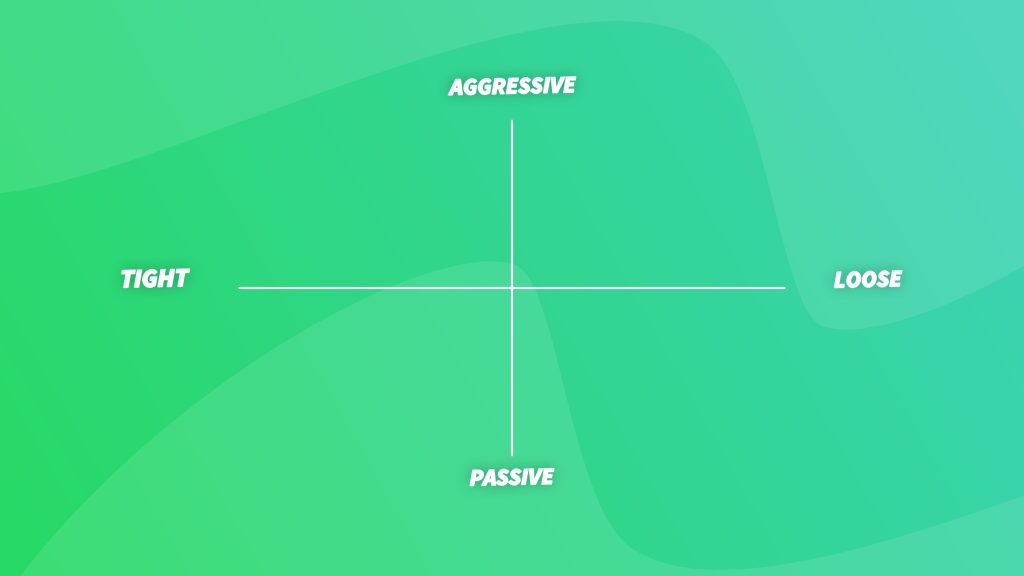
Against a tight regular who overfolds to river aggression, your strategy may become highly red-line oriented. Against a recreational player who calls three streets with weak pairs, the same player should suddenly become much more blue-line oriented.
The important variable is not your preferred style. It is the opponent’s error.
This distinction separates strategic identity from strategic execution. Saying “I am an aggressive player” may be psychologically satisfying, but it can become strategically dangerous when aggression is applied regardless of context.
A better identity is that of an adaptive player.
The objective of online cash game poker is not to produce a beautiful graph. It is to maximize expected value across thousands or millions of decisions. A hybrid strategy accomplishes this by using theoretically sound poker as a reference point while allowing meaningful deviations when population or individual data supports them.
How Poker Strategy Should Change as You Move Up in Stakes
One of the biggest mistakes in online poker is assuming that a strategy successful at one limit can simply be transferred upward without modification.
As stakes increase, several environmental variables typically change simultaneously. Player pools often become more technically competent, preflop ranges become more disciplined, recreational-player density may decrease, aggressive frequencies increase, and obvious strategic leaks become less common.
At micro stakes, large portions of profit can often come from basic structural exploitation. Opponents may limp too frequently, call raises with dominated hands, under-bluff rivers, use bet sizes that reveal hand strength, or defend incorrectly against large value bets.
In these games, the optimal response can be dramatically exploitative.
There may be little reason to construct perfectly balanced river bluffing ranges against an opponent who almost never folds second pair. Similarly, hero-calling rivers at equilibrium-inspired frequencies can become a major leak if the population significantly under-bluffs.
As a player moves into tougher small- and mid-stakes games, pure exploitation becomes more complicated. Regular opponents observe tendencies, databases become larger, and repeated strategic errors can be punished.
Your baseline therefore needs to become more robust.
This is where concepts from game theory become increasingly useful. GTO poker does not mean mechanically copying solver outputs in every situation. Its primary practical value is providing a defensible baseline from which deviations can be measured.
If you understand approximately how often a range should bet, check, bluff, call, or fold in equilibrium, you can identify when population behavior is significantly different.
The amount you change strategy should be proportional to the strength of the evidence.
A common tendency among developing players is to over-adjust. They see an opponent make one unusual bluff and immediately classify that player as extremely aggressive. They observe two river folds and begin triple-barrel bluffing excessively.
From a statistical perspective, these are weak inferences because the sample size is small.
At higher stakes, high-quality adaptation is generally more granular. Instead of deciding that a player “folds too much,” you want to understand where that player folds too much. Is the leak in single-raised pots or three-bet pots? In position or out of position? Against small bets or overbets? On flops, turns, or rivers?
The stronger the competition becomes, the more specific profitable deviations usually need to be.
Should You Play Data-Driven Poker?
Online poker produces an unusually rich amount of behavioral data, making data-driven poker one of the strongest approaches available to serious cash game players.
A data-driven strategy uses information from hand histories, database analysis, tracking software, HUD statistics where permitted, population reports, solver outputs, and personal review to determine where expected value is actually being gained or lost.
The major advantage of this approach is that it reduces dependence on intuition.
Human memory is highly selective. Poker players remember dramatic bluffs, large bad beats, unusual hero calls, and emotionally significant hands much more easily than thousands of routine folds. As a result, subjective impressions of opponents and populations can become distorted.
Database analysis creates a corrective mechanism.
Imagine that you believe players in your pool bluff rivers frequently. Your emotional memory may support this because several memorable river bluffs were shown recently. But after examining a sufficiently large database, you may discover that the pool’s river betting range is substantially under-bluffed in several common formations.
That information should change strategy.
However, data-driven poker also contains an important statistical danger: overfitting.
If you filter a database into increasingly narrow situations, the sample size eventually becomes too small to support reliable conclusions. A player may appear to fold 80% of the time to river raises, but if the statistic is based on five opportunities, the estimate has little predictive power.
This is why strong poker analysis distinguishes between individual reads, population tendencies, and theoretical baselines.
Population data can often provide a relatively stable prior. Individual player statistics can then modify that prior when the sample becomes meaningful. Solver analysis provides a theoretical reference point that helps identify how large the deviation may be.
The result is not purely GTO poker and not purely exploitative poker. It is evidence-weighted adaptation.
This may be the most accurate description of modern online cash game strategy.
The Best Poker Style Is an Adaptive System, Not a Fixed Identity
The debate between red line poker, blue line poker, GTO poker, and exploitative poker becomes much easier to resolve once poker style is viewed as dynamic rather than permanent.
There is no scientific reason that your strategy should maintain the same red-line profile at every stake or against every opponent.
Against players who fold too much, non-showdown aggression should increase. Against players who call too much, bluffing frequencies should decrease and value ranges should widen. Against unknown regulars, a theoretically robust baseline becomes more valuable. Against recreational players with obvious tendencies, larger deviations may generate substantially more expected value.
The ideal online cash game player therefore develops multiple strategic modes rather than one rigid style.
At lower stakes, this may mean emphasizing simple, high-confidence exploits and accepting that your red line does not look impressive. As competition improves, your baseline should generally become harder to exploit, while aggressive deviations become more selective and evidence dependent.
Data should guide these decisions whenever meaningful samples are available, but data should never be interpreted without considering sample size, game structure, and selection bias.
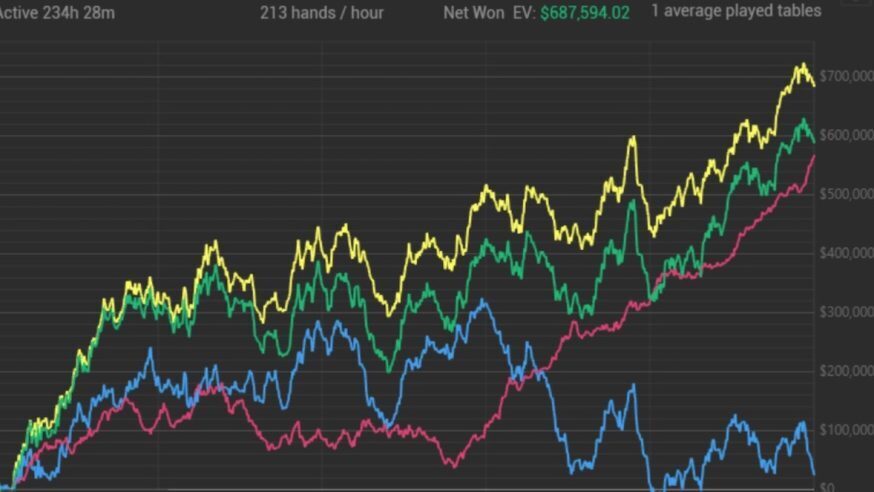
The most useful objective is not to become a red line player or a blue line player. It is to become a player whose red and blue lines reflect correct decisions for the environment being played.
If the pool overfolds, your graph may naturally become more red-line oriented. If the pool calls too much, your profit may increasingly appear in the blue line. If opponents are balanced and technically strong, both lines may become secondary to maintaining a strategically coherent total win rate.
Ultimately, the best poker style for online cash games is a hybrid, adaptive, and increasingly data-driven approach built on a strong theoretical foundation.
Poker is an optimization problem under uncertainty. Your objective is not to express a preferred style but to identify the highest-value response to incomplete information.
The strongest players are therefore not necessarily those who bluff the most, value bet the most, or follow solvers most closely. They are the players who accurately identify when each approach should be used, quantify the evidence supporting the adjustment, and change their strategy by the appropriate amount.
That is the point at which poker style stops being an identity and becomes what it should be: a continuously updated decision model.
If you want to improve you edge, you can read more about science and importance of soft skills in poker by clicking here.