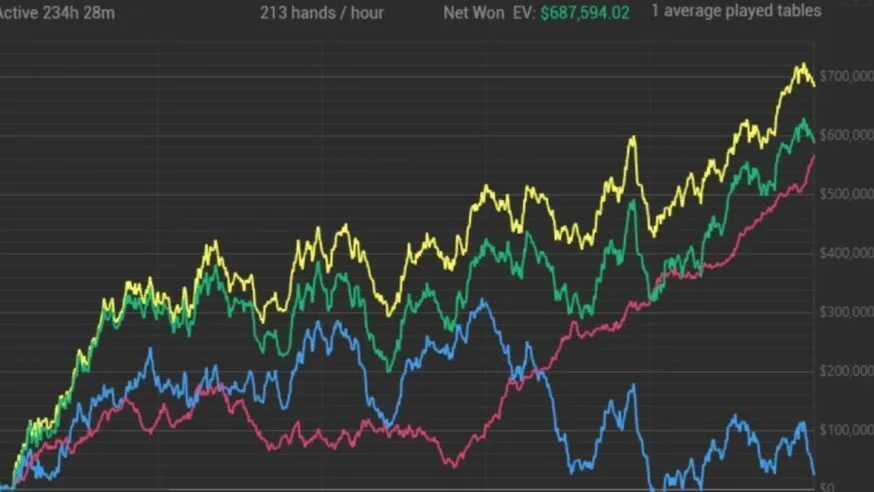
Modern poker is increasingly a game of measurement. Intuition, experience, and table feel still matter, but players who rely exclusively on memory are attempting to solve a statistical problem with an unreliable biological database. Human memory tends to overemphasize unusual hands, painful losses, large pots, and recent sessions while ignoring thousands of routine decisions that may have a much greater effect on long-term profitability.
Database analysis offers an alternative. By recording and studying hand histories, a poker player can transform thousands of individual decisions into structured evidence. Instead of asking whether a particular bluff was correct, the player can investigate whether an entire category of bluffs is profitable. Instead of wondering whether the blinds are running badly, the player can measure how much money is being lost from each position and compare that result across different situations.
This process resembles scientific analysis more closely than conventional poker study. A database provides observations. Filters create experimental subsets. Statistics identify patterns. Hypotheses can then be tested against additional hands.
For serious players, this makes poker database analysis one of the most efficient methods available for improving poker strategy. Solvers can explain theoretically optimal decisions, training videos can introduce new concepts, and coaching can accelerate learning, but a database answers a different question: what is actually happening in your own game?
That distinction is important. The largest theoretical mistake in poker is not necessarily the largest financial leak. The most valuable improvement is usually the one that corrects a frequently repeated error. Database analysis allows players to identify those errors objectively and prioritize study according to expected value.
Poker Database Analysis Turns Results Into Evidence
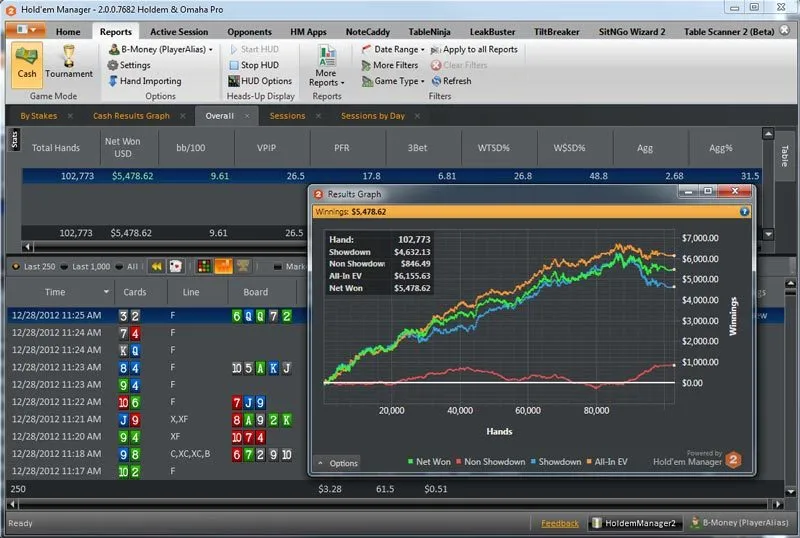
A poker tracking database records information from played hands and converts it into measurable variables. Depending on the game format and software being used, this may include position, stack depth, hole cards, preflop actions, bet sizes, board textures, showdown results, all-in expected value, and dozens of behavioral statistics.
The obvious attraction is volume. A player may have difficulty remembering the details of fifty hands from a session, but tracking software can preserve hundreds of thousands of hands with perfect consistency.
The deeper advantage, however, is classification.
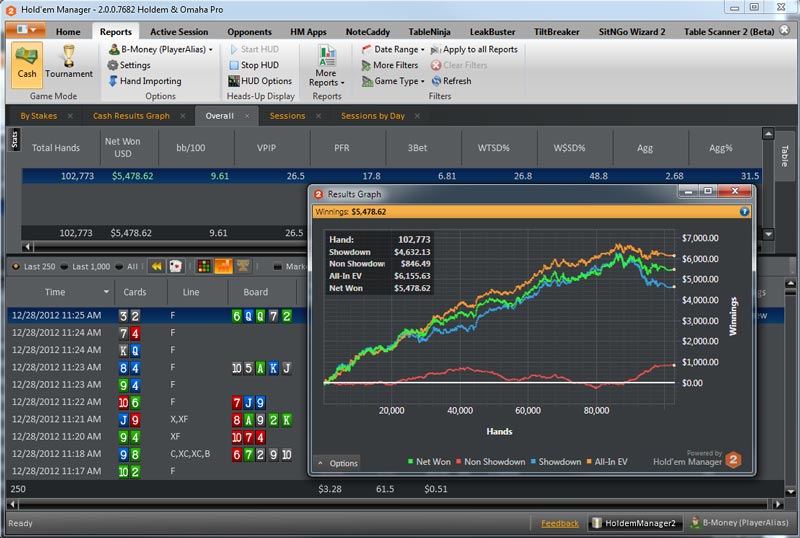
Suppose a player believes they are losing too much money with top pair. Looking through isolated hand histories will probably produce a collection of memorable examples, but those examples may not represent the underlying problem. A database makes it possible to separate single-raised pots from three-bet pots, distinguish in-position situations from out-of-position situations, isolate different stack depths, separate river calls from river bets, and compare performance across board structures.
That transforms a vague suspicion into a testable question.
Poker improvement becomes substantially more efficient when questions are defined precisely. Rather than asking, “Am I calling too much?” a player can ask whether their river call efficiency is unusually low in single-raised pots when facing large bets out of position. Instead of asking whether they are too passive, they can investigate turn aggression after checking back the flop as the preflop raiser.
The database therefore functions as a laboratory. Every hand is an observation, every filter is a method of controlling variables, and every statistical pattern is a potential clue.
This does not mean every pattern is meaningful. Poker contains enormous variance, and small samples routinely create misleading results. The purpose of database analysis is not to treat every negative number as evidence of a strategic error. The purpose is to separate variance from repeated decision-making patterns as carefully as possible.
That requires understanding both poker statistics and statistical uncertainty.
Start With Large-Sample Metrics Before Studying Individual Hands
One of the most common mistakes in poker database analysis is beginning with individual hands. Players frequently search for the largest losing pots, review a sequence of dramatic coolers, and conclude that they have discovered the source of their poor results.
Usually, they have discovered variance.
Large pots attract attention because they have an immediate effect on short-term results, but many of the most expensive leaks in poker occur in small and medium-sized pots. Losing an additional two big blinds in a situation that occurs thousands of times can be far more damaging than making one questionable stack-off decision.
A better approach begins at the macro level.
Overall win rate provides the broadest measurement, normally expressed in big blinds won per 100 hands. From there, results should be segmented by position. Position is one of the strongest structural variables in poker, so a healthy database normally shows significant differences between early position, late position, the small blind, and the big blind.
If a player’s button results are unexpectedly weak, the problem may involve insufficient stealing, poor three-bet defense, weak postflop aggression, excessive calling, or inefficient value betting. If losses from the big blind are unusually severe, the player may be defending incorrect ranges or making postflop mistakes after defending.
The important principle is that statistics should generate questions rather than immediate conclusions.
Common preflop measurements such as VPIP, PFR, three-bet percentage, fold-to-three-bet percentage, four-bet frequency, and blind defense statistics can reveal structural tendencies. Postflop statistics such as continuation-bet frequency, fold-to-continuation-bet percentage, turn aggression, river aggression, went-to-showdown percentage, and won-money-at-showdown percentage provide further information.
However, no individual statistic defines good poker.
A player’s three-bet percentage, for example, cannot be evaluated intelligently without considering position, game structure, opponent tendencies, rake, stack depth, and opening ranges. A percentage that appears aggressive in one environment may be conservative in another.
The scientific approach is therefore contextual. Database statistics are indicators. They tell the player where further investigation may be valuable.
Once a suspicious pattern has been identified, filters can be used to determine why it exists.
Use Filters to Identify Specific Poker Leaks
Filtering is the central mechanism of effective poker database analysis.
A database containing 100,000 hands is useful because it provides sample size, but an unfiltered sample combines thousands of strategically different situations. The goal of filtering is to reduce that complexity without reducing the sample so aggressively that the result becomes statistically meaningless.
Consider a player who is losing significantly after calling a three-bet. The raw result alone provides limited information. Calling a three-bet from the button against the big blind is fundamentally different from calling one from early position against the small blind. Pocket pairs, suited connectors, suited broadways, and offsuit broadways also behave differently after the flop.
The first stage might therefore be to examine three-bet pots by position.
If most of the losses originate from out-of-position calls, the player can narrow the investigation further. They may discover that marginal offsuit broadway combinations perform particularly badly. Alternatively, the preflop calling range may be reasonable while the postflop strategy is responsible for the negative result.
The same process can be applied to continuation betting.
If you are looking for a site to play poker and want a good rakeback deal, you should check out Champion Poker, as it offers flat rakeback of up to 30%.
A player with an excessively high flop continuation-bet frequency may still be playing well if the relevant boards and ranges justify aggressive betting. The meaningful question is whether certain categories of board are being overbet strategically.
By filtering for flop texture, position, number of players, preflop action, and bet size, the player can compare performance across different strategic environments.
An especially productive method is to study lines rather than isolated actions.
For example, examine hands in which you raised preflop, continuation-bet the flop, checked the turn, and then faced a river bet. Another useful filter might isolate hands in which you defended the big blind, check-called the flop, and faced a second barrel on the turn.
These sequences represent decision trees that recur repeatedly. If one branch of the tree is consistently losing more than expected, it becomes an excellent candidate for deeper study.
This is where database work connects naturally with solver analysis. The database identifies the problem. The solver can then help explain the theoretical structure behind it.
Compare Your Strategy With Theory Without Becoming a Slave to Solver Frequencies
Modern poker study often revolves around game theory optimal strategy, but database analysis and solver analysis serve different purposes.
A solver calculates equilibrium strategies under defined assumptions. Your poker database records the consequences of decisions made against real opponents.
The most powerful study process combines both.
Imagine that database analysis reveals poor results when defending the big blind against button opens. The next step is not necessarily to memorize an entire theoretical big blind range. Instead, divide the problem into categories.
First, analyze whether the preflop defense frequencies are approximately reasonable. Then examine which hands are losing disproportionately. After that, investigate postflop lines on common board textures.
Solver outputs can then be used to test hypotheses.
Perhaps the database shows frequent losses after check-calling the flop on low connected boards. A solver comparison may reveal that certain hands should check-raise more frequently, while others should fold immediately. Alternatively, the player’s flop strategy may be theoretically acceptable, but their turn defense may be too wide.
The crucial concept is deviation magnitude multiplied by frequency.
A decision that is slightly incorrect but occurs extremely often may deserve more study than a severe error in an unusual situation. Poker databases help quantify frequency, while solvers help estimate strategic accuracy.
This combination creates a rational study hierarchy.
Database analysis also prevents a common solver-study problem: studying situations simply because they are intellectually interesting. Four-bet pots on unusual river runouts may be fascinating, but if they occur only a few times per month, perfecting them will have minimal effect on overall win rate.
A database redirects attention toward the situations that actually dominate your volume.
It can also expose situations where exploitative poker strategy should differ from theoretical strategy. If a player pool folds too frequently to river bets, database evidence may justify additional bluffing. If opponents call too many three-bets and fold too frequently after the flop, a player may profit from adjusting both preflop construction and postflop aggression.
Theory establishes a baseline. Data reveals where reality differs from that baseline.
Sample Size, Variance and Statistical Bias Matter
Poker databases are powerful, but they can easily produce false confidence.
The fundamental problem is variance.
Even a winning poker player can experience long losing stretches, and individual hand categories can behave unpredictably across surprisingly large samples. Premium hands can lose over short periods. Specific positions can show unusually good or bad results. A particular postflop line may appear massively profitable simply because several large pots happened to occur inside the filtered sample.
For this reason, database analysis should focus more heavily on frequencies than short-term monetary outcomes when sample sizes are limited.
Suppose a player filters for river check-raises and discovers that the line has lost heavily across 40 occurrences. Forty hands are unlikely to provide enough evidence to conclude that the underlying strategy is fundamentally wrong.
If the same player discovers that they have folded to river bets 92 percent of the time across several thousand relevant opportunities, the evidence of a systematic tendency is considerably stronger.
Researchers distinguish between signal and noise, and poker players should do the same.
Large samples increase confidence, but sample size alone does not eliminate bias. Selection bias can occur when players review only losing hands. Outcome bias appears when a decision is judged primarily by whether the hand was won. Survivorship bias can emerge when players study successful opponents without accounting for the many players who used similar approaches unsuccessfully.
There is also a subtler danger: changing strategy too quickly.
Suppose a database indicates poor results from three-betting suited connectors. A player might immediately remove them from their range. That change could be incorrect because the negative result may be caused by poor postflop execution rather than the three-bet itself.
Good database analysis therefore asks several questions before making strategic changes. Is the sample sufficiently large? Is the filter measuring the intended situation? Is the negative result theoretically expected? Could variance plausibly explain the outcome? Does hand-level review reveal a consistent decision error?
Scientific thinking requires skepticism, including skepticism toward your own statistics.
Build a Continuous Database Analysis and Study Cycle
The greatest value of a poker database comes from using it continuously rather than performing occasional reviews after losing sessions.
A productive study cycle begins with observation.
First, examine broad performance indicators across a meaningful sample. Look at win rate by position, preflop frequencies, postflop aggression, showdown tendencies, and major pot categories. The objective is not to diagnose every problem simultaneously but to identify one area that appears strategically or financially important.
Next, formulate a specific hypothesis.
Perhaps you suspect that you are overdefending against three-bets from early position. Maybe your turn continuation betting is too passive after betting the flop. Perhaps you are losing too much from the small blind because your strategy contains excessive calling.
Then construct filters that isolate the relevant situations.
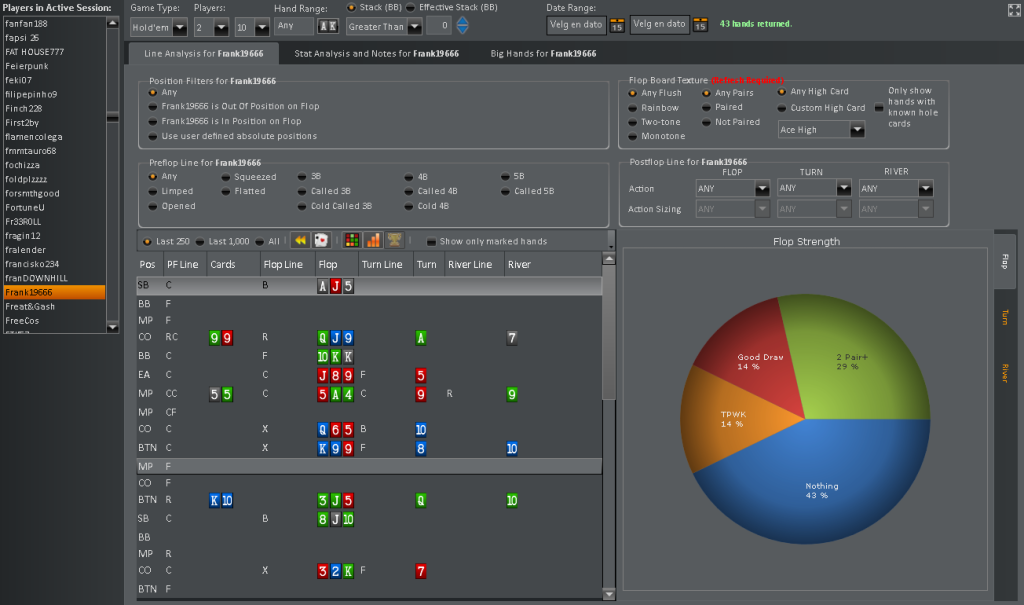
Review frequencies first and financial results second. Once a pattern appears credible, examine representative hands rather than only the largest winners and losers. This reduces outcome bias and provides a better picture of normal decision-making.
After identifying recurring mistakes, compare the relevant situations with strong theoretical references, solver outputs, coaching material, or population data. The purpose is to understand the mechanism behind the leak rather than simply memorizing a new percentage.
The final stage is implementation.
Change one clearly defined element of your strategy and continue collecting hands. After sufficient additional volume, return to the database and test whether the behavior has changed.
This creates a feedback loop: measure, hypothesize, analyze, modify, measure again.
That process is extremely powerful because poker improvement becomes observable. Instead of vaguely feeling that your game is becoming more aggressive, you can verify whether specific aggression frequencies have changed. Instead of hoping your blind defense has improved, you can compare old and new samples.
Over time, the database becomes more than a record of poker results. It becomes a record of strategic development.
Why Database Analysis Can Produce a Long-Term Poker Edge
Improving at poker is ultimately a problem of reducing decision error.
The difficulty is that errors do not announce themselves. Some losing decisions win money. Some excellent decisions lose stacks. Variance constantly interferes with short-term feedback, which makes intuition alone an unreliable measurement system.
Poker database analysis reduces that problem by aggregating decisions across large samples.
It allows players to move from stories to statistics. A bad session becomes less important than a recurring positional weakness. A memorable hero call becomes less important than overall river calling efficiency. A spectacular bluff becomes less important than whether the underlying bluffing line generates positive expected value over hundreds of repetitions.
This shift in perspective is essential for serious poker improvement.
The strongest players are not simply trying to play individual hands correctly. They are trying to construct systems in which profitable decisions occur more frequently and costly mistakes occur less frequently.
Database analysis provides the evidence required to build those systems.
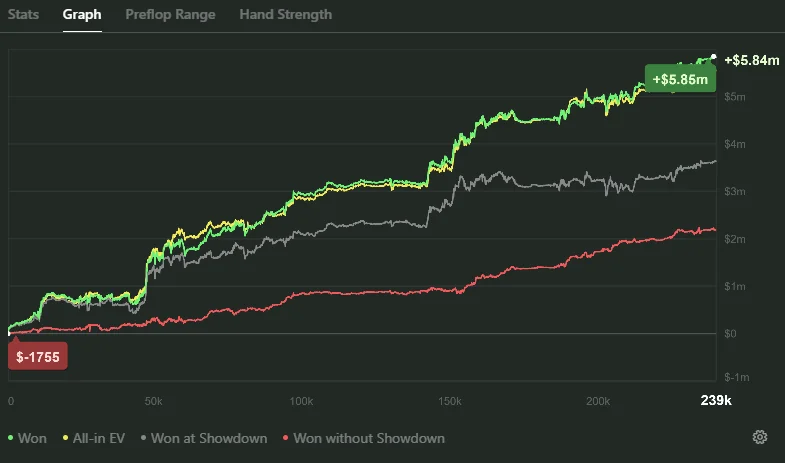
It can reveal where money is being lost, show which situations deserve immediate study, measure whether strategic changes are actually being implemented, and prevent players from wasting study time on low-frequency situations. When combined with sound poker theory, solver work, and careful hand review, it creates one of the most rigorous approaches to poker training available.
The objective is not to achieve perfect statistics. There is no universal VPIP, three-bet percentage, continuation-bet frequency, or river aggression number that automatically produces a winning player.
The objective is to understand why your numbers look the way they do.
Every statistic should connect to a range. Every range should connect to a strategic assumption. Every strategic assumption should eventually be tested against results.
That is the real strength of poker database analysis.
It transforms poker improvement from a collection of impressions into an evidence-based process. And in a game where very small differences in decision quality can compound across hundreds of thousands of hands, the ability to find, measure, and systematically eliminate leaks can become a significant long-term competitive advantage.
If you want to learn more about best strategies for online poker games, we have an article for you here!