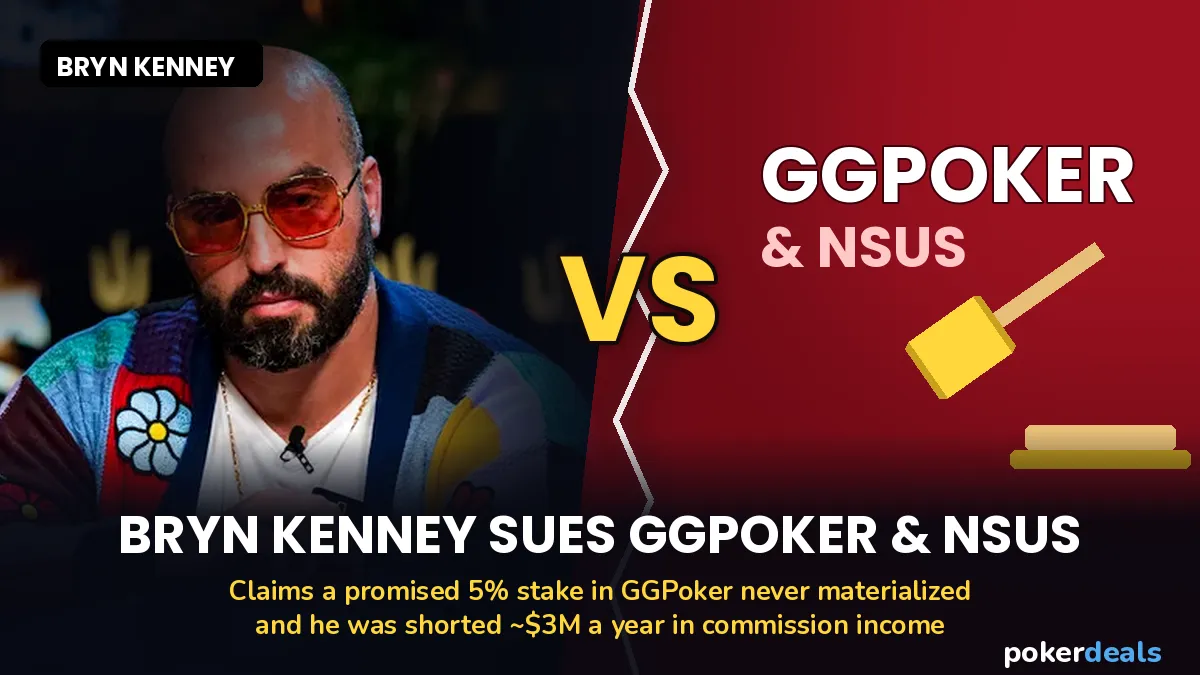
The online poker industry is facing a significant legal dispute as Bryn Kenney, one of the most successful professional poker players in history, has filed a lawsuit against companies associated with GGPoker and NSUS Group CEO Mansoo Kim. The case involves allegations of breach of contract, fraudulent representations, unpaid commissions, and a disputed 5% ownership stake in the business. Beyond its financial implications, the Bryn Kenney GGPoker lawsuit raises important questions about corporate accountability, contractual transparency, and the relationship between professional poker players and online gambling operators.
Filed in Nevada in July 2026 and subsequently transferred to federal court, the lawsuit concerns agreements allegedly established during Kenney’s association with GGPoker, which began in 2018. According to the reported complaint, Kenney maintains that financial commitments made during the partnership were not fulfilled, resulting in substantial losses in expected commission revenue and ownership benefits.
The controversy also introduces a broader dimension involving online poker security and the reliability of anti-cheating systems. An examination of the available legal records and reported allegations provides insight into how contractual disputes, technological oversight, and commercial incentives intersect within the rapidly developing online poker market.
1. The Origins of the Bryn Kenney GGPoker Lawsuit
Bryn Kenney’s position in professional poker provides important context for understanding the significance of the dispute. According to The Hendon Mob poker database, Kenney has accumulated more than $90 million in recorded live tournament cashes, placing him at the top of the all-time money list as of October 2026. These figures represent tournament payouts rather than net profits, but they demonstrate his exceptional prominence in competitive poker.
This recognition made Kenney a commercially valuable figure for online poker operators seeking international exposure and access to professional player networks. GGPoker, which subsequently developed into one of the industry’s most prominent platforms, entered into a promotional relationship with Kenney in March 2018.
According to the allegations reported by NEXT.io, Kenney initially signed an endorsement agreement with NSUS Limited, an Irish company associated with GGPoker. In August 2018, the professional player allegedly received additional assurances from executive Mansoo Kim regarding a broader commercial arrangement.
The alleged agreement included a 5% equity interest in the business and commissions generated through players recruited to the platform. These provisions, if established, would have transformed the relationship from a conventional sponsorship into a more substantial commercial partnership involving ongoing revenue participation and potential ownership rights.
Kenney’s complaint alleges that these commitments were subsequently disregarded. The dispute involves NSUS Group Inc., NSUS Limited, Global Gaming & Hospitality LLC, and Mansoo Kim, who is also identified as Michael Kim in the court proceedings.

If you are looking for a site to play poker and want a good rakeback deal, you should check out Champion Poker, as it offers flat rakeback of up to 30%.
The lawsuit was initially filed on July 2, 2026, in Nevada’s Eighth Judicial District Court in Clark County. On August 25, Kim removed the proceedings to the United States District Court for the District of Nevada, where the case is identified as Kenney v. Kim et al., case number 2:26-cv-02704.
The transition from state to federal court occurred under diversity jurisdiction, a procedural mechanism involving parties from different jurisdictions. This transfer does not establish the validity of either side’s arguments.
Although Kenney’s relationship with the GGPoker ambassador programme ended in 2020, the lawsuit indicates that disputes concerning the earlier commercial arrangements remain unresolved.
The central issue is therefore not simply the termination of a sponsorship. It is whether enforceable financial and ownership obligations were created, whether those obligations were subsequently breached, and whether the alleged conduct caused legally recoverable losses.
2. The Disputed 5% Equity Stake and Its Financial Significance
One of the most consequential elements of the Bryn Kenney lawsuit against GGPoker’s associated companies concerns the alleged promise of a 5% ownership stake.
Equity participation differs fundamentally from ordinary promotional compensation. Whereas an endorsement fee generally compensates an individual for specified services, an ownership interest may provide access to future increases in corporate value, distributions, and other shareholder rights.
According to Kenney’s reported allegations, Kim agreed in August 2018 to extend their existing commercial relationship by granting him an equity interest. Kenney maintains that this arrangement was never formally recognized or honored.
From a corporate finance perspective, the dispute introduces several distinct questions.
The first concerns the precise identity of the company in which Kenney was allegedly promised ownership. GGPoker operates within a wider corporate structure, and an interest in a parent company may carry different economic consequences from an interest in a subsidiary or particular operating business.
The second concerns the actual contractual terms. A promise involving 5% ownership might depend on specific performance obligations, vesting requirements, dilution provisions, or other conditions. Whether such qualifications existed in this case remains a matter for the available evidence.
The third concerns the difference between an alleged commercial promise and an effective transfer of shares. Establishing that an ownership interest was discussed does not necessarily establish that an enforceable agreement existed or that the interest was legally issued.
Potential evidence could include correspondence between the parties, corporate records, draft agreements, capitalization tables, and communications documenting the intended consideration for the alleged equity allocation.
An evidentiary analysis would also examine whether Kenney provided services in reliance on the alleged commitment and how the parties conducted their relationship after the purported agreement.
The financial implications could be substantial if a court ultimately recognized an enforceable ownership obligation. However, the available information does not establish the monetary value of the disputed 5% interest.
That distinction is essential. Ownership percentages cannot be converted into reliable dollar amounts without identifying the relevant company, the applicable valuation, and the contractual rights associated with the interest.
Consequently, the equity component of the Bryn Kenney GGPoker lawsuit represents a potentially important commercial dispute, but its economic value remains uncertain pending further evidence and judicial consideration.
3. Alleged Unpaid Commissions and the $3 Million Annual Revenue Decline
The second major component of the lawsuit concerns commissions allegedly generated through Kenney’s recruitment of players to GGPoker.
Referral and affiliate arrangements are widely used within the online gambling industry. Under these models, individuals or marketing partners may receive compensation based on customers they introduce and the revenue those customers subsequently generate.
According to the reported complaint, Kenney claims that his commission income reached approximately $5 million in 2019. He further alleges that subsequent changes to the company’s administration of his referral network substantially reduced the payments he received.
The accusations involve several alleged practices, including removing recruited players from Kenney’s network, applying unauthorized deductions, reducing commission rates, and encouraging agents associated with Kenney to move their accounts into company-controlled arrangements.
Kenney maintains that the combined effect reduced his annual commission income by more than $3 million compared with earlier earnings. This figure describes his alleged annual decline relative to a previous level, rather than a judicially established damages award.
Assessing these allegations requires more than comparing yearly payments.
In financial analysis, a reduction in revenue does not independently demonstrate contractual misconduct. Commission income can also change because of variations in player activity, customer retention, market conditions, or legitimately agreed commercial terms.

The important question is whether the reported reduction resulted from permissible business developments or from actions inconsistent with binding contractual obligations.
A rigorous financial reconstruction would therefore need to establish the original commission formula, identify the players assigned to Kenney’s referral network, and calculate the revenue attributable to those players during the relevant periods.
Investigators would also need to examine the timing of any changes to player attribution, commission percentages, payment calculations, and agent relationships.
This process resembles a forensic accounting investigation in which transaction-level records are compared against contractual entitlements.
For example, historical referral data could help determine whether a player previously attributed to Kenney was subsequently reassigned. Revenue records could then establish whether the change affected payments that would otherwise have been due under the applicable agreement.
The analysis would also need to distinguish changes authorized by contract from changes imposed without consent.
Kenney is reportedly seeking damages and an accounting of the relevant financial records. An accounting could be particularly significant where one party controls the underlying transaction data required to calculate revenue participation.
In economic terms, the situation illustrates information asymmetry: the platform may possess detailed records of player activity and commission calculations, while an external commercial partner may have limited independent access to those records.
This imbalance does not establish wrongdoing. However, it explains why contractual audit rights, transparent reporting procedures, and reliable accounting systems are important in long-term affiliate relationships.
The outcome of the commission dispute will depend on documentary evidence and the enforceable terms governing the parties’ arrangements, rather than the magnitude of the alleged revenue decline alone.
4. GGPoker Security, Cheating Allegations, and the Importance of Digital Trust
Beyond the financial disagreement, the Bryn Kenney lawsuit includes allegations concerning online poker security and representations about cheating prevention.
According to the reported complaint, Kenney claims that Kim assured him GGPoker maintained robust measures against cheating. Kenney alleges that he later learned systematic cheating was occurring on the platform and that the assurances he had received were misleading.
He also alleges that Kim subsequently attempted to attribute responsibility for cheating-related problems to him.
These statements remain allegations made by Kenney. They are not established findings that GGPoker systematically permitted cheating or that its executives knowingly misrepresented the effectiveness of security controls.
Nevertheless, the subject is relevant to understanding the technological foundations of online poker.
Unlike traditional live poker, online poker environments depend heavily on software infrastructure, account authentication, behavioral monitoring, and automated fraud detection.
Security threats may include collusion between players, automated poker bots, account sharing, and real-time assistance software capable of providing strategic recommendations during gameplay.
From a technical perspective, detecting such conduct requires identifying patterns that distinguish prohibited behavior from legitimate skilled play.

This presents an important statistical problem. An unusually successful player is not necessarily cheating, just as apparently ordinary gameplay does not guarantee compliance with platform rules.
Security systems must therefore balance the risk of false positives, in which legitimate behavior is incorrectly flagged, against false negatives, in which prohibited activity escapes detection.
GGPoker’s published Security Ecology Policy expressly prohibits bots, collusion, and unauthorized real-time assistance. The operator has also publicly described efforts to strengthen security, including cooperation with GTO Wizard announced in March 2025.
In October 2025, GGPoker publicly acknowledged a separate tournament-integrity incident involving unauthorized real-time coaching and described disciplinary action and compensation to affected players.
Such disclosures demonstrate that security incidents and enforcement actions can occur within the broader online poker ecosystem. However, incidents reported years after Kenney’s ambassador relationship ended do not independently substantiate his allegations about earlier representations or conduct.
An empirical assessment would require evidence concerning the relevant time period, including internal security reports, communications, detection procedures, and the information available to the individuals making the disputed assurances.
The distinction between the existence of cheating and a fraudulent representation about anti-cheating protections is especially important.
No complex online platform can guarantee the complete elimination of misconduct. A legal claim involving fraudulent assurances would require examination of what was specifically represented, whether those representations were materially false, and the knowledge and intentions of the parties.
The wider implication concerns the reliability of institutional trust. Professional ambassadors associate their reputations with platforms they promote, while ordinary players depend on operators to maintain competitive integrity.
Transparent security standards and independently verifiable controls are therefore commercially important, irrespective of how the present litigation is ultimately resolved.
5. Why the $500 Million World Series of Poker Acquisition Matters
Another relevant development occurred in October 2024, when NSUS Group completed its acquisition of the World Series of Poker brand from Caesars Entertainment.
According to Caesars Entertainment’s official announcement, the transaction was valued at $500 million, comprising $250 million in cash and a $250 million promissory note.
The acquisition represented a major expansion of NSUS Group’s position within the international poker industry. The World Series of Poker is among the most recognizable brands in competitive poker, making the transaction commercially significant for the acquiring group.
The deal is relevant to Kenney’s lawsuit because his complaint reportedly maintains that his alleged 5% ownership interest was never properly recognized or accounted for, including in the context of the acquisition.
However, an important financial distinction must be maintained.
The $500 million transaction involved the acquisition of WSOP intellectual property rights. It did not establish a $500 million valuation for NSUS Group itself.
Consequently, calculating 5% of the acquisition price would not produce a reliable estimate of Kenney’s alleged equity entitlement.
The correct analysis would require identifying the company to which the purported ownership promise applied, determining whether Kenney had enforceable rights in that entity, and examining whether the acquisition affected the value or treatment of those rights.
Corporate transactions can involve complex ownership structures, financing obligations, and asset transfers. An equity interest in one company does not automatically translate into a proportional entitlement to the purchase price or value of an asset acquired by a related entity.
These distinctions explain why the identification of the relevant corporate entity may become important in the litigation.
The WSOP acquisition also raises a broader question concerning the valuation of contributions made during the development of a digital platform.
Early ambassadors and commercial partners can contribute to brand recognition, player acquisition, and network growth. Such contributions may create economic value extending beyond the immediate duration of their promotional activity.
Nevertheless, the existence of that value does not independently establish an ownership entitlement. Compensation must ultimately be evaluated against the agreements and legal obligations governing the relationship.
For this reason, the WSOP transaction provides meaningful commercial context for the dispute but should not be interpreted as proof that Kenney’s equity allegations are correct.
6. The Legal Outlook and What the Bryn Kenney GGPoker Lawsuit Means for Online Poker
As of October 14, 2026, the Bryn Kenney GGPoker-related litigation remains in its preliminary procedural stages, with important questions concerning the allegations still unresolved.
Court records establish that Mansoo Kim filed a motion to dismiss on September 23, 2026. The filing represents an attempt to challenge the legal sufficiency of the claims brought against him, rather than a judicial determination of their factual accuracy.
On October 9, United States District Judge Jennifer A. Dorsey approved an extension of the relevant briefing deadlines.
Under the revised schedule, Kenney’s deadline to oppose Kim’s motion is October 14, 2026, while Kim’s reply is due on October 26. A hearing on the motion is scheduled for November 12, 2026, at 1:30 p.m. in Las Vegas.
These details are documented in the public federal court record for Kenney v. Kim et al.
A motion to dismiss generally examines whether the allegations and applicable legal arguments are sufficient for the challenged claims to proceed. It does not ordinarily function as a full evidentiary trial.
If claims survive preliminary challenges, subsequent proceedings may involve requests for documents, examination of financial records, witness testimony, and other forms of evidence gathering.
Such a process could provide additional information about the alleged 2018 equity arrangement, the administration of Kenney’s referral commissions, and communications concerning platform security.
Alternatively, the parties could pursue a negotiated resolution. Litigation involving commercial agreements can end through dismissal, settlement, or a judicial decision, and no particular outcome can be reliably predicted from the information currently available.
The broader importance of the case extends beyond the immediate financial claims.
Online poker platforms increasingly operate through international corporate structures and commercial relationships involving professional players, affiliates, marketing agents, and technology providers.
These arrangements create significant opportunities for expansion, but they also introduce risks when compensation rights, ownership promises, or performance requirements are insufficiently documented.
From a governance perspective, the dispute illustrates the importance of clearly defined contractual obligations, independent accounting mechanisms, and transparent procedures for resolving disagreements.
It also demonstrates the difficulty of separating commercial trust from technological trust. An ambassador may depend on a platform both to honor financial commitments and to maintain credible standards of competitive integrity.
The two forms of trust are distinct, yet both influence the stability of long-term business relationships in digital gambling markets.
For the poker industry, the lawsuit may encourage closer examination of how operators structure ambassador agreements, administer commission programmes, and document any promises involving equity participation.
Ultimately, the importance of the Bryn Kenney lawsuit against the companies behind GGPoker lies in the questions it presents rather than any conclusion that has already been reached.
The allegations involve potentially substantial financial interests, but their validity remains subject to legal scrutiny. The available evidence confirms that a dispute exists; it does not establish that the defendants committed the misconduct alleged.
As the proceedings develop, the case may offer a more detailed understanding of the contractual and operational structures supporting modern online poker businesses.
For now, it stands as a significant example of how disagreements over ownership, financial transparency, and platform integrity can move beyond the poker table and into the federal court system.
On the side with poker drama, if you want to improve you poker skills, you can read about bluffing in hotspots in online cash games here.