Online poker is a complex strategic environment in which mathematics, psychology, probability, and behavioral science interact to determine long-term profitability. Among the numerous skills required for successful play, bluffing remains one of the most intriguing. Although bluffing is frequently associated with intuition, aggression, and psychological manipulation, modern poker theory demonstrates that effective deception follows identifiable mathematical and strategic principles.
In online cash games, certain situations create particularly favorable conditions for bluffing. These situations, known as bluffing hotspots, emerge when board textures, betting sequences, positional advantages, and opponent tendencies combine to increase the probability that an opponent will fold. Recognizing these opportunities can significantly improve decision-making and help players avoid expensive, poorly timed bluffs.
Unlike tournament poker, where changing stack sizes and payout considerations affect strategic decisions, online cash games generally operate with relatively stable blind structures and directly measurable monetary outcomes. This environment makes them especially suitable for examining bluffing through the principles of game theory, statistical analysis, and expected value.
Understanding bluffing hotspots in online cash games therefore requires more than identifying weak opponents or making unusually large bets. It involves studying how information is distributed, how players interpret betting patterns, and how specific game situations influence the profitability of strategic deception.
1. The Mathematical Foundations of Bluffing in Online Cash Games
The scientific analysis of poker bluffing begins with game theory, particularly the concept of incomplete information. In poker, players know their own cards but cannot directly observe their opponents’ holdings. Consequently, every action communicates information about a possible range of hands rather than revealing a single definite hand.
Game theory provides a framework for understanding how rational players should construct betting strategies when opponents can adapt to their behavior. One influential concept is game theory optimal poker, commonly abbreviated as GTO. In practical terms, GTO strategies attempt to prevent opponents from consistently exploiting predictable patterns.
Bluffing serves an essential function within this framework. Without bluffs, an opponent could respond to large bets by folding almost every hand that does not beat the bettor’s value range. By incorporating an appropriate proportion of bluffs, players create uncertainty and make their opponents’ decisions more difficult.
The profitability of a bluff can be evaluated using expected value, or EV. Consider a simplified river situation in which a player holds a hand with no realistic chance of winning at showdown. The pot contains $100, and the player considers betting $75.
If the opponent folds, the bettor wins the existing $100 pot. If the opponent calls, the bettor loses the $75 wager. Ignoring ties and rake, the bluff needs to succeed more than approximately 42.9% of the time to generate positive expected value.
If you are looking for a site to play poker and want a good rakeback deal, you should check out Champion Poker, as it offers flat rakeback of up to 30%.
The break-even fold frequency follows the expression:
Required fold frequency = Bluff size / (Pot size + Bluff size)
This relationship illustrates why bluffing cannot be assessed independently of bet sizing. Larger bets require opponents to fold more frequently, while smaller bets can be profitable with lower fold probabilities.
However, the smallest possible bet is not necessarily the most effective. A small bet may fail to pressure marginal hands, whereas a larger bet can make the opponent’s bluff-catching decisions substantially more expensive.
Another important principle concerns minimum defense frequency, or MDF. This theoretical benchmark estimates how often a defender must continue against a bet to prevent an opponent from profiting automatically by bluffing any two cards, assuming a simplified zero-equity situation. It does not mean that every player must defend at that frequency in every real hand.
In actual online cash games, decisions also depend on hand equity, blockers, future betting possibilities, and the opponent’s strategic tendencies. These variables explain why mathematically informed bluffing is more effective than applying fixed betting formulas without considering context.
The most profitable bluffing hotspots occur when mathematical incentives align with credible representations of strong hands and an opponent’s willingness to fold.
2. Board Texture and Range Advantage: Where Bluffing Hotspots Develop
Board texture is one of the strongest determinants of bluffing profitability in online cash games. The community cards influence which player is more likely to possess strong hands, which combinations remain possible, and how convincingly an aggressive action represents value.
A central concept is range advantage, which describes a situation in which one player’s overall distribution of possible hands performs better than the opponent’s distribution.
Consider a heads-up pot where a player raises before the flop from an early position and receives a call from the big blind. The flop contains an ace, a king, and a low disconnected card.
The preflop raiser often has a range containing numerous strong aces, premium pocket pairs, and high-card combinations. Although the big blind can also hold strong hands, the original raiser may possess a meaningful range advantage on this board.
This can create opportunities for relatively frequent continuation betting, including bets with hands that have limited immediate showdown value.
Nevertheless, range advantage alone does not justify bluffing indiscriminately. A player must also consider the defender’s continuing range, available bet sizes, and the possibility of future improvement.
An additional concept is nut advantage, which refers to the relative concentration of the strongest possible hands within each player’s range.
Nut advantage becomes especially important when selecting larger betting sizes. A player who can credibly represent more extremely strong hands may apply pressure through substantial turn and river bets.
Dynamic board textures create a different category of bluffing hotspot. These boards contain connected cards, potential flush draws, and numerous combinations capable of changing strength on later streets.
For example, a flop containing nine, eight, and six with two cards of the same suit produces multiple possible straight draws, pair combinations, and flush draws.
Such environments can support semi-bluffing, where the bettor combines immediate fold equity with the possibility of improving to a strong hand.
Semi-bluffs differ fundamentally from pure bluffs because they retain equity when called. A flush draw may have sufficient potential to justify aggression even when the opponent does not fold immediately.
Turn and river cards can also shift range and nut advantages dramatically. A card completing a plausible draw may strengthen the perceived range of one player more than the other, producing a favorable situation for strategic deception.
The key scientific observation is that bluffing opportunities are not uniformly distributed across board textures. They become concentrated around particular combinations of range interaction, equity distribution, and believable betting narratives.
3. Positional Advantage and Betting Sequences as Predictors of Successful Bluffs
Position is a fundamental variable in poker strategy because it determines the order in which players act and the amount of information available before making decisions.
Players acting in position can observe an opponent’s action before deciding whether to check, bet, call, or raise. This informational advantage often improves their ability to control pot size, realize equity, and identify profitable bluffing opportunities.
In online cash games, the button is particularly influential because the player occupying this position acts last after the flop in most multiway configurations.
One recognizable bluffing hotspot occurs when a player in position sees an opponent check repeatedly across multiple betting rounds.
For instance, suppose the preflop raiser checks the flop and then checks the turn. Depending on board texture and previous actions, this sequence may indicate a range containing numerous medium-strength hands, missed overcards, or hands unwilling to build a large pot.
An appropriately selected turn bet can pressure some of these holdings, especially when the bettor’s perceived range contains stronger combinations.
However, repeated checking does not automatically indicate weakness. Skilled opponents protect their checking ranges by including strong hands, particularly on boards where they expect the other player to bet aggressively.

Another common hotspot involves delayed continuation betting.
Rather than automatically betting the flop, a preflop raiser checks behind and evaluates the turn. When the opponent checks again, the raiser may have an opportunity to bet with a carefully selected bluffing range.
Delayed continuation bets can be especially useful when the turn card improves the raiser’s perceived range or reduces the opponent’s incentive to continue.
Position also matters during river decisions. When an opponent checks after calling earlier bets, the player in position has the opportunity to decide whether the final board and betting history support a credible bluff.
Yet it is important to distinguish between a check that indicates a capped range and one that preserves strong hands. A capped range is a range that contains relatively few of the strongest possible holdings.
When an opponent’s actions suggest a genuinely capped range, large river bets may become strategically attractive, especially if the bettor retains several plausible premium hands.
These positional bluffing hotspots demonstrate that effective deception depends not merely on aggression but on extracting useful information from the sequence of decisions made throughout the hand.
4. River Bluffing Hotspots and the Importance of Blocker Effects
The river represents one of the most analytically demanding stages of online cash games. No additional community cards remain, meaning that the immediate decision is no longer influenced by the possibility of future improvement.
A river bluff therefore succeeds primarily by convincing an opponent to fold a better hand.
This creates a setting in which bet sizing, hand selection, and card-removal effects become particularly important.
Card removal, commonly described through the concept of blockers, refers to the way a player’s private cards influence the combinations an opponent can possess.
Suppose a river completes a possible flush. A player holding the ace of that suit without a completed flush may block certain strong flush combinations in the opponent’s range.
This card can make the player’s hand a more attractive bluffing candidate, depending on the entire board and betting sequence.
However, holding a blocker does not automatically make a bluff profitable. The same card might also remove hands that the opponent would otherwise fold, reducing the effectiveness of the bet.
For this reason, high-level river bluff selection considers both blockers to calling hands and the preservation of combinations likely to fold.
A second major factor is the relationship between bluffing frequency and value betting.
In a simplified balanced river strategy, the ratio of bluffs to value bets depends on bet size and the pot odds offered to the defending player.
For example, when a player makes a pot-sized bet, the theoretical proportion of bluffs within the betting range is approximately one-third under the standard polarized, zero-equity model.
This result follows from the defender’s pot odds. An opponent facing a pot-sized bet must call one pot-sized wager to contest a final pot equal to three times that wager, requiring approximately 33.3% equity to break even.
Importantly, this theoretical ratio describes a specific equilibrium framework rather than a universal prescription for every river situation.
Real opponents frequently deviate from equilibrium behavior. Some call too often with marginal hands, while others fold excessively when facing large bets.
These tendencies produce exploitable river bluffing hotspots.
Against an opponent who overfolds, a player may profitably increase bluffing frequency. Against a calling-heavy opponent, reducing pure bluffs and emphasizing value betting is often more effective.
The river is also where betting narratives become especially important. A credible river bluff generally follows a sequence of actions consistent with the strong hands being represented.
An unexpected large bet after several passive actions may sometimes be effective, but only when the player’s range and the runout make the represented value hands plausible.
Consequently, the strongest river bluffing opportunities are typically identified through a combination of combinatorial analysis, opponent tendencies, and coherent betting histories.
5. Behavioral Science, Opponent Modeling, and Online Poker Data
While mathematical models explain the structure of optimal poker decisions, behavioral science helps explain why real players frequently deviate from theoretical expectations.
Online cash games provide a particularly interesting environment for studying these deviations because digital play produces repeated, observable decisions.
Over a sufficiently large sample, patterns may emerge in how individual opponents respond to continuation bets, river aggression, check-raises, and unusual betting sizes.
The process of estimating these tendencies is known as opponent modeling.
One relevant measurement is fold-to-continuation-bet frequency, which tracks how often an opponent folds when facing a continuation bet in qualifying situations.
A consistently elevated value may suggest that the player relinquishes too many hands in certain scenarios.
However, this statistic should not be interpreted without accounting for sample size, positions, board textures, and bet sizes.
A player who folds frequently against early-position continuation bets on unfavorable boards may be behaving rationally rather than demonstrating an exploitable weakness.
River fold frequencies, aggression factors, and showdown tendencies can also provide useful information where tracking tools are permitted by the poker platform.
Such indicators become more meaningful when considered together.
For example, an opponent who calls many flop bets but folds disproportionately often to large river bets may create a potentially profitable bluffing hotspot for carefully constructed multi-street strategies.
Nevertheless, the reliability of any inference depends on the quantity and quality of available observations.
This introduces the statistical problem of sampling error.
If an opponent folds to three consecutive river bets, the observed fold rate is 100%. Yet three observations are insufficient to conclude that the player will reliably fold at that frequency in future situations.
A larger and more representative sample is necessary before drawing stronger conclusions.
Behavioral factors also influence the success of bluffing. Loss aversion, emotional frustration, overconfidence, and fatigue may alter how players respond to strategic pressure.
For example, a player experiencing a significant losing session may become less willing to fold marginal hands, potentially reducing the profitability of bluff-heavy strategies.
Another player may become excessively cautious after losing a large pot, creating opportunities for additional aggression.
These responses are not universal and should be treated as hypotheses rather than assumptions.
Modern behavioral analysis also emphasizes the danger of confirmation bias. Players may remember successful bluffs while overlooking failed attempts, leading them to overestimate the profitability of aggressive strategies.
A disciplined approach involves recording decisions, examining hand histories, and evaluating whether the original reasoning was sound regardless of the immediate result.
This distinction is essential because a profitable bluff can fail in an individual hand, just as an unprofitable bluff can occasionally succeed.
The objective is to maximize long-term expected value rather than to win every confrontation.
6. Integrating Bluffing Hotspots Into a Sustainable Online Cash Game Strategy
Identifying profitable bluffing hotspots is only the first stage of building an effective strategy. The second involves translating theoretical knowledge into consistent, measurable decisions under real playing conditions.
A useful analytical framework begins by examining the relationship between the player’s range, the opponent’s range, and the board texture.
From there, the player can evaluate position, stack depth, available bet sizes, and previous actions to determine whether a credible bluffing opportunity exists.
The distinction between single-street and multi-street bluffing is particularly important.
A single-street bluff attempts to generate sufficient immediate fold equity through one wager. A multi-street bluff involves betting across several rounds, often applying progressively greater pressure as the pot grows.
Multi-street strategies require careful planning because the hands that continue after an earlier bet are usually stronger than the opponent’s original range.
Consequently, a profitable flop bluff does not necessarily justify continued aggression on the turn or river.
Effective players reassess range distributions after every action, rather than treating the original bluff as a commitment to keep betting.
Bet sizing should also be evaluated according to the intended strategic objective.
Smaller bets can place efficient pressure on weak ranges, while larger polarized bets may be appropriate when the bettor can credibly represent very strong hands alongside selected bluffs.
There is no universally optimal bluff size across all online cash game situations.

The number of opponents further influences bluffing profitability. Multiway pots generally reduce the attractiveness of many bluffing opportunities because more players may hold strong hands or have sufficient equity to continue.
Heads-up situations are therefore often more suitable for sophisticated bluff construction, although even these require careful analysis.
Rake is another significant consideration. Online cash game operators typically collect a portion of qualifying pots, subject to their individual fee structures.
This cost affects the expected value of numerous decisions and should be incorporated into realistic strategic evaluations.
Equally important is bankroll management. Even well-chosen bluffs have uncertain outcomes, and short-term variance can be substantial. Maintaining adequate playing reserves helps prevent ordinary fluctuations from forcing financially damaging decisions.
Research-oriented players can improve their strategies by reviewing hand histories, using permitted analysis software, and studying simulated range interactions.
Poker solvers can be particularly useful for investigating how optimal bluff frequencies and bet sizes change across different board textures.
However, solver outputs should be interpreted as results generated from specific assumptions about ranges, stack sizes, betting options, and game structure.
They do not automatically describe how an unfamiliar human opponent will behave.
A sound online cash game strategy therefore combines equilibrium principles with cautious, evidence-based exploitation of measurable opponent tendencies.
Conclusion: Why Bluffing Hotspots Matter in Modern Online Poker
Bluffing hotspots in online cash games are not random moments of apparent weakness. They are strategically significant situations produced by the interaction of probability, range advantage, position, board development, betting history, and human behavior.
Game theory explains why balanced strategies require bluffs, while expected-value calculations establish the conditions under which individual bluffs can be profitable. Combinatorial analysis improves river hand selection, and behavioral data helps identify opponents whose decisions depart from theoretical expectations.
The most important finding is that successful poker bluffing depends on selecting the right situations rather than maximizing aggression.
Players who recognize favorable bluffing hotspots, evaluate their assumptions critically, and adapt to changing conditions can make more consistent strategic decisions.
As online cash games continue to evolve, the scientific study of bluffing remains central to understanding profitable poker strategy. Ultimately, the advantage belongs not to the player who bluffs most frequently, but to the player who best understands when deception has positive expected value.
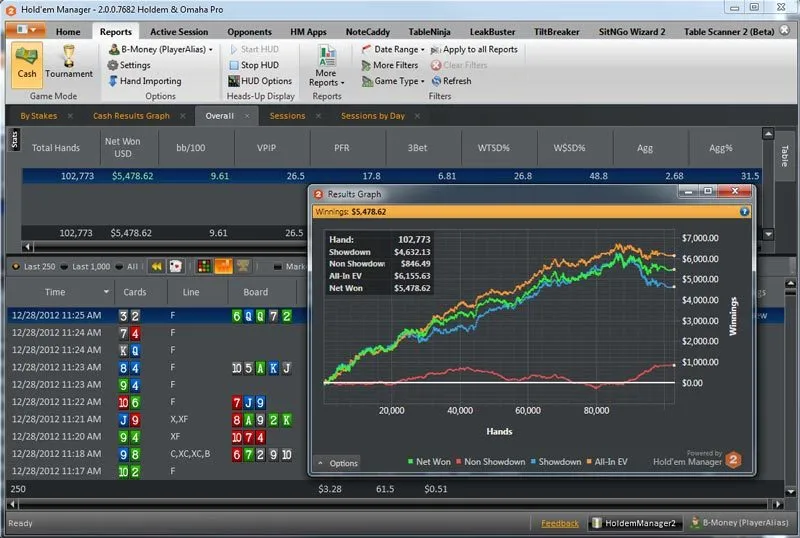
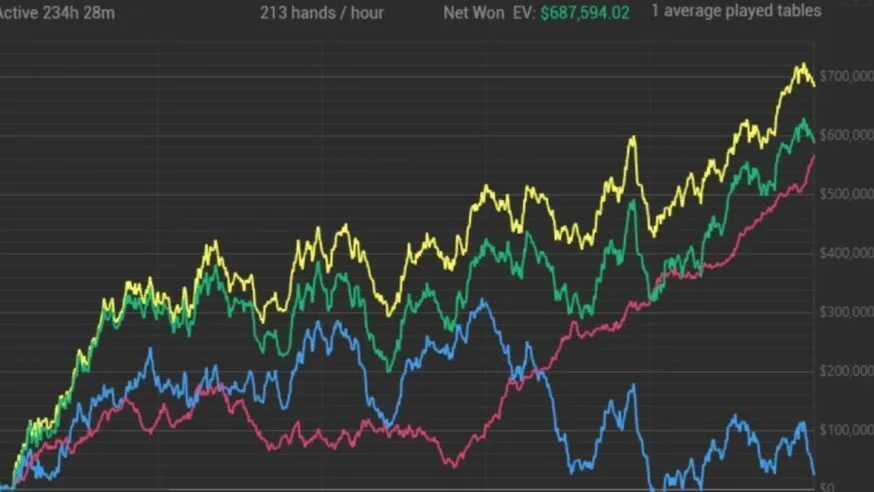
You can also fix your leaks and find the most effective bluffs if you study your database with the focus on the pool you play against, you can read about it here.