October 16, 2026 — GGPoker has announced a sweeping ban on all third-party poker software and automation tools following the Jurojin security scandal, marking one of the most significant changes to the online poker room’s security policies in recent years.
The decision, officially announced on October 15, comes after revelations that malicious actors exploited compromised third-party poker software to gain remote access to players’ computers, potentially exposing their hole cards during high-stakes games.
Under the new GGPoker third-party software ban, popular applications such as Jurojin, PokerTracker 4, Hand2Note, Holdem Manager 3, and several other poker tools are no longer permitted to run alongside the GGPoker client. The restrictions extend beyond traditional tracking software to include table-management applications, hotkeys, and automation utilities previously tolerated by the operator.
However, the decision also raises questions about how professional players will adapt, whether the restrictions go too far, and what the future holds for third-party poker software across the wider online poker industry.
GGPoker Announces Complete Ban on Third-Party Poker Software
GGPoker confirmed the new restrictions in an official security announcement published on October 15, 2026, outlining a series of changes intended to strengthen player protection and reduce the risk of another large-scale cheating scandal.
Previously, the poker room had allowed certain third-party applications that did not directly influence gameplay decisions or provide players with an unfair competitive advantage. Programs designed to organize multiple tables, improve navigation, or simplify routine actions could operate within specific restrictions.
That distinction has now effectively disappeared.
GGPoker’s latest policy prohibits all third-party poker software and automation tools while its client is running, regardless of whether those applications are designed to assist strategic decision-making or merely improve the playing experience.
The company explained that third-party applications can interact with poker tables, access sensitive information, or automate computer actions in ways that the operator cannot fully monitor.
Every additional application therefore represents another potential entry point for attackers seeking unauthorized access to player information.
The new restrictions are particularly notable because they affect tools that have become standard parts of the online poker environment for many serious grinders. While restrictions on heads-up displays, real-time assistance, and automated decision-making have existed for years, the latest announcement takes a much broader approach.
Players are now instructed to completely close prohibited poker applications before launching GGPoker, even when those programs are not actively being used at a GGPoker table.
Importantly, the announcement does not mean that every ordinary third-party application installed on a computer is banned. The restrictions specifically target poker-related software and automation tools, although the full scope of enforcement will depend on GGPoker’s interpretation of its updated policy.
The operator presents the decision as a necessary response to a security threat that exposed vulnerabilities beyond the poker client itself.
For players accustomed to customized multitabling setups, however, the change could require a significant adjustment to their daily playing routines.
Jurojin Scandal Exposes Serious Security Vulnerabilities in Online Poker
The catalyst for GGPoker’s latest security measures was the Jurojin poker scandal, which emerged publicly in late September 2026 and quickly became one of the most concerning online poker security stories of the year.
Jurojin is a popular third-party poker utility designed to help players manage multiple tables, configure hotkeys, organize their screens, and streamline their online poker sessions.
Unlike traditional poker tracking software, its primary purpose is not necessarily to provide detailed opponent statistics. Instead, it offers productivity features that allow players to navigate complex multitabling environments more efficiently.
However, investigators discovered that attackers had exploited compromised software updates to distribute malicious remote-access tools to selected users.
According to Jurojin’s updated security notice, an attacker intermittently replaced legitimate update packages delivered to a targeted group of users between June 2025 and January 2026. Some of the tampered packages contained software capable of providing unauthorized remote access to infected computers.
The security incident also involved IntuitiveTables, another poker utility, and was linked to phishing websites impersonating legitimate poker services.
The attack was particularly dangerous because it did not require the attacker to compromise the poker room’s central servers or manipulate the game’s random number generator.
Instead, the malicious software could allow an attacker to observe a victim’s computer screen remotely.
In online poker, where players rely on their opponents being unable to see their private hole cards, such access creates an enormous competitive advantage.
Someone who can secretly view another player’s cards can make decisions with information that should never be available to them, creating what the poker community commonly describes as a superuser situation.
The scandal was brought to public attention through the work of cybersecurity researcher known online as Wolf, or @wolfsec0x0, alongside investigations involving affected high-stakes players.
Early reporting identified approximately 30 potentially affected players, although the full extent of the incident remains uncertain. Jurojin has since emphasized that receiving a compromised update did not necessarily mean a player’s computer was infected or that they suffered financial losses.
The company said only a smaller number of high-stakes players were believed to have experienced actual in-game harm.
Among those who publicly discussed potential losses was high-stakes player Ignacio Moron, who reportedly believes he lost at least $100,000 as a result of the cheating operation. That figure remains a player’s estimate rather than a fully verified total of losses.
Jurojin publicly apologized, strengthened its internal security controls, and cooperated with investigators and poker operators.
Nevertheless, the incident demonstrated how software intended to make online poker more convenient could be exploited to compromise the integrity of the games themselves.
For GGPoker, that revelation appears to have been the decisive factor behind its decision to eliminate the risks associated with third-party poker applications.
Which Third-Party Poker Tools Are Now Banned on GGPoker?
One of the most immediate consequences of the GGPoker software ban is its impact on several widely used applications within the poker community.
GGPoker’s official announcement specifically names Jurojin, PokerTracker 4, Hand2Note, Holdem Manager 3, StarsCaption, DriveHUD 2, Intuitive Tables, Lobbyze, Equilab, and AutoHotkey among the prohibited programs.
The list is not exhaustive, meaning additional third-party poker utilities may also fall under the restrictions even if they are not explicitly named.
The inclusion of Jurojin and Intuitive Tables is unsurprising given their connection to the recent security incident.
However, the prohibition of other programs has attracted attention because many serve different purposes and were not publicly identified as compromised in the Jurojin attack.
PokerTracker 4, Holdem Manager 3, and Hand2Note are primarily associated with hand-history analysis, performance tracking, and poker statistics. Players frequently use such software to study their results, identify leaks, and analyze opponents.
Although GGPoker already imposed substantial restrictions on external HUDs and tracking software, the latest policy reinforces its position that these applications should not operate while the GGPoker client is open.
The inclusion of Equilab, a poker equity calculation and study tool, further illustrates the breadth of the restrictions.
Similarly, AutoHotkey is a general-purpose automation utility that some poker players use to create customized keyboard shortcuts and manage repetitive actions.
By including these applications, GGPoker is moving away from assessing only whether a particular program offers an unfair advantage during a hand.
Instead, the operator is treating external poker software as a wider security concern.
This distinction matters particularly for professional players who regularly compete across multiple poker rooms simultaneously.
A player who uses PokerTracker or another utility while playing on a different platform may need to close that program entirely before opening GGPoker, rather than simply disabling its features for GGPoker tables.
The official instruction focuses on applications running alongside the client. It does not establish that players must permanently uninstall every named application or abandon legitimate off-table poker study altogether.
Nevertheless, players will need to reconsider how they organize their software, especially when combining several poker rooms within the same session.
Until additional enforcement guidance is published, avoiding concurrent use of the named applications remains the clearest way to comply with the announced restrictions.
GGPoker Introduces New Security Features and Cheating Detection Technology
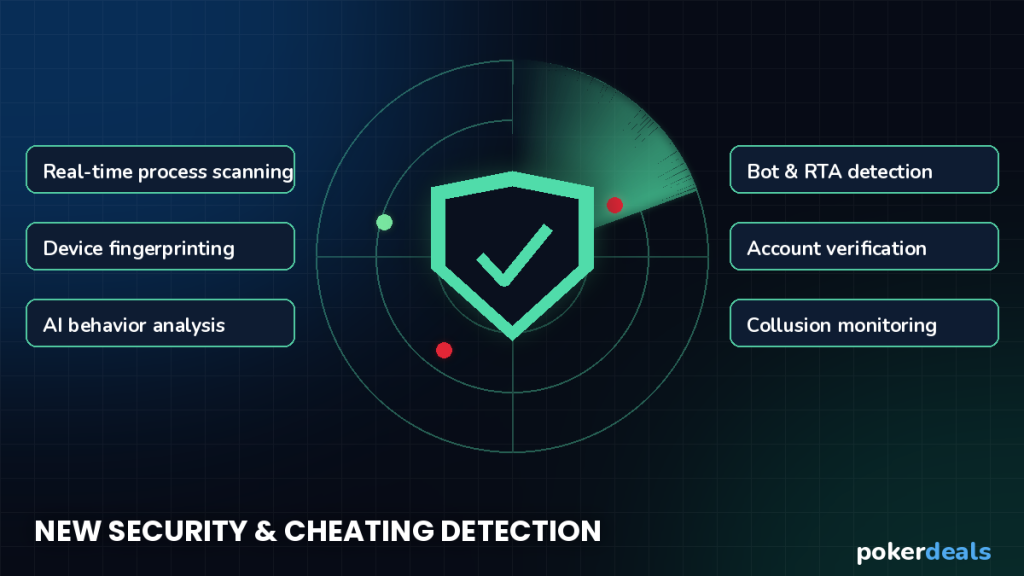
The third-party software ban is only one component of GGPoker’s broader response to the Jurojin scandal.
Alongside the updated policy, GGPoker has introduced additional client security functionality designed to protect sensitive player information and identify suspicious activity.
Among the most significant additions is Screen Guard, a feature intended to prevent GGPoker tables from being visible through screenshots, screen recordings, remote-viewing software, and screen-sharing applications.
This directly addresses the type of vulnerability exploited during the recent cheating operation.
If attackers obtain remote access to a player’s computer, Screen Guard is designed to prevent them from viewing the player’s tables and private cards through supported capture methods.
Players can also choose to extend the protection to other parts of the client, including the lobby, cashier, and account-related screens.
GGPoker has additionally introduced Connection Monitor, which alerts users to potentially suspicious network connections, and DNS Check, which looks for indications that a computer’s network settings may have been manipulated.
An Allowed Processes feature also gives players control over applications they trust, allowing them to prevent unnecessary security alerts.
The operator states that these client security functions are optional and operate only while GGPoker is open.
Beyond protecting the client, the company has introduced a new game integrity monitoring method described as Abnormally High Win-Rate detection, or WAD.
This system examines poker decisions in relation to opponents’ actual hole cards, looking for players whose decisions are correct with an unusually high frequency.
The theory is straightforward: a player secretly viewing an opponent’s cards may make strategically accurate calls, folds, and bluffs at a rate that would be extraordinarily difficult to explain through legitimate poker skill alone.
GGPoker says the new methodology has already helped identify historical cases and could improve its ability to detect unusual forms of cheating.
However, statistical detection systems must also account for variance, sample size, and legitimate differences in player strategy. Unusual results may justify further investigation without necessarily proving wrongdoing.
The announcement also includes plans to discontinue support for several outdated operating systems in 2027, including Windows 7, Windows 8, Windows 8.1, and macOS 11 or earlier.
Together, these changes suggest GGPoker is pursuing a wider security overhaul rather than relying solely on banning external applications.
Poker Community Reacts to GGPoker’s Tougher Security Restrictions
While protecting players from cheating is an objective shared across the online poker community, GGPoker’s new policy has generated debate over whether a blanket restriction on third-party poker software is the most effective solution.
For supporters of the decision, the Jurojin scandal demonstrates that even applications developed for legitimate purposes can become significant security liabilities.
A poker utility does not need to provide real-time strategic advice to expose confidential information. If attackers can compromise its update process or gain access to a user’s screen, the consequences can be severe.
From this perspective, removing unnecessary third-party software from the playing environment reduces the number of potential vulnerabilities and makes game integrity easier to manage.
The opposite argument focuses on the distinction between compromised applications and software that has not been linked to the attack.
Some players question whether banning widely used study and productivity programs is proportionate when the documented incident involved a targeted compromise of particular software distribution systems.
Critics also point out that external tracking applications can play a role in identifying suspicious behavior.
Hand histories and statistical analysis have historically helped poker players recognize unusual patterns, investigate questionable results, and raise concerns with poker operators.
Restricting these tools could consequently increase players’ dependence on poker rooms to detect and investigate cheating internally.
The announcement represents a fundamental change in GGPoker’s approach to game integrity, prioritizing the security of its poker ecosystem over the convenience offered by external applications.

If you are looking for a site to play poker and want a good rakeback deal, you should check out Champion Poker, as it offers flat rakeback of up to 30%.
Discussions on Reddit following the announcement reflect both sides of the debate, with some players welcoming stronger security controls and others questioning the loss of independent analytical tools.
A further issue concerns privacy and control over players’ computers.
Although GGPoker’s newly announced client security features are optional, the broader question of how poker operators monitor prohibited software remains important.
Players want confidence that security measures can identify genuinely dangerous applications without unnecessarily interfering with unrelated computer activity.
For professional grinders, there is also the practical question of whether GGPoker’s built-in features can adequately replace the convenience provided by specialized third-party tools.
The company already offers integrated functions such as PokerCraft and its own Smart HUD, giving players access to certain analytical and statistical information within the GGPoker environment.
However, those features are not necessarily direct substitutes for the customized workflows and extensive analysis capabilities developed through years of using dedicated poker software.
The key challenge for GGPoker will be demonstrating that the security benefits justify these limitations while maintaining sufficient transparency around how its new rules are enforced.
What the GGPoker Third-Party Software Ban Means for the Future of Online Poker
GGPoker’s decision could have implications extending far beyond a single poker room.
For years, third-party applications have played an important role in the development of online poker, particularly among experienced players who rely on tracking tools, detailed hand analysis, and multitabling software.
At the same time, the industry has faced continuing concerns over bots, real-time assistance, collusion, data mining, and other forms of technology-assisted cheating.
The Jurojin scandal introduces another dimension to that discussion.
It demonstrates that threats to online poker integrity do not necessarily originate inside the poker platform or from software specifically designed to cheat.
They can also emerge through compromised applications that players install voluntarily and trust to operate on their computers.
GGPoker’s response may encourage other poker operators to review their own policies governing external applications, although there is currently no guarantee that competing platforms will adopt similarly broad restrictions.
Third-party software developers may also face greater pressure to demonstrate the security of their products, particularly when those products require access to sensitive on-screen information or can update automatically.
The financial consequences of the Jurojin incident remain another important unresolved issue.
In its October 15 announcement, GGPoker stated that it had traced funds associated with the incident to a cryptocurrency wallet and shared its findings with Coinbase, where the operator believes the funds were deposited.
GGPoker said it had requested restrictions on the associated account, reported the wallet information to relevant industry networks, and contacted law enforcement.
These actions represent an attempt to pursue the financial trail behind the alleged cheating, but they do not, by themselves, establish that every affected player has been identified or that all losses have been recovered.
Further clarity on financial restitution, investigations, and enforcement would be important for rebuilding player confidence.
Ultimately, the GGPoker ban on third-party poker tools represents a notable shift in how one of online poker’s leading operators approaches security.
Rather than continuing to distinguish between acceptable productivity tools and prohibited strategic assistance, the company has adopted a much more restrictive policy toward external poker applications running alongside its client.
Whether that decision becomes an industry standard will depend on its effectiveness, player reaction, and how competing poker rooms respond to similar cybersecurity risks.
For now, the immediate message to GGPoker players is clear: external poker software that once formed part of a normal online grinding setup may no longer be compatible with the room’s rules.
And following the Jurojin scandal, the broader debate over online poker security has moved beyond who can access player statistics to a more fundamental question: who can be trusted with access to the players’ computers themselves?
If you want to know how live casinos are increasing the leave of security you can read our article about how Las Vegas casinos are changing the way they deal cards, click here.