
When we play poker, we want to make money, and money often comes from our opponents’ mistakes. The bigger the mistake, the bigger our opportunity to exploit it and to realize our equity, make money.
The key to recognizing mistakes and avoiding making mistakes is to learn as much as we can about the theory of poker, but let’s break down the types of mistakes and how they affect our income in poker.
There are two main types of mistakes: fundamental mistakes and frequency mistakes. The difference is that fundamental mistakes will always lose you money one way or the other, and frequency mistakes will only lose you money if other players realize you are doing something too little or too much (folding, calling, raising).
Fundamental Mistakes
When we discuss fundamental mistakes, we are referring to opening the wrong ranges, which are often too wide for the position we are in. This will automatically burn us money, as our hands will be too weak to defend properly against 3-bets, and to put pressure on our opponents, who will have stronger hands.
Another fundamental mistake is when we don’t recognize the relative strength of our hand postflop, for example, if we flopped a set and by the river board drew to four to flush. Our hand went from a disguised strong hand to just a bad bluffcatcher, meaning we can’t bet for value, as that would be a fundamental mistake that would directly cost us money.
We can also make a fundamental mistake when we use the wrong sizing. There are outcomes where we should just be block betting and folding against shoves on the river, as our opponent just won’t have enough or any bluffs at all. But we decided to go all-in or bet big because we are just looking at our hand and not thinking about ranges and how they change on each street.
Frequency Mistakes
Frequency mistakes will lose us money only if our opponents recognize we are making them and start exploiting our wrong frequencies.
If we are calling too much, they should just stop bluffing completely and just value bet against us.
If we are bluffing too much, they should just start calling more. If we are not bluffing enough, they should just start folding more.
If we are folding too much, they should just adjust to start bluffing a lot.
There are primary ways to exploit players who are making frequency mistakes. To recognize if our opponent is making frequency mistakes, we will need to have a HUD or some way of PRECISLEY tracking it (we can’t do it in our head, as we need to have a big sample, and we need to remove biases from our decision making).
Frequency mistakes are much more common, and much harder to detect for the one exploiting and for one being exploited, as the principle of exploitation works in both ways. You can’t exploit without leaving a window to be exploited. The question is, if our opponents see the window.
Poker Mindsets/Styles
There are also two types of poker player mindsets/play-styles that approach the game and mistakes differently. Let’s start with the blue line players.
Blue line players are more focused on playing balanced, meaning trying not to make frequency mistakes, so they are not exploiting or opening a window for other players to exploit them.
They are called blue line players as the blue line in the graph shows winnings won at showdown. These kinds of players will mostly sacrifice their red line (non-showdown winnings), and most of the winnings will come through value betting and calling with strong hands.
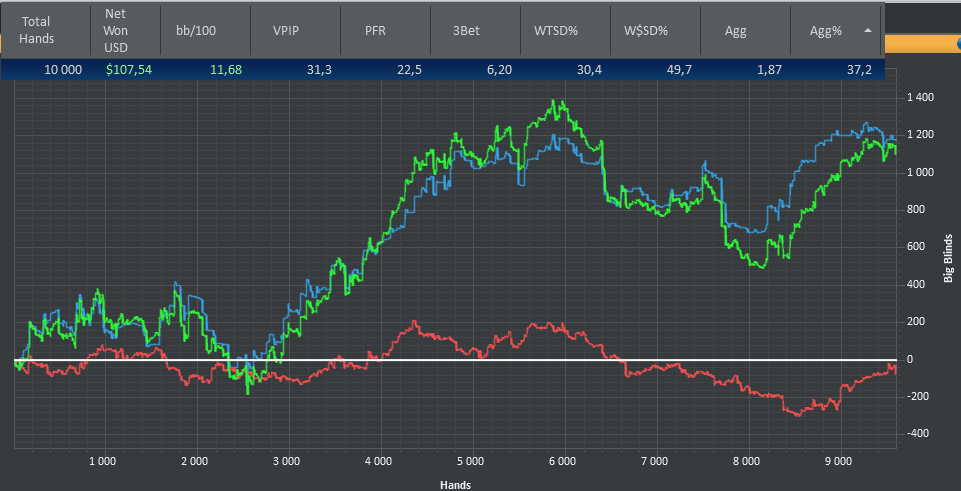
On the other hand, red line players are focused on exploiting and seeking imbalances/frequency mistakes where they can put pressure and get as many folds from their opponents as they can. They often sacrifice the blue line for the sake of the red line (turning showdown value into bluffs, more double and triple barreling, more check raising, more aggression on the river, etc.)
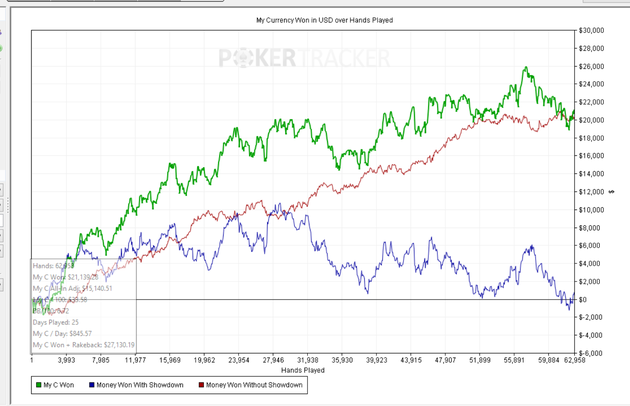
Most players play blue line style, and red line players are a rare occurrence at the poker table. It’s important to mention that both styles have the main focus of not making fundamental mistakes.
The difference in mindset between the two styles could easily be explained on a river decision where the blue line player will think about what frequency he should balance his bet/check range, and the red line player will think about how to unbalance his range and extract the most money from his opponent, in which way is my opponent unbalanced?
If you want to reduce the number of mistakes you make in poker, you can read our article about the difference between amateur and professional poker players.