Poker is a game of incomplete information, calculated risk, and repeated decision-making. Yet many players judge themselves almost entirely by short-term results. They feel confident after winning a large pot, frustrated after a bad beat, and tempted to change their strategy whenever the cards stop cooperating.
This emotional response is understandable, but it is also dangerous.
Strong poker decision making requires players to separate the quality of a decision from the outcome of a single hand. A mathematically correct play can lose. A reckless play can win. Neither result changes whether the original decision was profitable.
The central skill in poker is therefore not predicting every card or avoiding every loss. It is consistently making decisions with positive expected value and allowing those decisions to compound over hundreds, thousands, and eventually millions of hands.
This article explains how to separate emotion from mathematics, evaluate decisions objectively, manage variance, and build a poker mindset focused on long-term profitability.
What Is Poker Decision Making?
Poker decision making is the process of selecting the most profitable available action based on the information available at the time.
Depending on the situation, that action may be:
- Folding
- Calling
- Checking
- Betting
- Raising
- Going all-in
A good decision considers factors such as position, stack depth, pot size, bet sizing, opponent tendencies, ranges, equity, fold equity, and expected value.
The important phrase is “information available at the time.”
Players often evaluate decisions with information they learned afterward. They see an opponent’s hand at showdown and conclude that they should have played differently. This is known as results-oriented thinking.
For example, suppose you correctly call an all-in with a hand that has 70% equity. You are a clear mathematical favorite, but your opponent wins after hitting one of their outs.
The result does not mean the call was wrong. It means the lower-probability outcome occurred.
Good poker decision making is not measured by whether you won the hand. It is measured by whether your decision produced the highest expected value against your opponent’s likely range.
The Difference Between a Good Decision and a Good Result
Poker creates a constant conflict between decision quality and immediate results.
A good result happens when you win chips or money.
A good decision happens when you choose the action that is expected to produce the greatest long-term return.
These two things frequently overlap, but not always.
Imagine a player calls a large river bet with a weak hand because they “have a feeling” the opponent is bluffing. The opponent happens to be bluffing, and the call wins a large pot.
The player may feel brilliant, but the decision could still be poor. If the opponent’s range contains value hands far more often than bluffs, the call loses money over time.
Now consider the opposite scenario. A player gets all-in preflop with pocket aces against pocket kings and loses when a king appears on the board.
The player lost the hand, but the decision was excellent. Getting all-in with the strongest starting hand against a dominated range is highly profitable.
This distinction is fundamental. Poker players who confuse outcomes with decisions become strategically unstable. They repeat bad plays that happened to work and abandon strong plays that happened to fail.
The goal is not to be rewarded immediately. The goal is to make decisions that would remain profitable if the same situation occurred repeatedly.
Why Emotion Interferes With Poker Math
Poker is emotionally intense because it combines money, uncertainty, competition, and imperfect control.
Players can make every reasonable decision correctly and still lose. This lack of short-term control creates frustration, anger, fear, overconfidence, and self-doubt.
Emotion becomes harmful when it alters strategic judgment.
Common examples include:
- Calling too widely because you feel an opponent is targeting you
- Bluffing unnecessarily to recover a recent loss
- Refusing to fold because you are emotionally attached to a strong starting hand
- Playing too cautiously after losing a large pot
- Increasing stakes to win money back quickly
- Avoiding thin value bets because you fear being raised
- Continuing a session despite obvious mental fatigue
These decisions are not based on pot odds, ranges, or expected value. They are attempts to reduce emotional discomfort.
That is one of the most important insights in poker psychology: many poor plays are not attempts to maximize profit. They are attempts to escape an unpleasant feeling.
A frustrated player may make an aggressive bluff because folding feels weak. A fearful player may check back a profitable value bet because losing another pot feels unbearable. A tilted player may call an all-in because accepting a loss feels worse than risking more money.
The math has not changed. The player’s emotional state has changed.
Expected Value: The Foundation of Good Poker Decisions
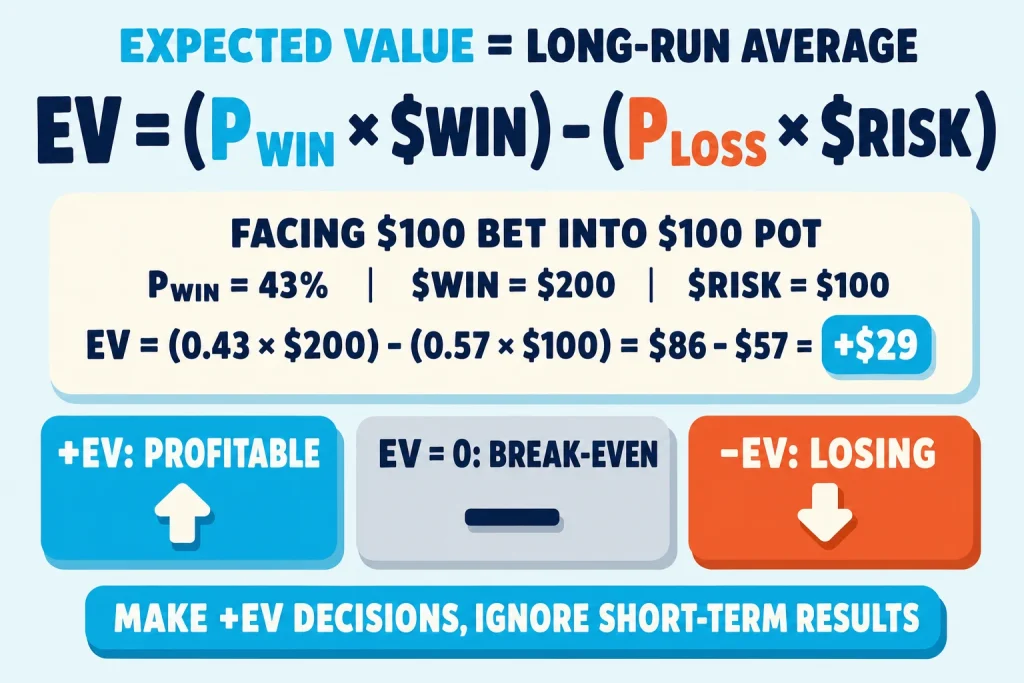
Expected value, usually abbreviated as EV, measures the average amount a decision is expected to win or lose over time.
A positive expected value decision is called +EV.
A negative expected value decision is called -EV.
Suppose you are considering a $100 call. Based on your analysis, you believe you will win the final pot 40% of the time. If winning produces a $200 profit and losing costs the $100 call, the decision can be evaluated mathematically.
Over repeated trials:
- You win $200 forty percent of the time
- You lose $100 sixty percent of the time
The expected value is:
EV = (0.40 × $200) – (0.60 × $100)
EV = $80 – $60
EV = $20
The call has an expected value of positive $20.
That does not mean you will earn exactly $20 every time you call. In one instance, you will either win or lose. The $20 represents the average long-term value of making the same decision repeatedly under similar conditions.
This is where emotional discipline becomes essential. You must be willing to lose the current hand while trusting that a profitable decision will produce gains across a meaningful sample.
Variance Does Not Mean the Math Is Wrong
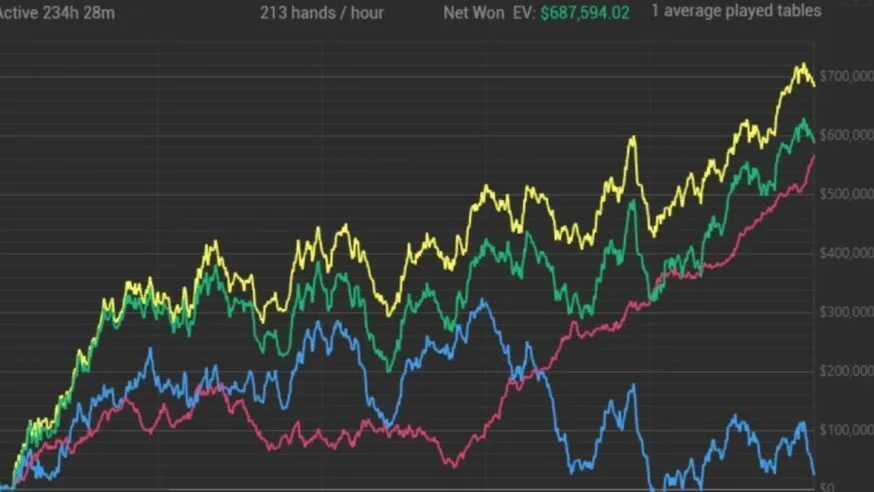
Variance describes the natural fluctuation between expected outcomes and actual short-term results.
Even when you are a favorite, you will sometimes lose. Even when you make several profitable decisions in a row, you may experience a losing session, week, or month.
Players often understand variance intellectually but struggle to accept it emotionally.
They know pocket aces can lose, but they still become furious when it happens. They know strong draws will sometimes miss, but they still feel personally punished by the deck. They understand that downswings are inevitable, yet begin questioning their entire strategy after a few bad sessions.
The solution is not to ignore results completely. Results matter over sufficiently large samples. The solution is to avoid drawing major conclusions from small samples.
A single hand tells you almost nothing about your ability.

A single session tells you very little.
Even several thousand hands may contain substantial noise, depending on the game format and your win rate.
Variance is especially severe in tournaments, where large fields, escalating blinds, and top-heavy payouts create dramatic swings. A highly skilled tournament player can go through long stretches without a major score.
Cash games usually provide more consistent opportunities, but short-term results can still be volatile.
Accepting variance means recognizing that correct decisions do not guarantee immediate rewards. They only improve the probability of long-term success.
How Good Decisions Compound Over Time
The real power of disciplined poker decision making appears through repetition.
A small edge may seem unimportant in one hand. Over thousands of similar decisions, however, that edge becomes financially meaningful.
Suppose one player makes an average mistake worth $5 every 100 hands. Another player avoids that mistake.
After 1,000 hands, the difference is approximately $50.
After 10,000 hands, it becomes approximately $500.
After 100,000 hands, it becomes approximately $5,000.
The gap grows even if the mistake feels minor in the moment.
Poker profitability is rarely built from one spectacular decision. It is built from thousands of ordinary decisions made slightly better than those of your opponents.
These decisions include folding a marginal hand from an unprofitable position, selecting a better bet size, value betting more accurately, avoiding an emotional bluff, quitting when mentally compromised, and choosing games with weaker competition.
Every disciplined decision protects or adds a small amount of expected value.
Over time, these decisions compound.
Poor decisions compound too. A player who repeatedly makes emotional calls, chases losses, ignores bankroll limits, or plays while tilted may lose far more from these habits than from any advanced technical weakness.
Long-term success therefore depends less on playing one hand perfectly and more on creating a reliable process that produces good decisions consistently.
If you are looking for a site to play poker and want a good rakeback deal, you should check out Champion Poker, as it offers flat rakeback of up to 30%.
Stop Trying to Win Every Pot
One of the most damaging emotional beliefs in poker is the idea that winning players should constantly win pots.
In reality, folding is a core part of profitable poker.
You will often invest chips before the flop and later fold.
You will sometimes make a continuation bet and give up when called.
You will occasionally fold strong hands because the opponent’s range, action, and sizing indicate that continuing is unprofitable.
A fold can feel like surrender, especially against an aggressive opponent. Emotion may tell you that you are being exploited, bullied, or embarrassed.
Math asks a different question: does continuing have positive expected value?
If the answer is no, folding is not weakness. It is capital preservation.
Professional decision-making requires indifference to appearances. You do not need to prove that you cannot be bluffed. You do not need to defend every blind. You do not need to punish every aggressive opponent immediately.
You need to make the most profitable decision available.
Sometimes that decision is to fold and wait for a better opportunity.
Use Ranges Instead of Emotional Narratives
Weak poker decisions are often built around stories.
“He always has it.”
“He is trying to push me around.”
“She would never bluff here.”
“I know he is frustrated.”
These statements may contain useful observations, but they become dangerous when treated as certainty.
Strong players think in ranges.
A range is the collection of hands an opponent could reasonably hold based on their actions. Instead of deciding that an opponent has one exact hand, you estimate how often their range contains strong value hands, medium-strength hands, draws, and bluffs.

Range thinking reduces emotional bias because it forces you to work with probabilities.
For example, rather than saying, “He is definitely bluffing,” you might ask:
- Which missed draws could he have?
- Which value hands would use this bet size?
- Does he bluff often enough for my call to be profitable?
- What hands reach the river after taking this line?
- Does my hand block value or bluff combinations?
These questions are analytical rather than personal.
The opponent is no longer “attacking you.” They are representing a range, and your task is to respond with the highest-EV action.
Create a Decision Process Before You Act
Emotional mistakes often happen quickly. A player feels anger, fear, or urgency and acts before fully analyzing the situation.
A structured decision process helps interrupt that reaction.
Before making a significant decision, consider the following sequence.
First, identify the pot size and effective stack.
Second, review the action from earlier streets.
Third, estimate the opponent’s range.
Fourth, compare your hand or range against that range.
Fifth, consider your available options and likely responses.
Sixth, evaluate bet sizing, pot odds, fold equity, and expected value.
Seventh, make the decision without attaching your identity to the outcome.
This process does not need to take several minutes. With experience, it can happen quickly. The value comes from directing attention toward relevant information rather than emotional impulses.
A practical mental prompt is: “What decision would I make if I could not see the outcome?”
That question removes the desire to be proven right and brings the focus back to strategy.
Recognize the Early Signs of Tilt
Tilt is not limited to obvious anger. It can appear as impatience, fear, passivity, excessive confidence, revenge-seeking, or mental exhaustion.
Common warning signs include:
- Playing more hands than usual
- Making unusually fast decisions
- Fixating on one opponent
- Checking results repeatedly
- Moving up in stakes impulsively
- Ignoring table selection
- Feeling desperate to finish the session ahead
- Making plays you cannot explain logically
- Continuing because you want to recover losses
- Feeling personally insulted by normal poker action
The earlier you recognize tilt, the easier it is to control.
Once severe tilt takes over, technical knowledge becomes much harder to access. You may know the correct strategy but lack the emotional capacity to follow it.
A strong player does not wait until they are completely out of control. They respond to the first signs of deteriorating decision quality.
That response may involve taking a short break, ending the session, reducing the number of tables, stepping down in stakes, or reviewing the emotional trigger.
Quitting a bad mental session is not failure. It is a profitable decision.
Separate Session Goals From Financial Results
Many players begin a session with the goal of winning money. That goal sounds logical, but it creates a problem: you cannot fully control short-term profit.
You can control your preparation, focus, game selection, decision process, and emotional discipline. You cannot control the cards.
A better approach is to set process-based goals.
Examples include:
- Take enough time on major decisions
- Avoid checking session results during play
- Mark difficult hands for later review
- Follow predetermined bankroll limits
- Leave the table if tilt reaches a defined level
- Focus on ranges rather than individual hands
- Maintain consistent bet-sizing logic
- Avoid playing when tired or distracted
These goals are measurable and controllable.
A losing session can still be successful if you followed a strong process and made good decisions. A winning session can be strategically poor if you played recklessly and benefited from favorable cards.
This does not mean money is irrelevant. Profit is the long-term objective. However, short-term financial results are a poor tool for evaluating immediate performance.
Review Decisions Without Judging Yourself
Hand review is one of the best ways to improve poker decision making, but only when it is conducted objectively.
The purpose of review is not to prove that you played well or criticize yourself for losing. It is to understand whether your assumptions and actions were reasonable.
When reviewing a hand, remove the final result whenever possible.
Ask:
- What range did I assign my opponent?
- Was that range realistic?
- Did I consider stack depth and position?
- Did my bet size accomplish its purpose?
- Was my call supported by pot odds?
- Did I overestimate fold equity?
- Was emotion influencing my decision?
- What would a stronger alternative look like?
This approach turns mistakes into information.
Self-criticism often feels productive, but excessive judgment can reduce learning. A player who labels themselves stupid after every error becomes defensive and may avoid honest review.
Instead, treat each mistake as a technical or psychological leak.
The question is not, “What is wrong with me?”
The question is, “What process allowed this mistake, and how can I improve it?”
Bankroll Management Protects Decision Quality
Bankroll management is usually discussed as protection against ruin, but it also protects emotional stability.
When you play stakes that are too large for your bankroll, every pot feels more important. Normal variance becomes threatening. You may avoid profitable risks, chase losses, or make decisions based on financial fear.
Proper bankroll management creates psychological distance between one result and your overall financial security.
This makes it easier to fold, bluff, call, and value bet according to strategy rather than emotion.
The correct bankroll requirements depend on game type, stake level, win rate, variance, and personal circumstances. Tournament players generally require more buy-ins than cash-game players because tournament variance is higher.
Regardless of the exact number, the principle remains the same: you should be financially and emotionally prepared for normal downswings.
Playing under pressure makes mathematical discipline significantly harder.
Confidence Should Come From Process, Not Recent Results
Many poker players feel confident only when they are winning.
This creates fragile confidence.
A few successful sessions make them feel unbeatable. A downswing makes them question every decision.
Stable confidence comes from preparation and process.
You should trust yourself because you study, review hands, manage your bankroll, understand variance, and follow a rational decision framework.
This form of confidence survives short-term losses because it is not dependent on immediate validation.
It also prevents overconfidence during winning periods. A heater does not prove that every decision was correct. Strong players continue reviewing their game when results are positive because favorable variance can hide serious mistakes.
The goal is neither emotional pessimism nor blind optimism. It is accurate self-assessment.
Practical Ways to Separate Emotion From Math
Separating emotion from mathematics does not mean becoming emotionless. It means preventing emotion from controlling strategic choices.
Several habits can help.
Use a warm-up routine before playing. Review your strategic focus, current mental state, and reasons for ending the session.
Establish a stop-loss or mental stop rule. A financial stop-loss can be useful, but a mental threshold is even more important. Leave when your decision quality declines.
Avoid checking your bankroll or session profit constantly. Frequent checking encourages results-oriented thinking.
Take notes on emotional triggers. Identify whether bad beats, aggressive opponents, missed bluffs, or large pots create the strongest reactions.
Study away from the table. Technical confidence reduces uncertainty and makes emotional control easier.
Use breathing or brief pauses before large decisions. Even a few seconds can interrupt impulsive action.
Review your best folds, not only your biggest wins. This reinforces the idea that disciplined decisions matter more than dramatic results.
Track decision quality as well as profit. A journal can record focus, tilt level, mistakes, and successful adjustments.
These practices create a gap between feeling and action. That gap is where better poker decisions are made.
Long-Term Thinking Is a Competitive Advantage
Most players know that poker is a long-term game. Far fewer behave as though it is.
They still chase losses, overreact to downswings, change strategies after small samples, and judge every session by profit.
This creates an opportunity.
A player who genuinely thinks long term gains an advantage over opponents who are controlled by short-term emotion.
Long-term thinking allows you to accept folds, tolerate variance, study patiently, maintain bankroll discipline, and continue making profitable decisions during difficult stretches.
It also changes the meaning of failure.
A lost hand is not automatically a failure.
A losing session is not automatically a failure.
A temporary downswing is not automatically a failure.
The real failure is repeatedly abandoning sound decision-making because the short-term outcome is uncomfortable.
Final Thoughts on Poker Decision Making
Poker rewards disciplined decisions, but it does not always reward them immediately.
That delay is what makes the game psychologically difficult. Players must continue trusting probability, expected value, and strategic logic even when recent results appear to contradict them.
The strongest poker mindset separates process from outcome.
You can be happy with a decision that lost and disappointed with a decision that won. You can accept variance without becoming passive. You can acknowledge emotion without allowing it to determine your action.
Every hand is one small part of a much larger sample.
Your job is not to control the next card. Your job is to make the best decision possible with the information available.
Do that repeatedly, and the quality of your decisions begins to compound. Small edges accumulate. Avoided mistakes preserve capital. Emotional discipline creates consistency. Better choices produce better long-term results.
In poker, you do not need to win every hand, every pot, or every session.
You need to keep making good decisions long enough for the math to work.
If you want to know more about how poker prepares you for other segments of the life, you can read more about it here.