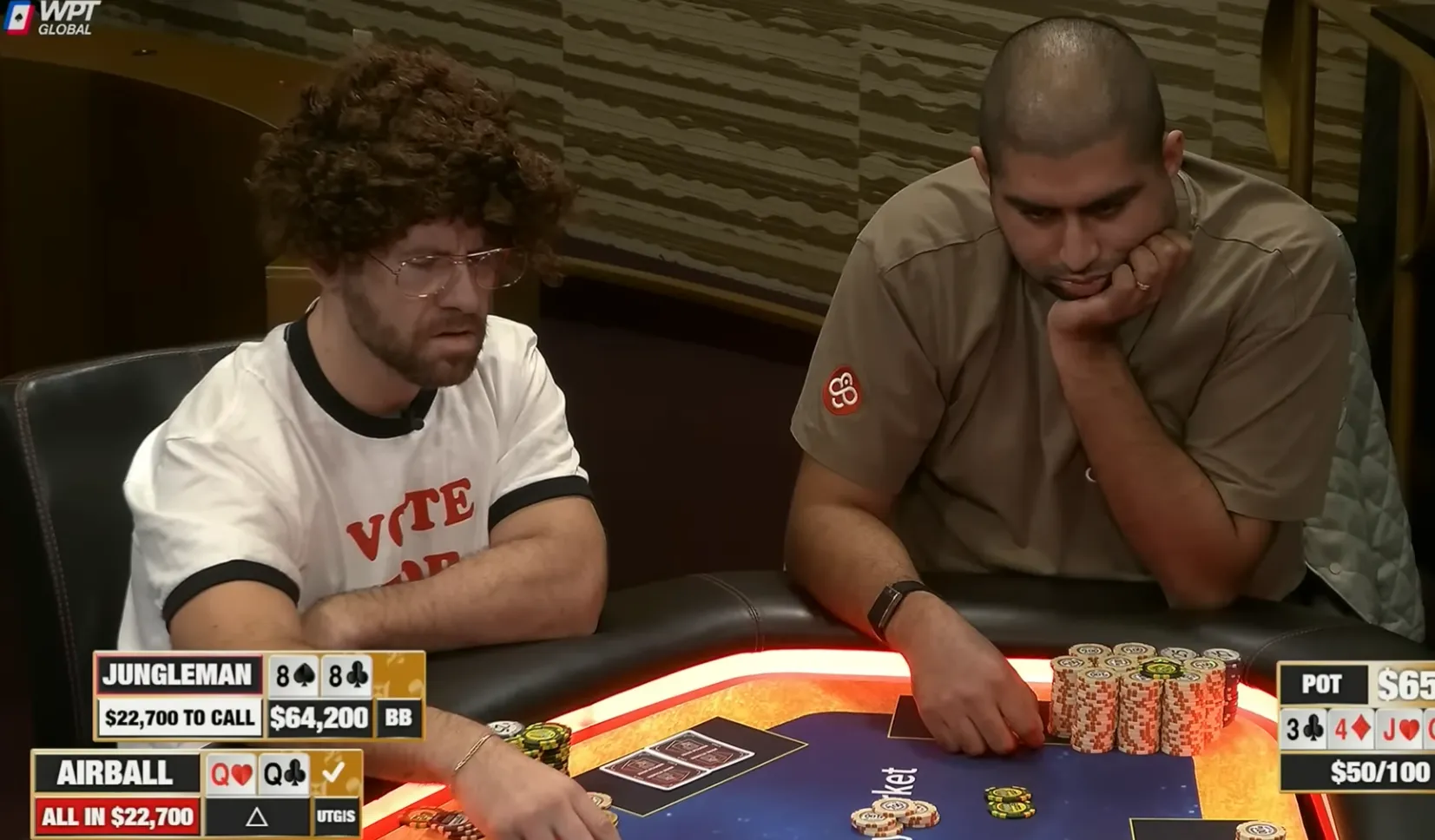
In this breakdown article, we will analyze a hand that took place on the Hustler Casino Live stream, where Jungleman ended up facing Nik Airball and made a correct decision on the river. But let’s see how the entire hand developed and whether it was played correctly throughout.
The game is $50/$100 No-Limit Hold’em, 7-max, with most players sitting around 400 big blinds deep.
Preflop
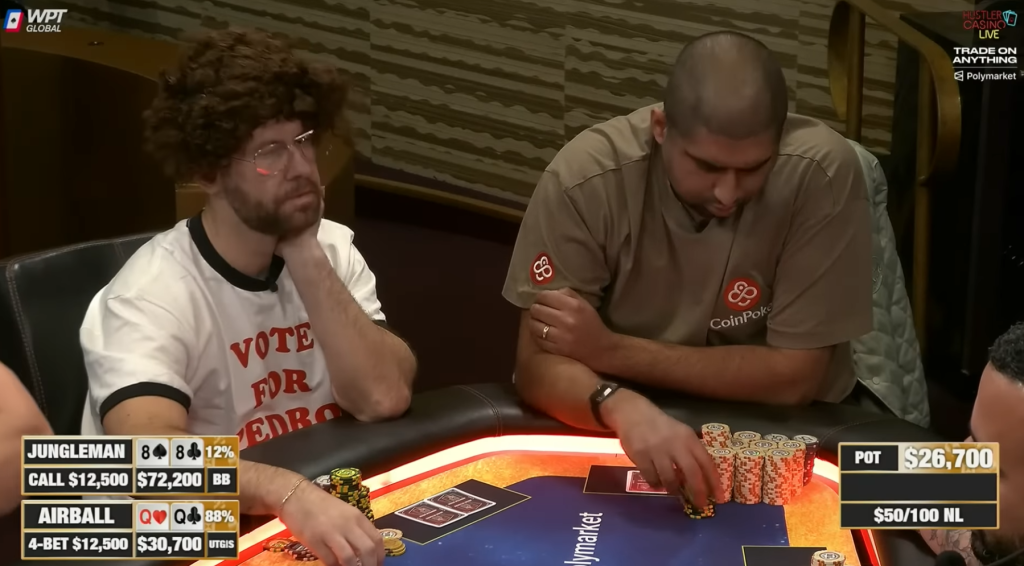
The hand started with two limpers. Mariano squeezed to $1,200, Jungleman 3-bet to $4,500 with 8♠8♣, Airball cold 4-bet to $12,500 with Q♥Q♣, and Jungleman was the only caller. The pot was $26,700 going into the flop.
Let’s start with the limps. Ohio David limped from the hijack with A♠5♠, and Señor Zen called on the cutoff with 9♠8♦ offsuit. I can understand why Ohio David would limp with the intention of calling a raise with A5s, both to avoid facing larger raises and potential 3-bets while playing this deep against a table that can sometimes get out of control. With A5s, seeing the flop for a cheap price might actually be a winning play at this table.
The 98o call from Señor Zen, however, is clearly very bad. His hand is simply too weak and invites other players to squeeze more aggressively, especially with extra dead money and capped ranges already in the pot.
Mariano recognizes this and immediately goes for a loose squeeze, as he wants to isolate the limpers and discourage players behind him from entering the hand. Unfortunately for him, Jungleman also plays very loose by 3-betting with pocket eights. He correctly recognizes that Mariano is squeezing because the limpers have capped ranges and that Mariano’s range itself may be weak. While I understand Jungleman’s reasoning, the play still feels very loose.
Airball then finds pocket queens and goes for a 4-bet, which I’m not sure is the correct decision when playing 400bb+ deep against such strong-looking prior action. In this case, however, Airball does have the best hand and forces everyone except Jungleman to fold.
Jungleman decides to call with pocket eights, which is questionable. Airball’s range should mainly consist of JJ (not always), QQ (not always), KK, AA, and AK (both suited and offsuit). JJ and QQ should sometimes—if not most of the time—be flatted instead. 🙂
I’m also not even sure Airball can have any bluffs in this exact line, as the action looks extremely strong. This is a 125bb call out of position by Jungleman.
The Flop
The flop comes 3♣4♦J♥, which is a relatively clean runout for Airball. While Jungleman can have pocket jacks that beat him, he can also have smaller pairs like 77–TT and A-high hands, meaning that most of the time Airball will be able to extract more value from Jungleman.
Airball goes for an $8,000 bet on the flop, which I think is good, as it aims to extract maximum value from Jungleman’s pocket pairs and also forces him to continue with hands like AQ, AQs, AK, and AKs.
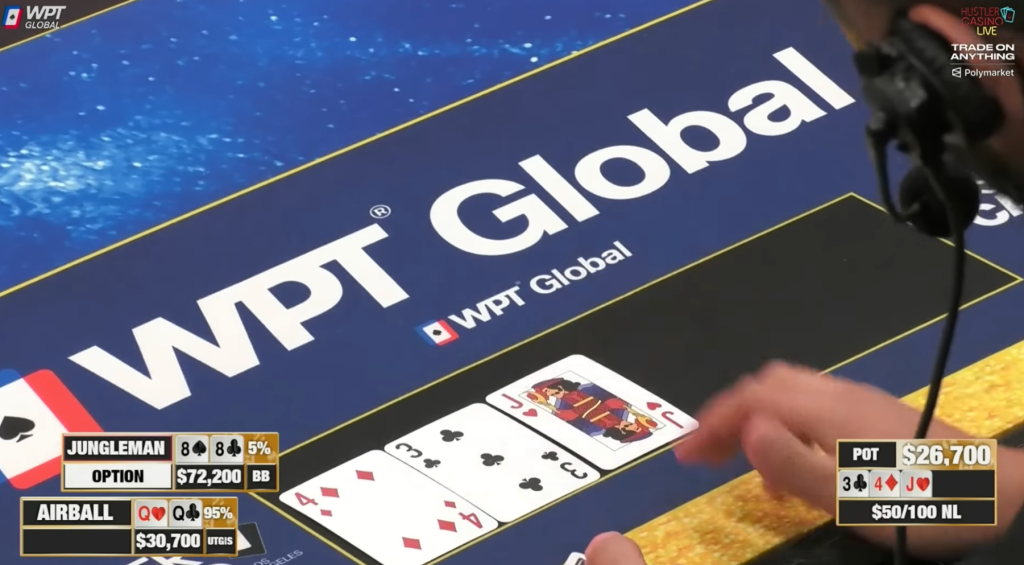
Jungleman is in a weird spot, as he already put a lot of money into the pot preflop, and it’s difficult for him to fold on the flop with second pair. As a result, he has to continue, and he calls. The pot is $42,700.
The Turn
The turn comes Q♦, and Jungleman is drawing dead. This card gives Airball more confidence, as he now beats the only hand that was previously ahead of him (JJ), allowing him to focus entirely on how to extract the most value from Jungleman. Both players check the turn, but I think Airball should have gone for a small bet to continue getting value from hands like AK, AKs, and TT, or to potentially induce an all-in from AQ, AQs, or even JJ.
Jungleman has shown no initiative in this hand and is clearly in check-call mode, so it’s less likely that he will bluff on the river. Because of that, slow-playing here doesn’t seem worthwhile.
The River
The river comes 2♥, which is a complete brick. The only hand Jungleman could have that beats Airball—though it’s very unlikely—is A5s. With such a great runout for Airball, he has no better sizing option than going all-in, as the shove is slightly more than 50 percent of the pot. Jungleman checks, Airball shoves, and after about 30 seconds, Jungleman makes the correct decision and folds.
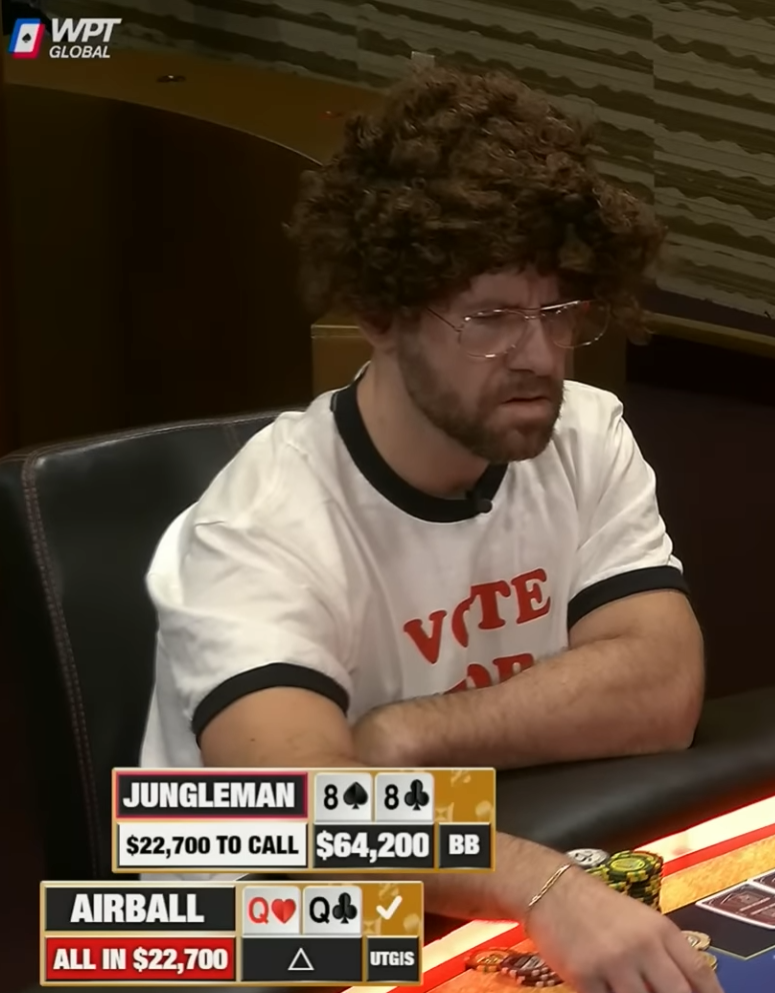
In this hand, we can see why calling against cold 4-bets—or even 3-bets—out of position with marginal hands can be very costly. If you don’t hit a set, you will often be priced in to call the flop bet, and most of the time the turn will not improve your situation, making it even harder to realize your equity.
When playing deep-stacked poker, pocket pairs increase in value because of their potential to hit a set and win a large pot. However, this should only be done in situations where you can see the flop relatively cheaply. In this hand, Jungleman had to pay 125 big blinds to see the flop and then another 80 big blinds to see the turn—only to be forced to fold on the river.
From a mathematical standpoint, this play simply doesn’t add up. You will hit a set on the flop only about 12 percent of the time, and if you miss, your chance of hitting a set on the turn drops to just 4.3 percent. Even when you do manage to hit a set, it’s still not guaranteed that you will win your opponent’s full stack.
If you are interested in learning from the mistakes of pro players, you can read this hand breakdown featuring Alan Keating, Martin Kabrhel, and Steve, where they play a $2M pot and make some very expensive mistakes.