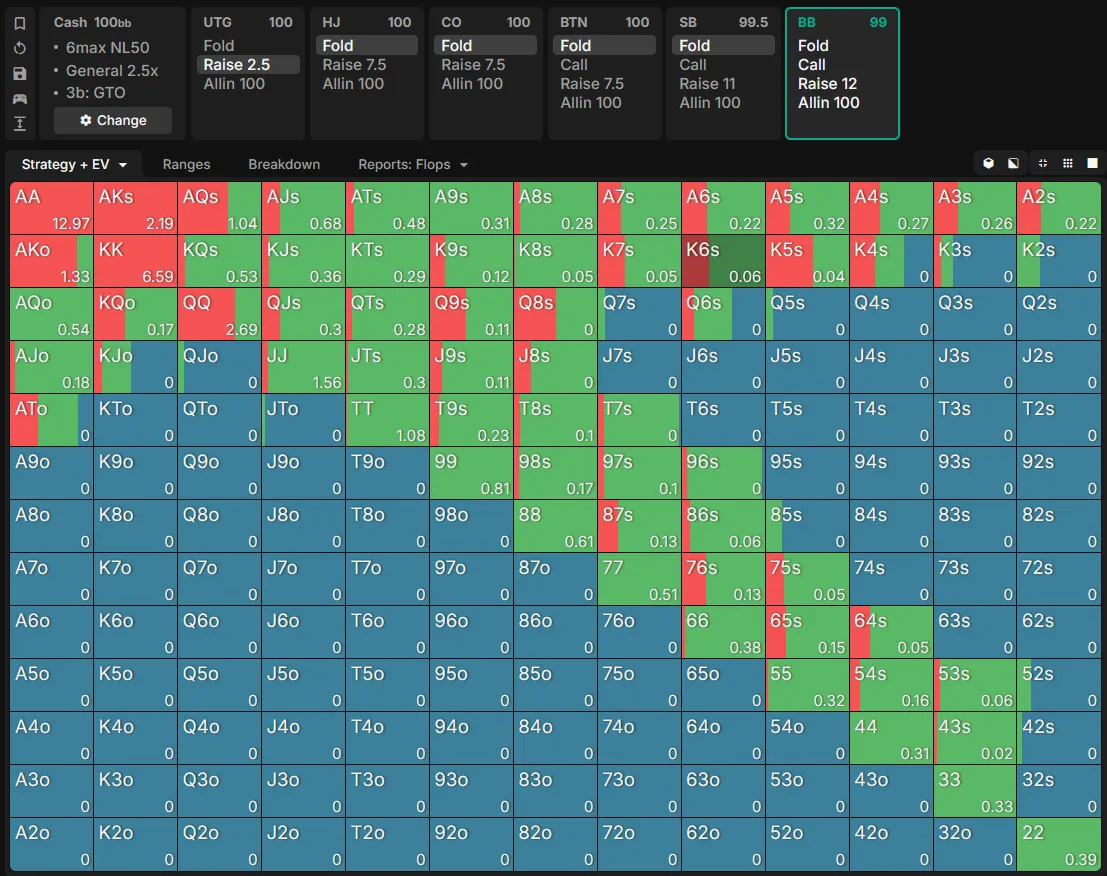
When we open a solver and experiment with it a little bit, we can notice that K6s is a hand that appears in many spots as a hand we should use to put on aggression. In GTO Wizard’s charts, K6s is open from every position, and it’s used as a frequency 3-bet in almost all positions, which may seem a bit unnatural.
In this article, we will try to explain why K6s is a special hand and why the solver loves it. Let’s start!
UTG vs BB 3-bet
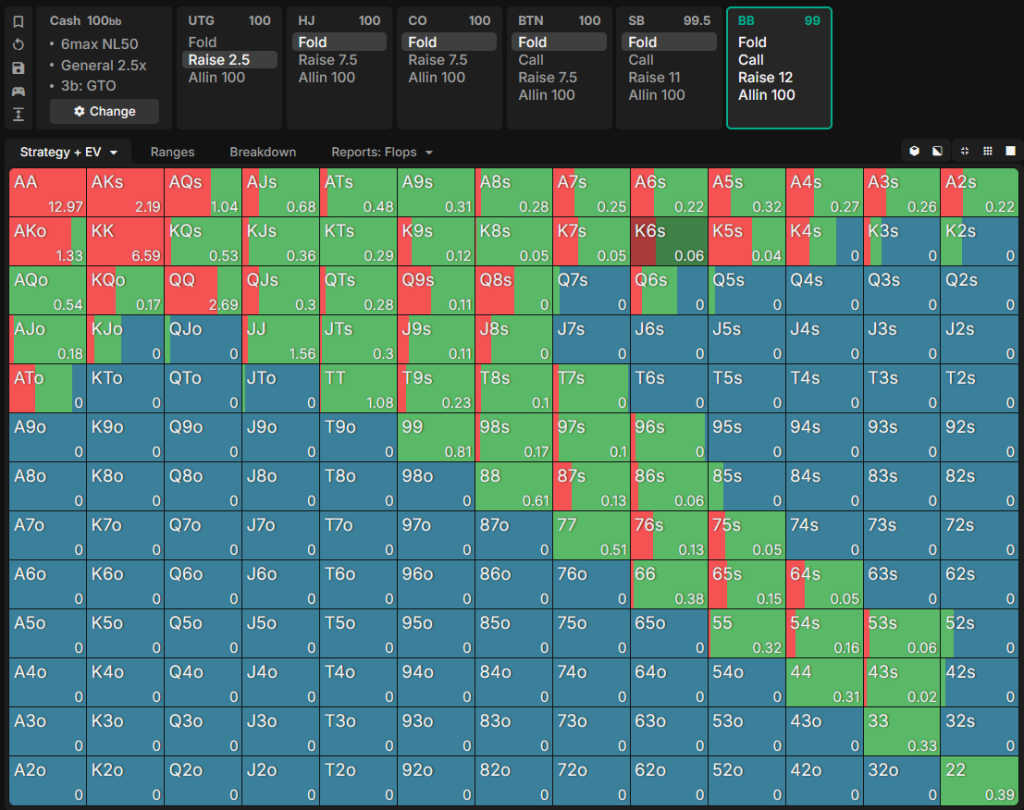
In the image below, we can see that BB is recommended to 3-bet against a tight UTG range with low suited Kx hands, and one of them is K6s. The reason why in this spot solver likes to 3-bet with K6s specifically is that king is a good blocker against UTG opening range, 6 is a good un-blocker to part of the range our opponent wants to fold (QJs, QTs, Q9s, JTs, T9s..)
In this specific spot, the solver uses K5s even more than K6s, as K5s has all the same benefits as K6s, but it also has a 5 that is a blocker to UTG 4-bet bluffs with A5s.
In theory, K5s is better here, but if we think about how realistic low-stakes player plays, K6s might be better as opponents won’t be 4-betting A5s often enough, but will prefer to call or fold, so we want them to have it more often as we would have range and nuts advantage against their capped calling range.
BTN vs BB 3-bet
In a spot where BTN opens and faces a 3-bet from BB, it is interesting to see that BTN is supposed to defend against the 3-bet with K6s more than 50 percent of the time, and it is the only low suited king that the solver defends with.
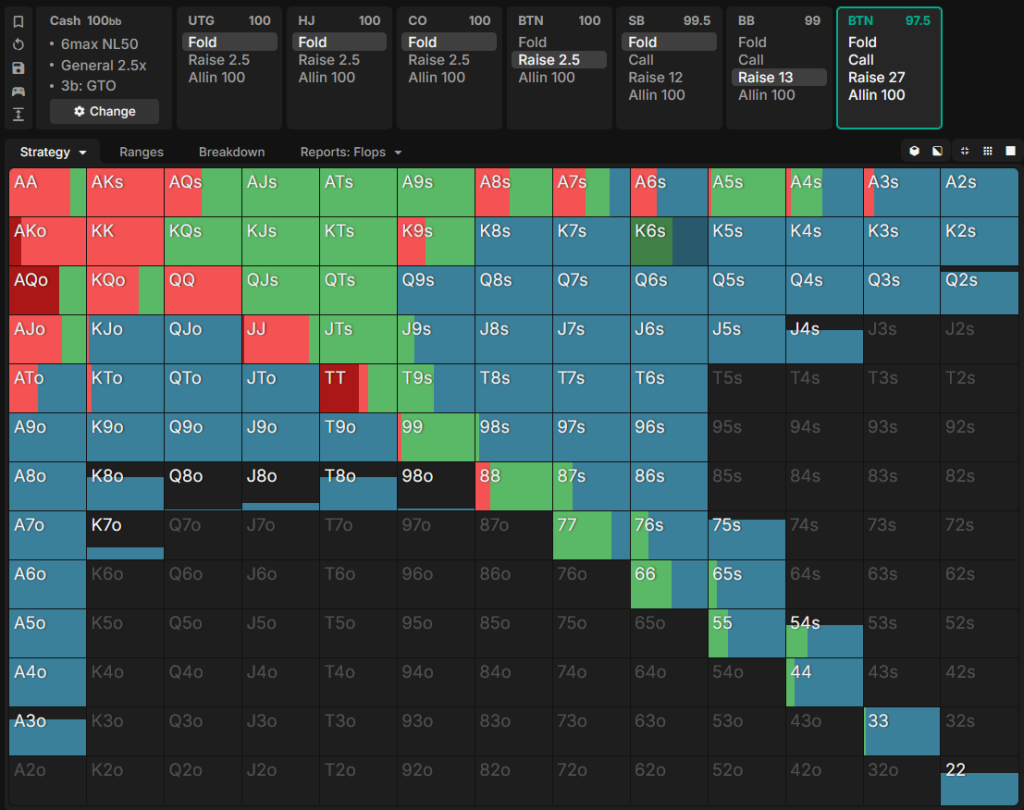
The main reason is that BB has enough bluffs in his 3-betting range that are weaker than K6s, such as Q8s-Q3s, JTs-J4s, T9s-T6s, 98s-54s, etc, but it also performs well against Ax 3-bets that BB has in his range, like A5s, A4s, AQs, AJs, AJo-A3o have around 60% equity vs K6s. (This excludes AKo and AKs, as it’s less likely due to our king blocker).
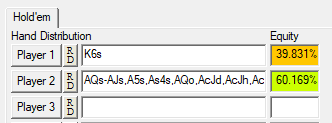
We have to keep in mind that once we flat as BTN against BB 3-bet, we are playing in position, and there are plenty of boards where BB has to check and give us an opportunity to steal the pot. This happens outside of the solver, as in real games, players just won’t 3-bet merged ranges and have enough mid hands that would secure some board coverage.
K6s also performs well on boards like 432r, where it will have nice implied odds as 5x on the turn or the river would give our opponent a straight good amount of time, as they will have a lot of Ax, but we would have them coolerd with better straight and basically take their whole stack. This doesn’t happen all of the time, but once it happens, it’s big and covers for the times we missed.
If you missed our previous strategy article, a hand breakdown where Martin Kabrhel goes for a three-barrel bluff and gets full value instead, check it by clicking here.